How to Use Goals to Track Life Outcomes
Set meaningful 30–365 day goals across 8 life categories, build the milestone structure that makes them achievable, and watch the progress ring advance as projects complete.
Section Protocoltitle: "How to Use Goals to Track Life Outcomes"
description: "Goals in JeevanAxis are outcome containers that span 30–365 days, broken into milestones, backed by projects, and tracked through a visual progress ring — they transform vague intentions into measurable commitments with real-time visibility."
category: "Plan Module"
publishedAt: "2026-05-29"
readingTime: "20 min"
tags: ["goals", "milestones", "progress", "purusartha", "life-balance"]
Operational Directive
Section ProtocolWhat Makes a Good Goal — Versus a Vague Wish
Most people do not fail at goal-setting because they lack ambition. They fail because they confuse a wish with a goal. A wish is a desire with no operational definition. A goal is a commitment with a specific outcome, a deadline, and a structure that makes progress measurable.
JeevanAxis uses the SMART framework as its underlying logic for goal validity — but we interpret it in a way that suits long-form life planning rather than corporate project management.
TACThe SMART Framework Applied to Life Goals
Specific — The goal names a concrete outcome, not a direction. "Get healthier" is a direction. "Run 5km without stopping by September 30" is specific. You should be able to stand in the future and clearly know whether you achieved it.
Measurable — The goal must have at least one success criterion you can verify. This is what the Success Criteria field in JeevanAxis is for. Write it as an observable fact: "Portfolio website is live with 5 published case studies."
Achievable — The goal stretches you but does not require a miracle. If achieving the goal requires a chain of events you have no influence over, it is a wish, not a goal.
Relevant — The goal connects to a life category that genuinely matters to you right now. JeevanAxis has 8 goal categories aligned to the Purusartha framework — using the right category ensures your goal feeds the right dimension of your Balance Radar.
Time-bound — Every goal in JeevanAxis requires a target date between 30 and 365 days. Goals without deadlines are aspirations — they belong in a journal, not in a planning system.
TACThe Litmus Test
Before you create a goal, ask yourself: "On the target date, how will I know without any ambiguity whether this goal is achieved?" If the answer requires you to hedge ("I'll feel like…", "I think I'll have…"), the goal needs to be sharpened.
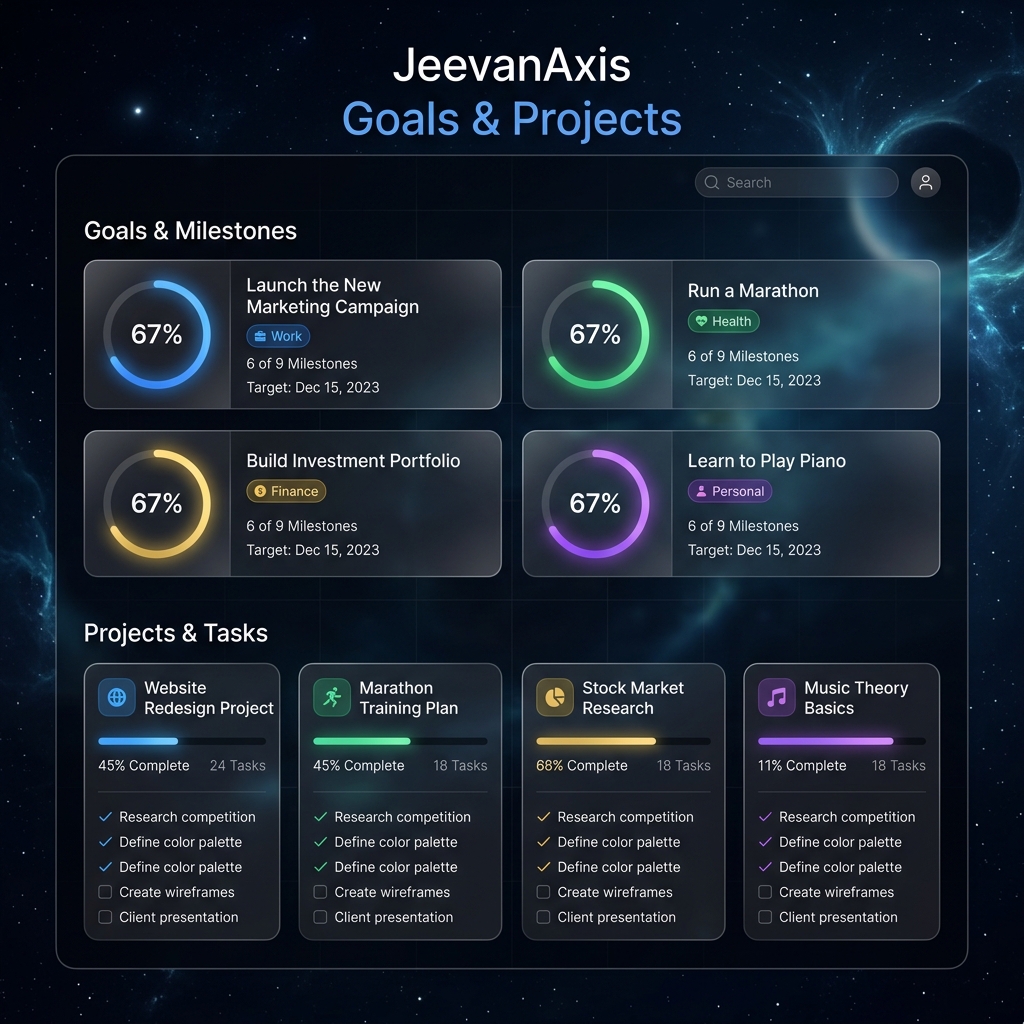
Section ProtocolGoal Anatomy: The Seven Elements
Every goal in JeevanAxis is composed of seven elements. Together they form the complete anatomy of a well-structured life commitment.
TAC1. Title
Name the destination, not the journey. "Learn Spanish" is a direction. "Complete Duolingo B1 Course and have a 30-minute conversation in Spanish" is a destination.
TAC2. Category
JeevanAxis offers 8 goal categories, each aligned to a Purusartha (purpose framework). The category determines which segment of your Balance Radar advances when this goal makes progress. Choose the category that best reflects the life dimension this goal belongs to.
TAC3. Target Date
Set a date that creates healthy urgency. A goal with a 90-day horizon should have milestones at roughly the 30-day and 60-day mark. A 365-day goal typically warrants 4–6 milestones. The target date anchors your milestone planning.
TAC4. Success Criteria
Write 1–3 sentences describing what "done" looks like from the outside. This is your contract with your future self. Keep it observable: avoid subjective terms like "happy with" or "comfortable with."
TAC5. Milestones
Milestones are the intermediate checkpoints that break the goal into achievable arcs. Each milestone has a name, a target date, and can be backed by one or more Projects. See the Milestone section below for deep guidance.
TAC6. Status
Status is one of: Active, Paused, Completed, or Expired. A goal becomes Expired if its target date passes without being marked complete — this is designed to surface honest reckoning rather than silently rolling the goal forward.
TAC7. Progress Ring
The Progress Ring is the visual representation of milestone completion. It is a circular indicator that fills as milestones are completed. Its value is calculated from the proportion of milestones complete, not from task completion — which means progress is measured in outcomes, not in activity.
Section ProtocolHow to Create a Goal: Step by Step
Goal creation in JeevanAxis is designed to take 10–15 minutes when done properly. If it takes 2 minutes, you are probably not being specific enough.
Step 1 — Open the Plan Module Navigate to the Plan Module via the side navigation. Click the Goals tab at the top of the panel.
Step 2 — Click + New Goal A full-screen goal creation panel opens. This deliberate step — using a full screen rather than an inline modal — signals the gravity of the commitment you are about to make.
Step 3 — Write the Title Use the destination format. Read it back to yourself: does this title make clear what you will have produced or achieved?
Step 4 — Select the Category Choose from the 8 categories: Health, Career, Finance, Relationships, Learning, Creative, Spiritual, or Personal. Each maps to a Purusartha pillar. See the next section for the full mapping.
Step 5 — Set the Target Date Use the date picker. The system will suggest milestone spacing based on the duration you choose — you can accept these suggestions or set custom milestone dates.
Step 6 — Write the Success Criteria This is the most important field. Write 1–3 sentences that describe done from the outside. Example: "A portfolio website is live at [myname].com, contains at least 5 case studies, loads in under 2 seconds, and has been shared publicly."
Step 7 — Add Milestones Add 2–5 milestones with names and target dates. Each milestone should be an intermediate outcome state — not a list of tasks. Example milestones for the portfolio website goal: "Content written for all pages," "Design approved and implemented," "Site live and tested."
Step 8 — Save the Goal Click Create Goal. The goal appears in your Goals panel with a 0% progress ring and Active status. It is now live in your planning system and will feed your Balance Radar.
Section ProtocolThe 8 Goal Categories and Purusartha Mapping
JeevanAxis is built on the philosophical framework of Purusartha — the four aims of human life from Indian philosophy: Dharma (right action), Artha (material wellbeing), Kama (pleasure and fulfilment), and Moksha (liberation and transcendence).
The 8 goal categories map to these pillars in a way that gives your goal portfolio philosophical coherence — ensuring you are investing in all dimensions of a complete human life, not just career and productivity.
TACThe Complete Mapping
| Category | Purusartha Pillar | What It Covers | |----------|------------------|----------------| | Health | Kama | Physical fitness, nutrition, sleep, energy, preventive care | | Career | Dharma + Artha | Professional growth, skills, reputation, meaningful work | | Finance | Artha | Savings, investments, income, financial security | | Relationships | Kama + Dharma | Family, friendships, community, love, social bonds | | Learning | Dharma | Knowledge acquisition, skills, education, intellectual growth | | Creative | Kama + Moksha | Artistic expression, creative projects, aesthetic pursuits | | Spiritual | Moksha | Meditation, philosophy, inner growth, connection to purpose | | Personal | Moksha + Dharma | Character development, habits, self-understanding, identity |
TACWhy Category Balance Matters
The Balance Radar on your Today Dashboard draws from these 8 categories. If all your active goals are in Career and Finance, your radar will be lopsided — which is honest data, not a failure. The system is showing you a reflection of where your intentional energy is going.
A balanced life does not mean equal effort in all 8 categories at all times. It means conscious allocation — knowing which categories you are investing in, and which you are temporarily deprioritising with awareness rather than neglect.
Section ProtocolMilestone Structure: Breaking a Goal into Achievable Arcs
The difference between a goal that gets achieved and one that quietly expires is almost always the quality of its milestone structure. Milestones are not checkboxes — they are the evidence that you are traversing the right path toward the right destination.
TACThe 2–5 Milestone Rule
JeevanAxis recommends 2 to 5 milestones per goal:
- ▶2 milestones for goals shorter than 60 days
- ▶3 milestones for goals between 60 and 120 days
- ▶4–5 milestones for goals longer than 120 days
More than 5 milestones usually means the goal is too complex — consider splitting it into two separate goals.
TACNaming Milestones as Outcome States
The quality of a milestone name predicts whether it will motivate you or disappear into background noise.
Weak milestone name: "Research phase" Strong milestone name: "Research complete — 10 sources reviewed, key insights documented"
Weak milestone name: "Working on the app" Strong milestone name: "MVP with core 3 features live on TestFlight"
The strong version names the world state you will inhabit when the milestone is complete. You can imagine standing there.
TACDistributing Milestones Across the Timeline
Avoid clustering all milestones at the end of the goal timeline. Distribute them roughly evenly, with slightly more work front-loaded. This prevents the classic pattern of casual progress in the first half and panicked sprint in the second.
For a 90-day goal, a good distribution is:
- ▶Milestone 1 at Day 25
- ▶Milestone 2 at Day 55
- ▶Milestone 3 at Day 80 (not Day 90 — the last 10 days are for closing, polishing, and review)
Section ProtocolLinking Projects to Goals: The Cascade Architecture
Goals in JeevanAxis exist at the strategy layer. Projects exist at the execution layer. The linkage between them is the structural spine of the entire Plan Module.
TACThe Cascade
A Goal can have multiple Milestones. Each Milestone can be backed by one or more Projects. Each Project contains multiple Tasks. This cascade means that every task you complete is — if properly linked — advancing a milestone, which is advancing a goal.
When you complete a project linked to a milestone, JeevanAxis advances the milestone's completion status. When all milestones for a goal are complete, the goal's progress ring reaches 100% and the system prompts you to formally complete the goal.
TACCreating the Link
When you create or edit a project, you will find a Goal Linkage section. Select the goal and then the specific milestone within that goal. A project can contribute to only one milestone. If a project spans multiple milestones, split it into two projects.
TACWhat Happens When a Project Stalls
If a project linked to a goal milestone falls behind schedule, the goal's health begins to deteriorate. The goal does not have a separate health calculation — it inherits the health signals from its linked projects. This creates accountability across the entire hierarchy.
Section ProtocolThe Goal Progress Ring: Calculated from Outcomes, Not Activity
The Progress Ring is the most visible element of a goal in JeevanAxis. It is the circular indicator that fills as you advance — and its calculation logic is deliberate.
TACHow the Ring Is Calculated
The ring percentage is computed from milestone completion, not from task completion. This is a conscious design choice:
Progress = (Number of Completed Milestones / Total Milestones) * 100
If a goal has 4 milestones and 2 are complete, the ring shows 50% — regardless of how many tasks have been done across all milestones.
TACWhy Outcomes, Not Activity
Tracking progress by tasks completed incentivises busyness. You can complete 200 tasks and still be no closer to the goal if none of them produced a milestone outcome. By tying progress to milestone completions, JeevanAxis forces the question: "Have I actually achieved something, or have I just been busy?"
This aligns with the JeevanAxis philosophy: what matters is impact on the destination, not volume of action.
TACPartial Milestone Credit
If you want finer-grained progress visibility, you can enable Partial Milestone Credit in Goal Settings. This calculates the ring as a weighted average of:
- ▶Completed milestones (full weight)
- ▶In-progress milestones (weighted by their linked project's task completion %)
This gives a smoother ring progression while maintaining the primacy of milestone outcomes.
Section ProtocolGoal Lifecycle: Active, Paused, Completed, and Expired
TACActive Goals
Active goals appear in your Goals panel, contribute to your Balance Radar, and generate health signals based on linked project health. Limit yourself to 3–5 active goals at any time — more than that and you are not planning, you are wishful thinking with extra steps.
TACPausing a Goal
Pause a goal when life genuinely requires you to suspend work on it — a health event, an emergency project, a change in priorities. When you pause, JeevanAxis asks for a brief reason and a "Revisit Date." This prevents goals from silently dying in the Paused state, which is the graveyard of abandoned ambitions.
TACCompleting a Goal
When all milestones are marked complete, click Mark Goal as Complete. The system:
- ▶Records the completion date
- ▶Updates the Balance Radar with a full contribution from this category
- ▶Generates a Goal Completion Card — a shareable summary of what you achieved
- ▶Archives the goal with all its linked projects, milestones, and notes
The Completion Card captures: goal title, duration, success criteria met, linked projects, milestones achieved. This becomes part of your JeevanAxis achievement timeline.
TACExpired Goals
If a goal's target date passes without completion, it enters Expired status. JeevanAxis surfaces expired goals prominently and asks you to make one of three decisions:
- ▶Recommit — Reset the target date and continue
- ▶Retire — Acknowledge that this goal no longer serves you, and archive it
- ▶Reconceive — The goal was right but the framing was wrong — edit it and recommit with a new structure
The expired state is not a failure state — it is an honesty state. It forces the reckoning that most planning systems allow you to avoid.
Section ProtocolHow Goals Feed the Balance Radar
The Balance Radar on your Today Dashboard is a spider/radar chart with 8 axes — one for each goal category. It shows you, at a glance, the distribution of your intentional life investment.
TACHow the Radar Is Populated
Each axis receives a score from 0 to 100, calculated as:
- ▶Active goal in this category: Each active goal contributes a base score of 15 points
- ▶Goal progress: Additional points based on the average ring progress of active goals in this category
- ▶Recent completion: A completed goal within the past 90 days adds a 20-point bonus
- ▶Maximum per axis: 100 points (requires at least 2 active goals with high progress or a recent completion)
TACReading the Radar
A well-balanced radar is not perfectly uniform — life is seasonal and some categories demand more attention than others. What you are looking for is:
- ▶No axis at zero — If a category is completely empty, you have no intentional investment there at all
- ▶No single axis dominating — If Career is at 100 and everything else is under 20, you are optimising one area at the cost of all others
- ▶Movement over time — The radar should shift as you complete goals and begin new ones in different categories
⚠Common Traps
✓Goal Creation Checklist
Section ProtocolThe Quarterly Goal Review
Goals deserve a deeper review cycle than projects. Once per quarter, take 60 minutes to review all active and paused goals:
- ▶Completion check — Has this goal reached 100%? Mark it complete and celebrate
- ▶Progress audit — Is the ring at the percentage you would expect given elapsed time? If not, investigate
- ▶Relevance test — Does this goal still matter as much as it did when you created it? If not, retire or reconceive it
- ▶Category balance — Look at the Balance Radar. What does the distribution tell you about your current season of life? Is this intentional?
- ▶Next quarter goals — What new goals should enter the active list? Ensure each new goal has a project already planned or in progress before you activate it
The quarterly review is also the right time to close out the previous quarter's completed goals and begin fresh goal setting for the next 90-day cycle.
Reflection Prompts
Executive Summary
▸Goals in JeevanAxis are not wish lists — they are commitments with architectural structure: title, category, target date, success criteria, milestones, and a progress ring calculated from outcome completion rather than activity volume.
▸The 8 goal categories, mapped to the Purusartha framework, ensure your goal portfolio reflects a complete vision of human flourishing — not just professional output.
▸The cascade from Goal to Milestone to Project to Task gives every action you take a traceable connection to a life outcome.
▸The Balance Radar turns your goal portfolio into a visual truth-teller, showing you exactly where your intentional energy is going.
▸Use the system with integrity — mark milestones only when genuinely complete, respond honestly to expired goals, and limit your active goals to a number you can realistically attend to.
▸A planning system is only as honest as the person using it.
Intelligence Pipeline
Organise Your Work with Projects →
Projects are the execution containers that make goal milestones achievable. Learn how to create projects, structure milestones, use the Kanban board, and read health status signals that keep your work honest.
Block Time on the Calendar →
Goal progress happens during scheduled, protected work time. Learn how to use the JeevanAxis Calendar to time-block your project sessions and prevent the overcommitment that quietly kills most goals.
Understand the Balance Radar →
The Balance Radar is your weekly signal on how well your goal portfolio covers all eight life dimensions. Learn how to read it, what imbalance means, and how to make conscious allocation decisions across the Purusartha pillars.
Connected Intelligence
Ready to Deploy Your Life OS?
Experience the full power of integrated intelligence. Stop managing apps and start operating your life.
Launch Command Center