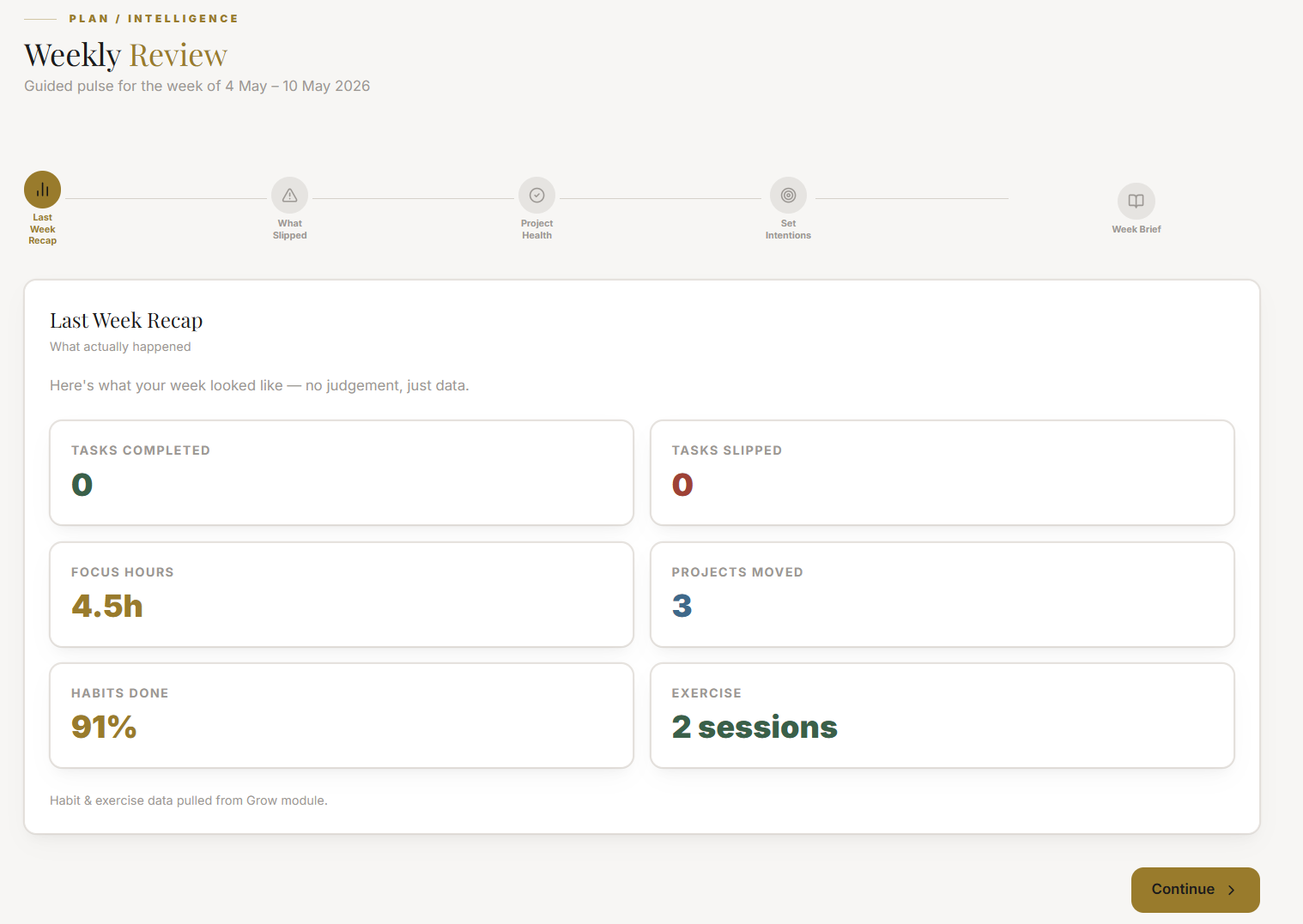
How to Run Your Weekly War Room Review
The complete 5-step Sunday protocol — Weekly Wins, Challenges, Balance Check, Goal Review, Next Week Priorities — that converts last week's chaos into next week's clarity.
Section Protocoltitle: "How to Run Your Weekly War Room Review"
description: "Master the 5-step Weekly War Room — JeevanAxis's highest-leverage Sunday review protocol — to convert the chaos of the previous week into precise clarity, intentional priorities, and unstoppable momentum for the next."
category: "Plan Module"
publishedAt: "2026-05-29"
readingTime: "14 min"
tags: ["weekly review", "war room", "reflection", "goals", "planning"]
Operational Directive
The Weekly War Room is a 15–30 minute structured Sunday review protocol — the single highest-leverage behavior in the JeevanAxis system — that converts the chaos of the previous week into clarity for the next. This guide gives you the complete 5-step protocol, what to examine at each step, and the outputs that make next week dramatically more intentional than the last.

Section ProtocolWhy Weekly Review Is the Highest-Leverage Behavior
In any complex system — a business, a career, a life — the behaviors that produce the greatest results are rarely the most urgent ones. They are the ones that quietly shape everything else. Weekly review is the definitive example.
A 20-minute Sunday review does not just organize next week. It:
- ▶Closes the open loops from the previous week that silently consume cognitive RAM. Unfinished tasks, unresolved decisions, and unacknowledged wins all live in your subconscious until explicitly processed. The War Room externalizes them.
- ▶Prevents compounding chaos. Every week you skip a review, you carry forward the confusion of the previous week — unreviewed tasks stack on top of unreviewed goals, creating a growing debt of strategic ambiguity. After three skipped reviews, you are operating entirely reactively.
- ▶Creates the conditions for intentional weeks. A week begun with clear priorities is categorically different from a week begun by checking email. The first is authored by you. The second is authored by everyone else.
- ▶Builds self-knowledge over time. The War Room is not just planning — it is observation. By consistently reviewing your wins, challenges, energy, and output, you accumulate a precise understanding of how you actually work: when you're best, what blocks you, which goals genuinely matter to you.
David Allen, author of Getting Things Done, calls the weekly review "the master key to GTD." In JeevanAxis, we call it the War Room because the language matters: you are not passively reviewing — you are strategically assessing the battlefield of your life and deciding how to fight the next engagement.
TACThe Compound Effect of Consistent Weekly Review
Consider two practitioners:
Person A does the War Room consistently for 52 weeks. Each review produces modest improvements — clearer priorities, a better task queue, one thing learned about their patterns. The compound effect of 52 such improvements is dramatic strategic clarity.
Person B skips the review most weeks, doing it once a month when the chaos becomes undeniable. Each session is spent firefighting — catching up on missed tasks, reorienting to goals they've lost touch with, starting from a position of deficit.
After one year, Person A and Person B are in categorically different positions — not because of talent, but because of one 20-minute weekly habit.
Section ProtocolWhen to Do the War Room: Timing and Consistency
The War Room works best when done at the same time every week. Consistency is more important than the specific time you choose.
TACSunday Evening vs. Sunday Morning
Sunday Evening (Recommended for most people)
Sunday evening — 7-9pm — is the most popular War Room window for a clear reason: it bridges the psychological gap between the weekend and the workweek. A well-executed Sunday evening War Room means you go to sleep Sunday with a clear mind and wake up Monday with direction rather than dread.
The "Sunday dread" that millions of people experience — that creeping anxiety as the weekend ends — is largely caused by the unresolved strategic ambiguity of the coming week. The War Room eliminates that dread by replacing ambiguity with clarity.
Sunday Morning (Best for early risers and those with Sunday evening obligations)
Sunday morning — 8-10am — works exceptionally well for people who have their highest cognitive clarity in the morning. The risk is that weekend activities can interrupt it. If you choose Sunday morning, treat the War Room as a non-negotiable appointment — not something to do "after brunch if there's time."
The Consistency Rule: Whichever time you choose, hold it. After four weeks of consistent Sunday War Rooms, your brain will begin anticipating it — you'll find yourself mentally gathering War Room inputs throughout the week: "I should remember this for the War Room" becomes a natural thought pattern. This is the meta-cognitive habit maturing.
Section ProtocolPre-War Room Preparation
The War Room is most effective when you enter it with the right materials ready. Spend 2-3 minutes on preparation before starting the 5-step protocol.
What to have ready:
- ▶JeevanAxis open on your device, navigated to Plan → Weekly War Room
- ▶A quiet, private space where you won't be interrupted for 20-30 minutes
- ▶Your calendar from the previous week visible (JeevanAxis surfaces this in Step 1 automatically)
- ▶A hot drink or anything that signals to your brain "this is a thinking ritual"
- ▶A genuine willingness to be honest — the War Room only works if you observe reality clearly, not optimistically
The War Room UI in JeevanAxis guides you through all five steps sequentially. You cannot skip steps. Each step builds on the previous one, and the system captures your inputs to update the analytics layers below.
Section ProtocolStep 1 — Weekly Wins: What Genuinely Moved
The War Room begins not with analysis but with acknowledgment. Step 1 asks you to identify your three genuine wins from the previous week.
The word "genuine" is critical. A win is not "I was busy." A win is not "I completed the task I was supposed to complete." A win is something that moved the needle — on a goal, on a relationship, on your capabilities, on your understanding of something important.
TACHow to Identify Your Three Wins
JeevanAxis surfaces several data points to help you find wins:
- ▶Tasks completed this week, sorted by goal
- ▶Focus Engine sessions completed and total hours logged
- ▶Milestone progress percentages
- ▶Any entries you made in your Daily Note this week
Look at this data and ask: Which three moments of this week represent genuine forward motion? Not "I survived." Not "I got through it." But actual progress — things that will matter in a month.
TACWhy Celebration Matters (It's Not Soft)
Many high-performers skip or rush Step 1 because it feels indulgent — "I don't need to celebrate, I need to plan." This is incorrect. Neurologically, the acknowledgment of genuine wins:
- ▶Reinforces the behaviors that produced them, making repetition more likely
- ▶Combats achievement treadmill syndrome — the inability to feel satisfied that drives endless striving without fulfillment
- ▶Provides accurate signal about what's working — if your wins consistently come from a specific type of activity, you're observing where your leverage is highest
Write your three wins in JeevanAxis. Be specific. Date them mentally. Let them register.
Section ProtocolStep 2 — Challenges: Root Causes, Not Symptoms
Step 2 examines what didn't go well. This is where most weekly reviews become superficial — people identify symptoms ("I didn't finish the report") rather than root causes ("I consistently underestimate how long research takes, which causes me to start writing too late").
TACRoot Cause Analysis vs. Symptom Identification
Symptom: "I didn't complete my three priority tasks this week." Root cause: "My three priority tasks required sequential dependencies I didn't map — I couldn't complete Task B until Task A was done, but I didn't notice that when I planned. I need to map task dependencies explicitly during planning."
The difference between these two observations determines everything. The symptom leads to "I'll try harder next week." The root cause leads to a specific, actionable change in how you plan.
TACThe 5-Why Technique
For your most significant challenge of the week, apply the 5-Why technique briefly:
- ▶Why didn't X happen? Because Y.
- ▶Why did Y happen? Because Z.
- ▶Why did Z happen? Because...
Three to five "Whys" typically surface the structural root cause — the upstream problem that generates the downstream symptom. Once you see the root cause, you can address it at the planning level rather than the execution level.
In JeevanAxis, Step 2 provides a free-text field for your primary challenge and a structured "Root Cause" field. Fill both. The root cause field feeds your personal patterns analysis over time — after 8-10 War Rooms, JeevanAxis can show you your recurring challenge patterns.
Section ProtocolStep 3 — Balance Check: Rating the Four Quadrants
JeevanAxis is built on the philosophy of the four Purusartha — the ancient Sanskrit framework for a complete life:
- ▶Purpose (Dharma): Your contribution, craft, vocation, and growth
- ▶Security (Artha): Your financial stability, resources, and material wellbeing
- ▶Vitality (Kama): Your physical health, relationships, pleasures, and joy
- ▶Freedom (Moksha): Your autonomy, inner peace, and alignment with what truly matters
Step 3 of the War Room asks you to rate each quadrant on a 1-10 scale based on how you felt in that dimension this past week — not how you performed, but how you experienced it.
TACHow to Rate the Quadrants
For each quadrant, ask:
- ▶"This week, did this dimension of my life feel alive, attended to, and in good shape?" → 7-10
- ▶"This week, this dimension felt neutral — not neglected, not thriving." → 4-6
- ▶"This week, this dimension felt starved, neglected, or actively declining." → 1-3
Do not rationalize. Do not justify. Rate your felt experience honestly.
TACHow This Feeds the Balance Radar
Your four ratings in Step 3 are immediately written to the JeevanAxis Balance Radar — the visual representation of your life's dimensional balance. The Balance Radar shows you:
- ▶Your current week's balance shape
- ▶How this week compares to your 4-week and 12-week moving averages
- ▶Which quadrant has declined the most over the past month
A Balance Radar shaped like a diamond (all quadrants rated similarly) reflects integration. A Balance Radar heavily skewed toward Purpose and Security with collapsed Vitality and Freedom is one of the most common patterns JeevanAxis surfaces — and the one that predicts burnout most reliably.
Section ProtocolStep 4 — Goal Review: Progress, Risk, and Adjustment
Step 4 is the strategic core of the War Room. Here you examine every active goal in JeevanAxis and assess:
- ▶Progress: Is this goal's milestone completion percentage on track with its timeline?
- ▶Risk: Is any goal at risk of missing its deadline? What is the risk factor?
- ▶Adjustment: Does any goal need a timeline adjustment, scope change, or priority shift?
JeevanAxis surfaces all active goals in Step 4, ordered by deadline proximity. For each goal, you see:
- ▶Current milestone completion percentage
- ▶Tasks completed this week linked to this goal
- ▶Projected completion date based on current pace
- ▶Days remaining until deadline
TACIdentifying At-Risk Goals
A goal is at-risk when its projected completion date (based on current pace) exceeds its target deadline. JeevanAxis flags these automatically with an amber or red indicator. At-risk goals require one of three responses:
- ▶Increase effort: Add more tasks, book more Focus Engine sessions against this goal for next week
- ▶Adjust timeline: Move the deadline if the original was unrealistic — honesty now prevents failure later
- ▶Reduce scope: Remove lower-priority milestones from the goal to make the remaining deliverables achievable
There is no shame in adjusting timelines or scope. The shame is in carrying a goal on your list for months without honest assessment, telling yourself you'll "catch up" until the deadline silently passes.
TACThe Adjustment Decision
When a goal is at-risk, use this decision framework:
- ▶Is the goal still genuinely important to me? → If no, consider archiving it.
- ▶Is the deadline externally fixed (a launch date, a commitment to someone else)? → If yes, scope must change.
- ▶Is the deadline self-imposed? → If yes, timeline adjustment is appropriate.
- ▶Have I had three consecutive weeks of at-risk status on this goal? → This is a structural problem requiring a deeper conversation about what's blocking this goal.
Section ProtocolStep 5 — Next Week Priorities: Seeding Your Intentional Week
Step 5 is where the War Room produces its most tangible output: the three priorities that will define next week. Everything else in the War Room — the wins, the challenges, the balance check, the goal review — has been building to this moment.
TACSelecting Your Top 3 Priorities
From the goals you reviewed in Step 4, select the three goals or milestone-level objectives that will receive your primary attention next week. Three is not arbitrary — it is the maximum number of genuine priorities a human being can hold with the focus required to make real progress. More than three priorities means no priority.
Your three priorities for next week should reflect:
- ▶Urgency: At-risk goals or approaching deadlines
- ▶Importance: Goals most aligned with your Purpose and long-term direction
- ▶Momentum: Goals where you have current momentum and stopping would cost you
Write these three priorities into JeevanAxis's Step 5 interface. They will appear as your Weekly Focus on the Today Dashboard for the entire coming week.
TACBooking Calendar Blocks
Once priorities are set, Step 5 prompts you to book Focus Engine sessions in your calendar for each priority. This is not optional — priorities without calendar blocks are wishes, not plans.
For each of your three priorities:
- ▶Identify which days this week you will work on it
- ▶Estimate how many Focus Engine sessions it requires
- ▶Book those sessions as calendar blocks (JeevanAxis integrates with your calendar)
TACSeeding the Task Queue
The final action in Step 5 is seeding your task queue — creating or reviewing the specific, executable tasks for next week that serve your three priorities. This is different from setting goals: tasks are the concrete, completable actions that move goals forward.
A well-seeded task queue means Monday morning begins with clarity: you open JeevanAxis, see your Today Dashboard, and your first task is waiting. No decisions required. Just execute.
Section ProtocolThe War Room Outputs: What Changes in the System
Completing the full 5-step War Room triggers a cascade of updates across JeevanAxis:
| Output | Where It Appears | What It Enables | |---|---|---| | Weekly Wins logged | War Room history, personal journal | Pattern recognition over time | | Root cause entry | Challenge analytics | Long-term pattern surfacing | | Balance Radar updated | Balance Radar chart | Trend awareness and imbalance alerts | | Goals reviewed and adjusted | Goal tracker | Accurate projections and risk flags | | Top 3 priorities set | Today Dashboard Weekly Focus | Intentional week start | | Calendar blocks created | Calendar integration | Protected time for priorities | | Task queue seeded | Today Dashboard task list | Monday morning clarity | | War Room completion badge | Momentum Score | Weekly review streak tracked |
The War Room completion badge contributes to your Momentum Score — specifically, the consistency dimension. Users who complete War Rooms consistently score significantly higher on consistency metrics, which compound into better overall Momentum Scores over 4-12 week windows.
Section ProtocolWhat Happens When You Skip the War Room
Skipping one War Room is recoverable. Skipping two is a pattern. Skipping three is the beginning of strategic drift — a condition where your weeks are shaped entirely by incoming demands rather than chosen priorities.
The compound chaos effect works in reverse:
- ▶Week 1 skipped: You start the week without clear priorities. You default to reactive work.
- ▶Week 2 skipped: Unreviewed tasks from last week accumulate with unreviewed tasks from this week. Your task list becomes a source of anxiety rather than direction.
- ▶Week 3 skipped: At-risk goals you would have caught and adjusted in a timely War Room have now missed their windows. You're catching up on compounding debt.
The antidote is not willpower — it is making the War Room non-negotiable through scheduling. Block it on your calendar as a recurring event. Name it "War Room" so it carries the appropriate psychological weight. Treat it like a meeting with your most important client — because that's exactly what it is.
⚠Common Traps
✓Weekly War Room Pre-Flight Checklist
Reflection Prompts
Executive Summary
▸The Weekly War Room is not a planning session — it is a strategic operating ritual that converts the raw material of the previous week into the precise direction of the next.
▸Its five steps are not interchangeable: Wins come first to anchor your attention in what worked, Challenges follow to identify root causes before they compound, Balance Check ensures no life dimension is silently eroding, Goal Review keeps your long game honest and adjusted, and Next Week Priorities complete the circuit by seeding Monday morning with clarity rather than chaos.
▸The compound effect of 52 consistent War Rooms — each one modest, each one actionable — produces a life that is genuinely authored by you rather than assembled from other people's urgencies.
▸The War Room is the difference between a reactive year and a directed one.
Intelligence Pipeline
Master the Focus Engine →
Learn how to run structured deep work sessions that generate the session history and actual hours that feed directly into your War Room's Step 4 Goal Review analytics.
Build Your Personal Knowledge Base →
Discover how linking notes to goals and tasks creates the persistent project context that makes your War Room reviews richer, faster, and more strategically precise.
Understand the Balance Radar →
Dive deep into how the four Purusartha quadrants are calculated, what imbalance patterns predict, and how to use Balance Radar trend data to make proactive life adjustments before they become crises.
Connected Intelligence
Ready to Deploy Your Life OS?
Experience the full power of integrated intelligence. Stop managing apps and start operating your life.
Launch Command Center