How to Use the Vision Section
Project your identity forward into a concrete picture at one, three, and ten years, plus the legacy you want to leave.
How to Use the Vision Section
Vision projects your identity forward. If Identity is who you are becoming, Vision is the concrete picture of the life that person lives — at one year, three years, ten years, and beyond. It gives your goals a destination and your daily effort a reason.
Operational Directive
Write your vision in the present tense, as if it were already true, and make it specific enough that you could one day tell whether you got there. Vague hopes cannot be aimed at.
Section ProtocolThe four horizons
| Horizon | What you write | Feeds into |
|---|---|---|
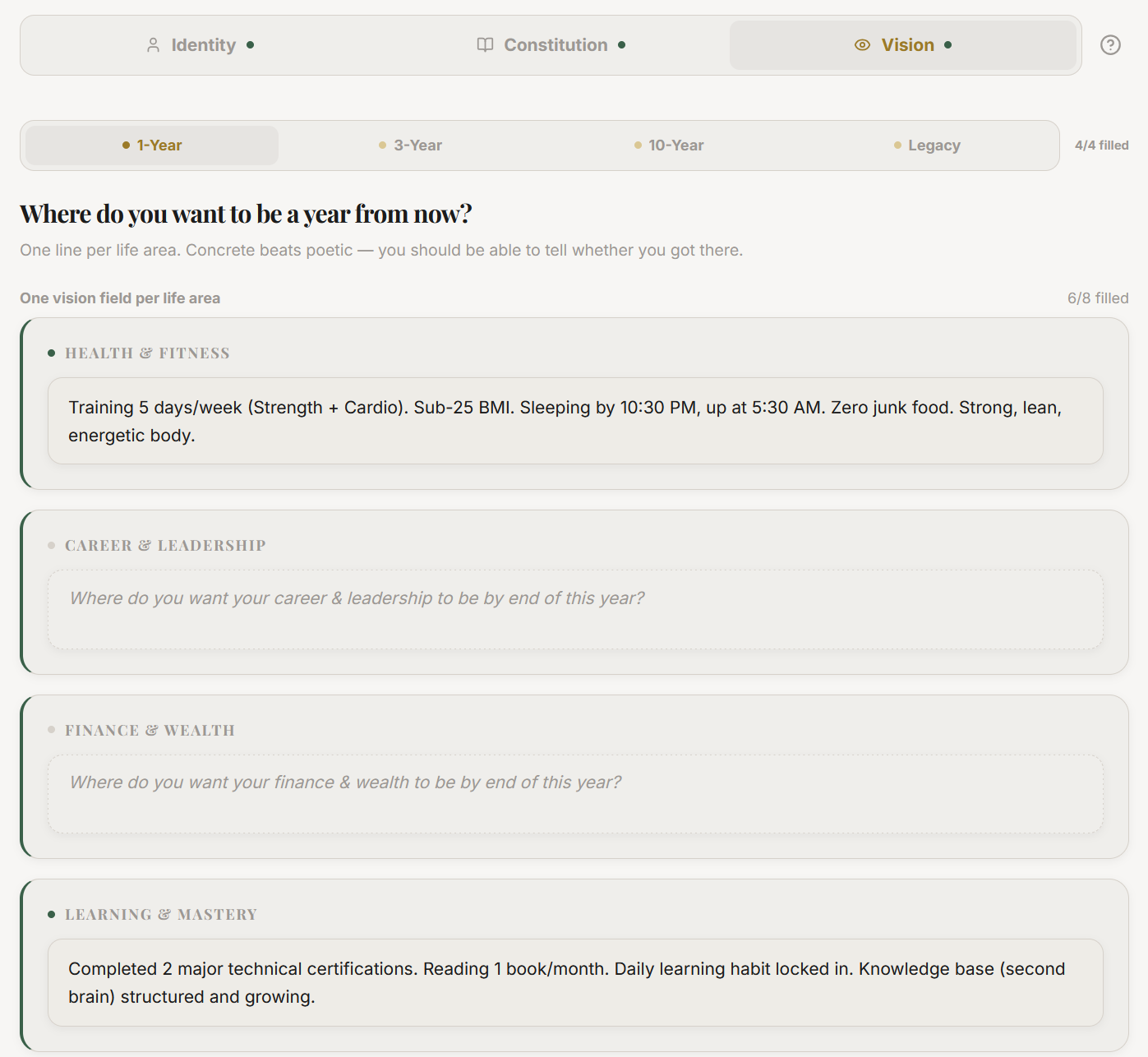
| 1-Year | One line per life area for the year ahead | Your goals in Direction |
| 3-Year | Five focus areas: health, career, finance, relationships, growth | Quarterly planning |
| 10-Year | The long story: lifestyle, wealth, health, relationships, impact | Direction of the whole Blueprint |
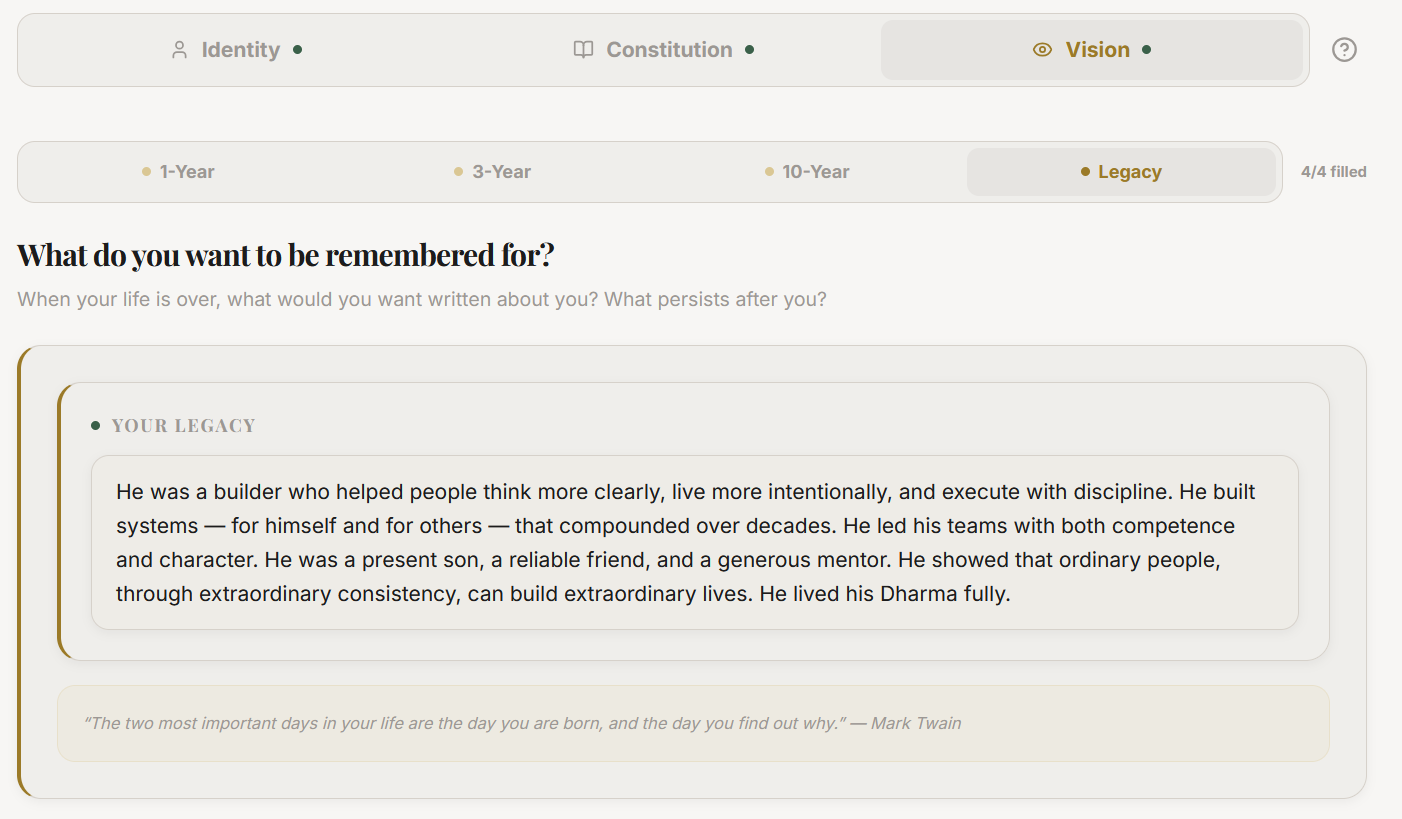
| Legacy | What you want to be remembered for | The meaning behind it all |
Section ProtocolHow to fill each horizon
1-Year. One field per life area, describing what is true a year from now. This is the horizon your goals attach to, so keep it concrete: "I run 5k comfortably and sleep seven-plus hours on weeknights" beats "I am healthier."
3-Year. Five fixed focus areas — Health and Fitness, Career and Business, Finance and Wealth, Relationships, Personal Growth. Three years is long enough for real change and short enough to picture clearly.
10-Year. Six sections that paint the long picture: your future story, your lifestyle, your income and wealth, your health, your relationships, and your impact. This is where you let yourself think big; the near-term horizons keep it grounded.
Legacy. A single free-text answer to "what do you want to be remembered for?" It is the north star behind every other horizon.
Section ProtocolBest practices
- ▶Present tense, as if true. A vision written as a description reads very differently from one written as a wish, and it pulls harder.
- ▶Testable specifics. Somewhere in each horizon, include something you could measure or verify. That is what lets a future review say "yes" or "not yet."
- ▶Let the 1-year feed your goals. The near horizon is not decoration — it is where you go to set goals in Direction.
⚠Common Traps
Section ProtocolWorked example
For 1-Year Health, Meera writes: "I run 5k without stopping and hold a consistent weekday sleep schedule." For 10-Year Impact: "I have mentored a dozen designers into senior roles and shipped a product people rely on daily." For Legacy: "The person my team learned steadiness and craft from." Each is present tense, and each contains something she could one day check.
Reflection Prompts
Intelligence Pipeline
Connected Intelligence
Ready to Deploy Your Life OS?
Experience the full power of integrated intelligence. Stop managing apps and start operating your life.
Launch Command Center