How to Use the Identity Section
Write the one-sentence identity statement the whole Blueprint hangs on, plus your roles, standards, and the lines you will never cross.
How to Use the Identity Section
Identity is the anchor of the entire Blueprint. Before you plan a single goal or track a single habit, you answer one question: who are you becoming? Everything downstream — your Constitution, your Vision, even your daily Transform anchors — is built on the sentence you write here.
Operational Directive
Write your identity statement first, and write it in the present tense. Not 'I want to be' but 'I am'. Behavior follows self-image, so the sentence is doing real work, not decoration.
Section ProtocolThe four parts of Identity
| Part | The question it answers | What good looks like |
|---|---|---|
| Statement | Who are you, in one sentence? | I am a calm, deliberate builder who ships small things daily |
| Roles | What hats do you wear? | Parent, founder, athlete — each with an honest importance |
| Standards | What do you always do? | I train before I open my laptop |
| Lines | What will you never do? | I never trade on tilt |
Section ProtocolField by field
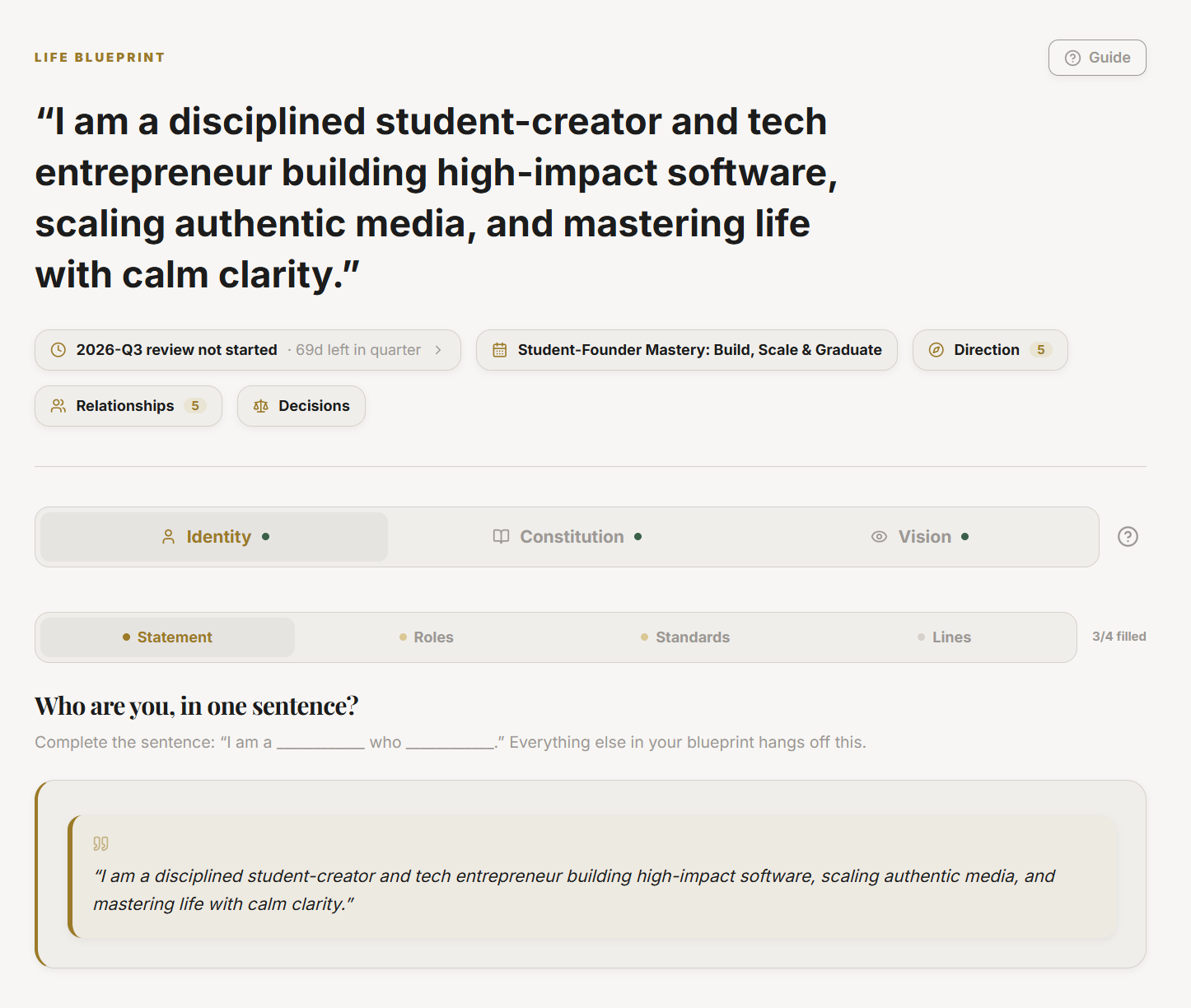
Statement. Complete "I am a ___ who ___" in one honest sentence. It auto-saves as you type. Make it aspirational but believable — a sentence you can grow into, not a fantasy. This is the single most important field in the whole app.
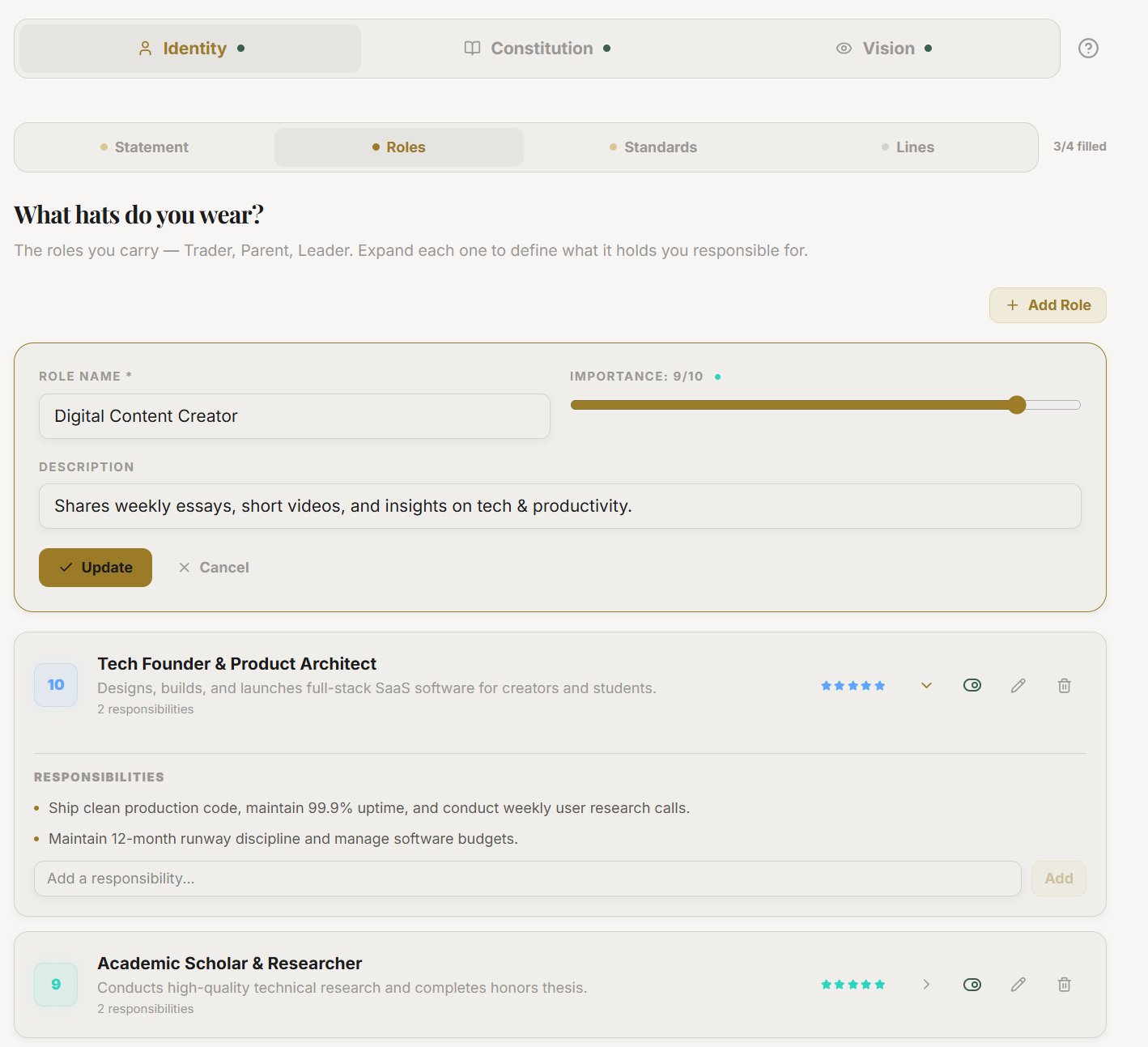
Roles. Add the hats you wear. Each role takes a name (required) and an importance from 1 to 10, shown as a colour-coded slider. The importance is not vanity — it exposes where your time and attention should actually go. Three to six real roles is plenty; twenty is noise. Each role can hold a description and a list of responsibilities.
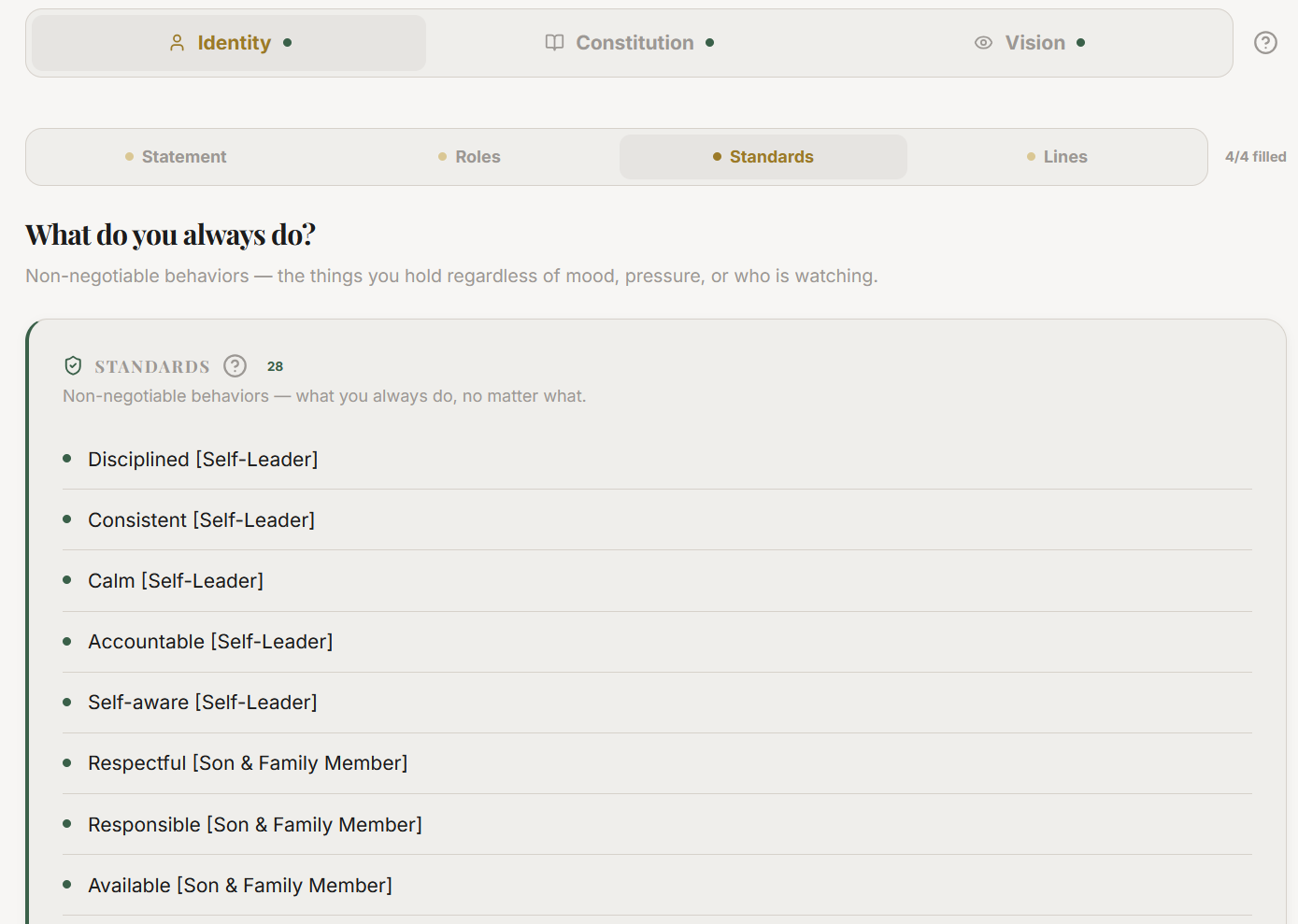
Standards. The behaviors you always keep — your positive non-negotiables. Phrase them as concrete actions, not vague ideals. "I read for twenty minutes before bed" is a standard; "I value learning" is not.
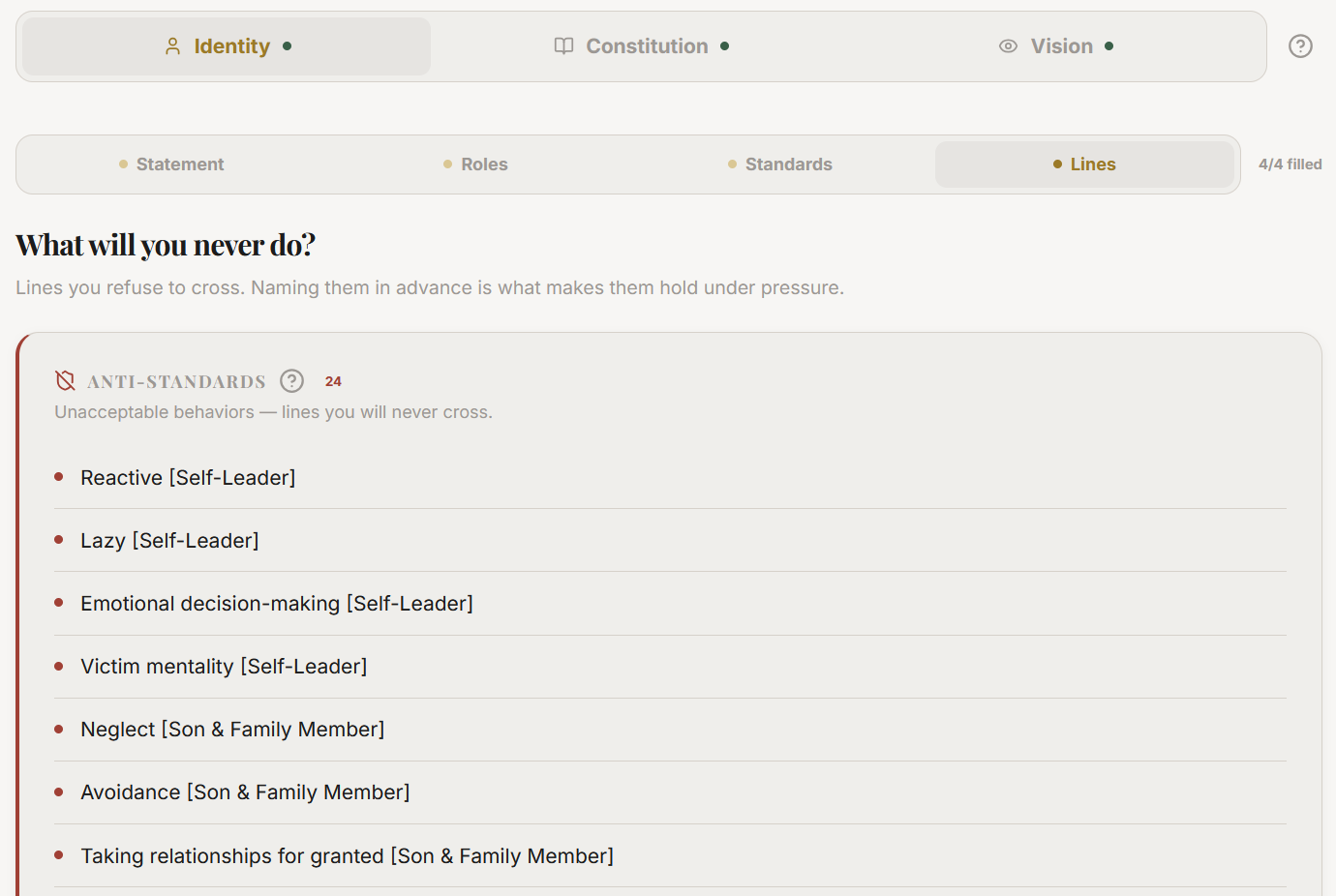
Lines. Labelled Anti-Standards internally, these are the things you will never do — the lines you refuse to cross. They are as defining as your standards. Knowing what you will not do sharpens who you are.
Section ProtocolBest practices
- ▶Statement before everything. The Vision, Constitution, and Transform modules all read from this. Leaving it blank leaves them rootless.
- ▶Present tense, always. "I am a runner" negotiates with a rainy morning very differently than "I am trying to run."
- ▶Concrete over abstract. Every standard and line should describe a behavior you could catch yourself doing or not doing.
⚠Common Traps
Section ProtocolWorked example
Meera writes: "I am a focused designer who protects deep work and ships weekly." Her roles are Designer (importance 9), Partner (9), and Runner (6). Her standards: "I do ninety minutes of focused work before any meeting" and "I run three mornings a week." Her lines: "I never ship without a self-review" and "I never check email before my first block." Notice how each standard and line is a behavior her identity statement would predict.
Reflection Prompts
Intelligence Pipeline
Connected Intelligence
Ready to Deploy Your Life OS?
Experience the full power of integrated intelligence. Stop managing apps and start operating your life.
Launch Command Center