How to Use the Constitution Section
Values, principles, personal laws, decision rules, and anti-goals — cleanly separated, with the two priority mechanics explained.
How to Use the Constitution Section
If Identity says who you are, the Constitution says how you govern yourself. It turns character into operating rules you can actually consult when a choice is hard. It has five parts, and because they sound similar, most of the confusion in the whole Blueprint lives here. This guide separates them cleanly.
Operational Directive
Rank your values honestly, and keep your laws few and absolute. A Constitution where everything is priority ten gives you no tie-breaker when it counts — and the tie-breaker is the entire point.
Section ProtocolThe five parts, cleanly separated
| Part | What it is | Example |
|---|---|---|
| Values | What you stand for, each with a 1 to 10 priority | Health (10), Family (9), Craft (8) |
| Principles | Guiding truths that shape how you act | Choose long-term over short-term |
| Personal Laws | Bright-line rules with no exceptions | Never miss two workouts in a row |
| Decision Rules | An ordered tie-breaker list for trade-offs | 1 Health, 2 Family, 3 Career |
| Anti-Goals | Outcomes you are building away from | Debt, burnout, a reputation for flaking |
Section ProtocolHow to fill each part
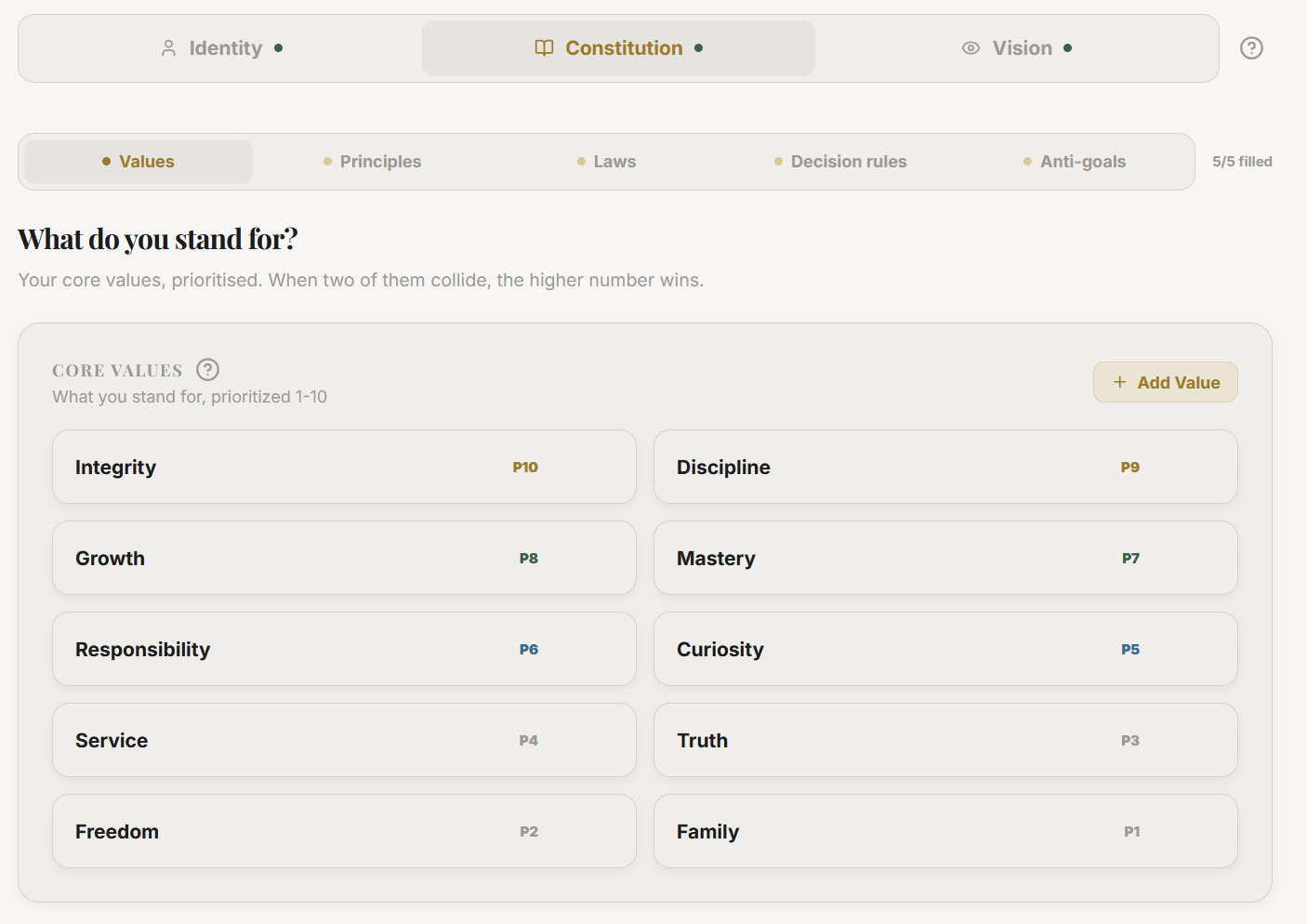
Values. Name what you stand for and give each a priority from 1 to 10. This number is not decoration — when two values collide in a real decision, the higher number wins. That is why ranking honestly matters more than the list itself. Values sort in descending priority so your top commitments stay visible.
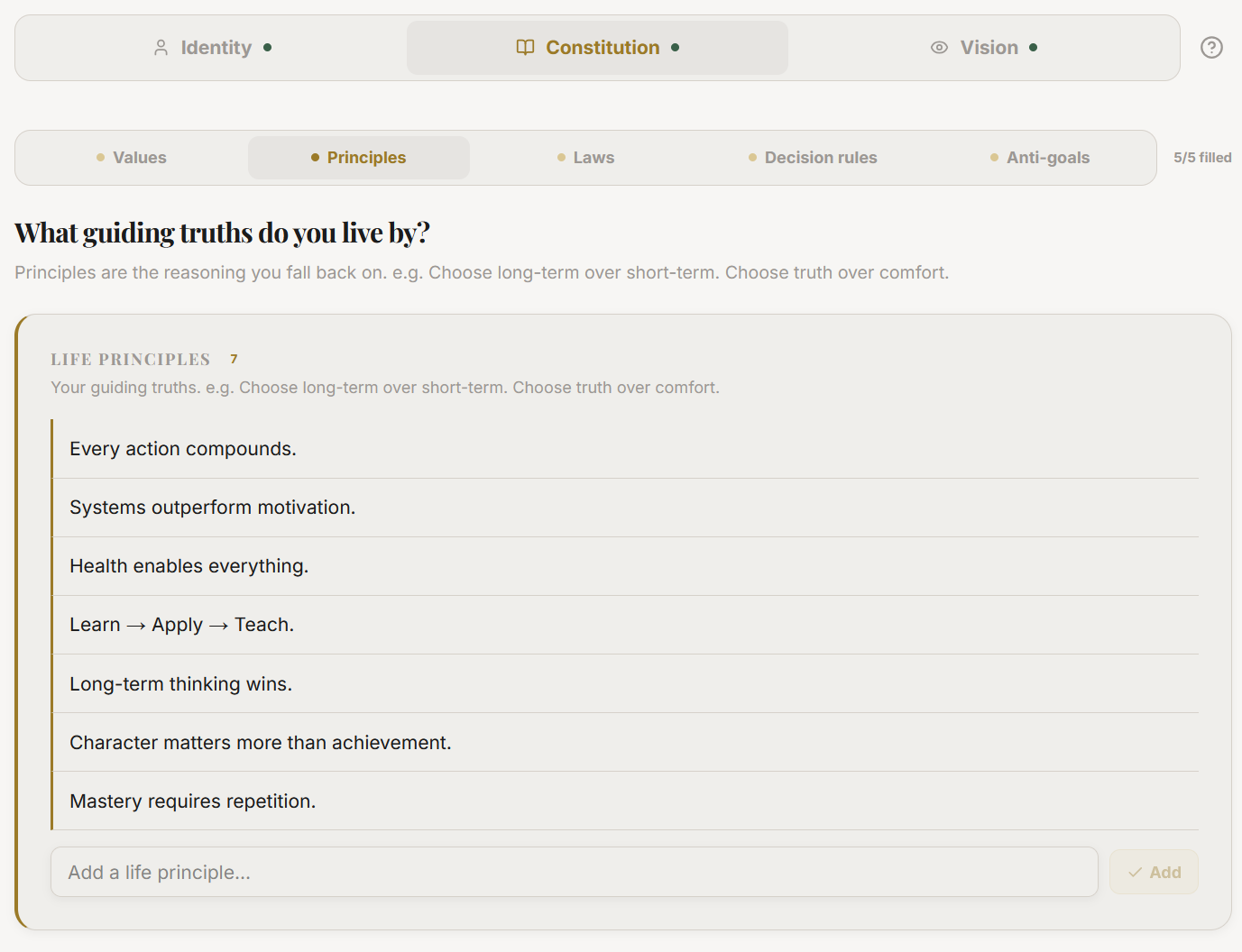
Principles. Directional truths, not absolute rules. "Choose long-term over short-term" points you the right way without pretending there are no exceptions. Use principles for wisdom that guides; use laws for lines that hold.
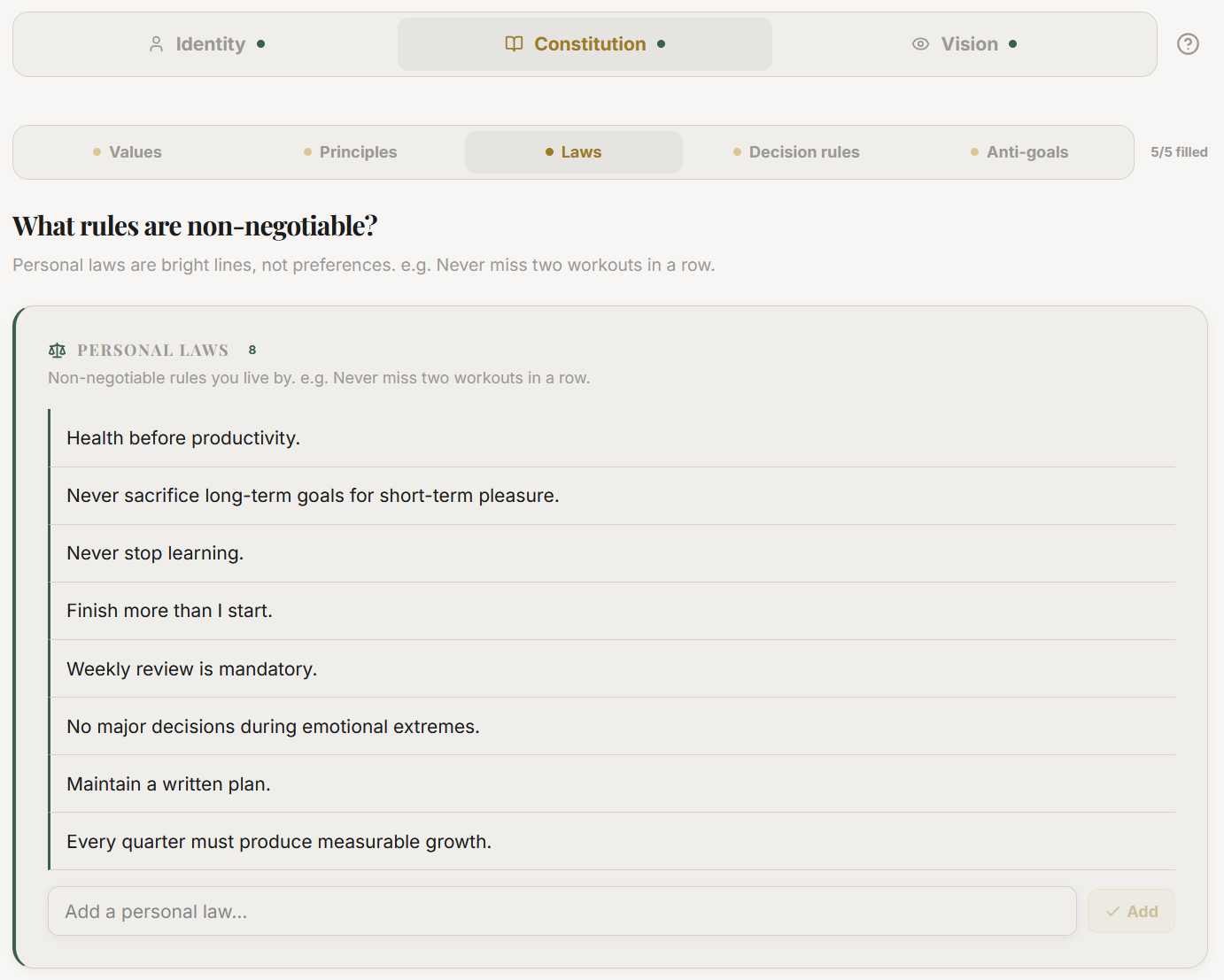
Laws. Bright-line, no-exception rules. "Never miss two workouts in a row." A law with exceptions is just a preference, so keep them few and keep them absolute — three real laws you never break beat fifteen you negotiate.
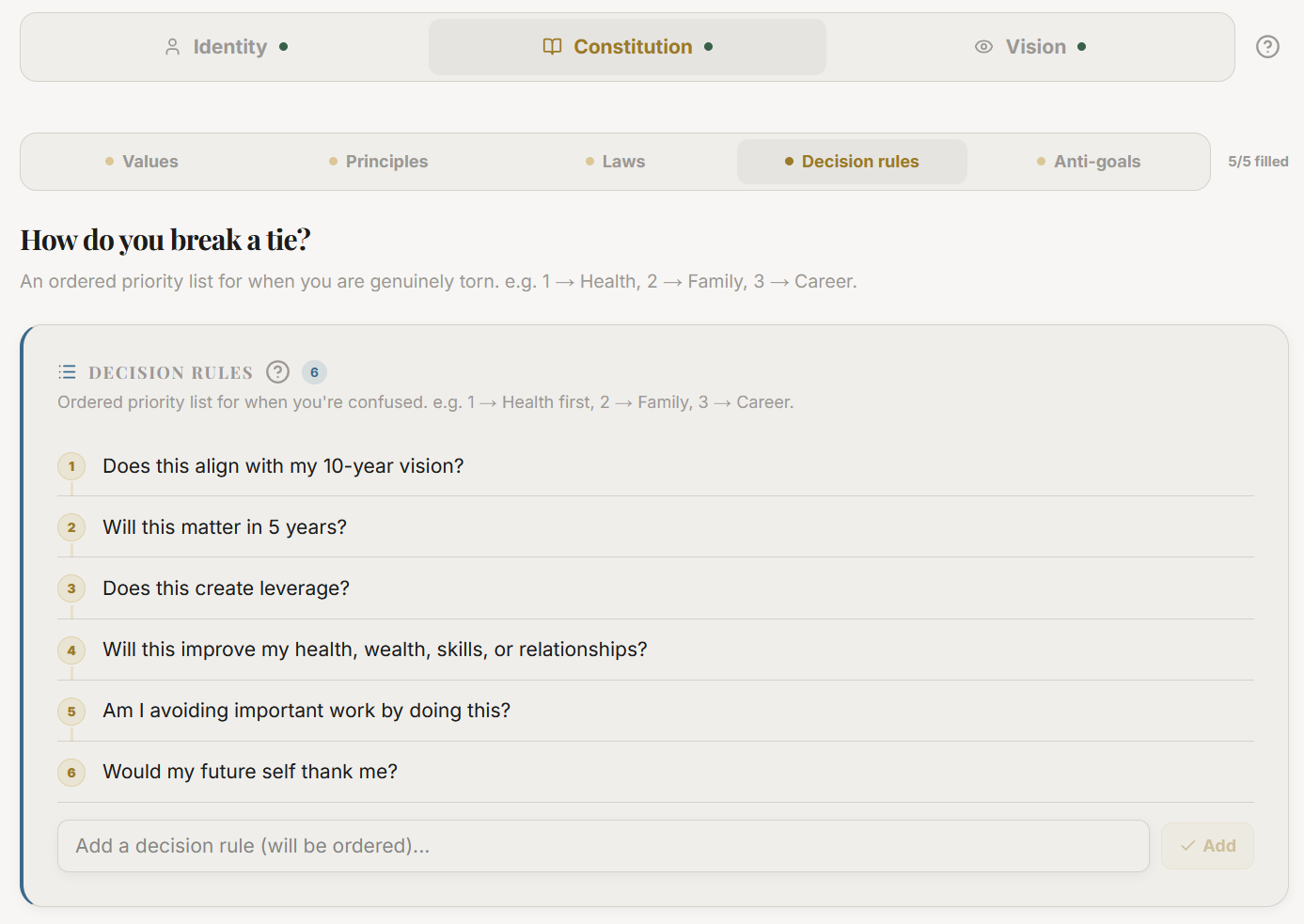
Decision Rules. An ordered list you fall back on when good options conflict. "1 Health, 2 Family, 3 Career" tells you what to cut first when you are overloaded. Without this, every hard trade-off starts from scratch.
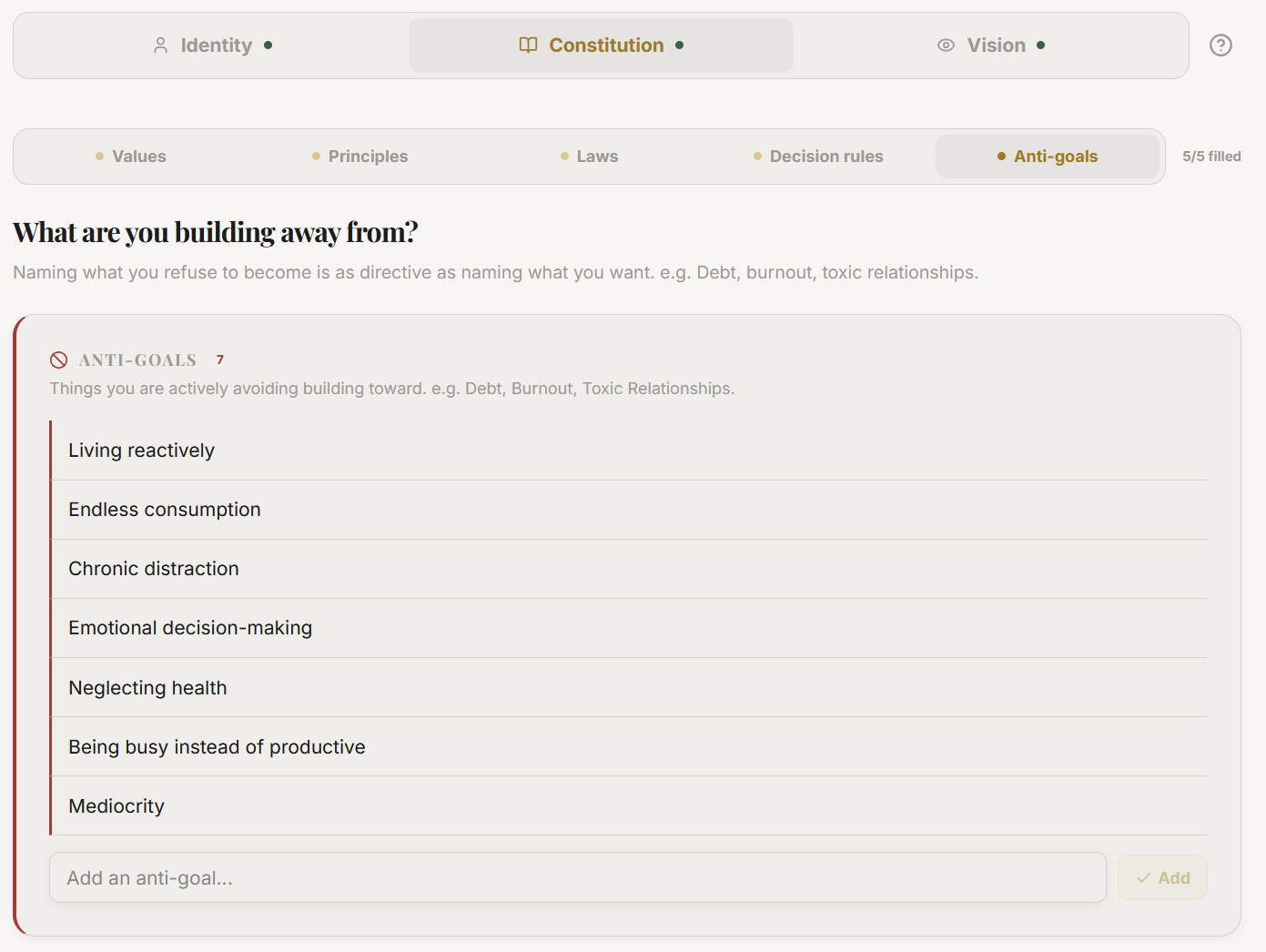
Anti-Goals. The outcomes you are deliberately steering away from. Writing them as vividly as your goals sharpens what you are pursuing — you cannot avoid what you have never named.
Section ProtocolThe two priority mechanics
Value priority can be set two ways, and knowing this prevents surprise. During onboarding, the order you pick your values sets their priority automatically. In the Constitution, you can also drag the 1 to 10 slider directly. Both feed the same conflict rule. If a value feels mis-ranked after onboarding, adjust its slider here.
⚠Common Traps
Section ProtocolWorked example
Ravi sets Values: Health (10), Family (9), Craft (8), Wealth (6). A Principle: "Reversible decisions get made fast; irreversible ones get slept on." A Law: "No screens in the bedroom." A Decision Rule for overload: "Cut anything that does not serve the top two values this week." An Anti-Goal: "Becoming the person who is always busy and never present." When a lucrative project threatens his family time, the ranking (Family 9 over Wealth 6) makes the call for him.
Reflection Prompts
Intelligence Pipeline
Connected Intelligence
Ready to Deploy Your Life OS?
Experience the full power of integrated intelligence. Stop managing apps and start operating your life.
Launch Command Center