How to Use Transform Journey
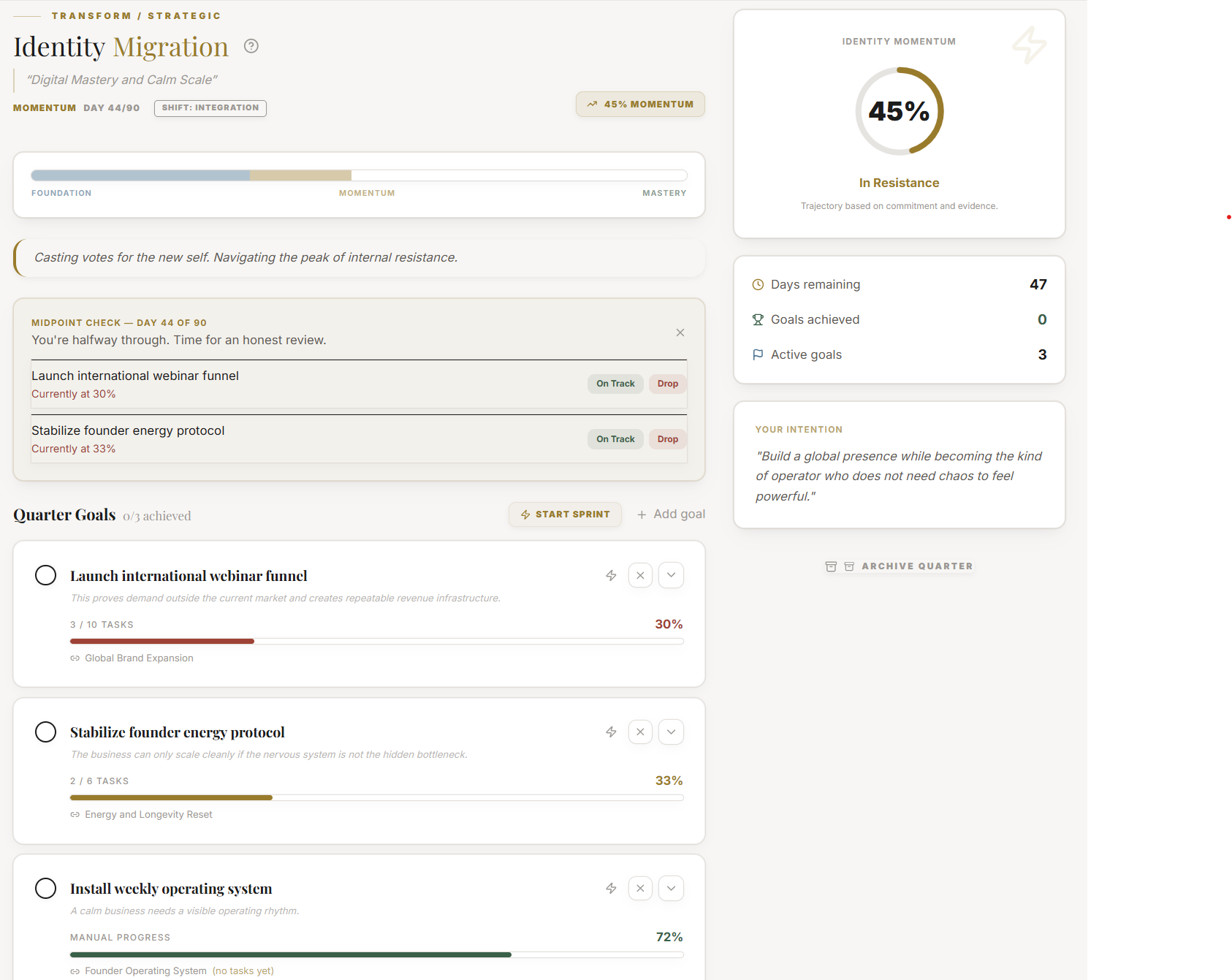
The long view of your cycle — the 90-day timeline and goals, your 21-day evidence sprints, and the planning notebook. What a sprint is really for.
How to Use Transform Journey
The daily companion keeps your head down on today. Journey is where you lift it and see the whole arc — how far into the 90 days you are, how your goals are tracking, and which short experiments you are running. It has three tabs: Cycle, Sprint, and Notebook.
Operational Directive
Journey is the zoom-out. Visit it weekly to check trajectory and to run 21-day experiments on single behaviours — the sprints that generate evidence faster than a full habit can form.
Section ProtocolThe three tabs
| Tab | What it shows | Use it to |
|---|---|---|
| Cycle | Day number, phase, timeline, goals, identity evolution | See the whole 90-day arc at a glance |
| Sprint | 21-day experiments on one behaviour, up to three active | Test a specific behaviour and build proof |
| Notebook | Free planning and strategy space for the cycle | Think on paper without leaving Transform |
Section ProtocolUnderstanding 21-day sprints
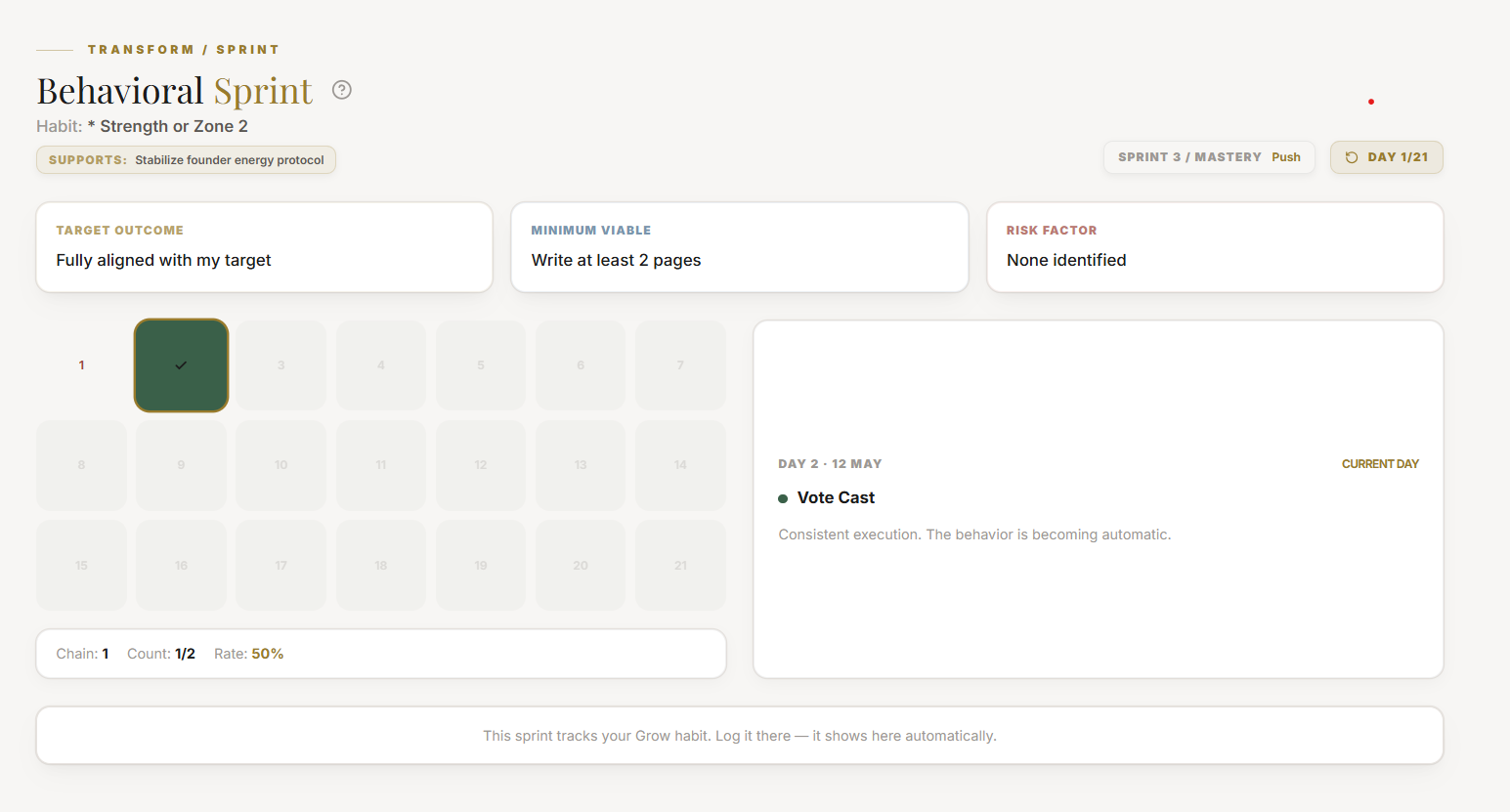
A sprint is an experiment, not the habit itself. You pick one behaviour, commit to it for 21 days, and track it as a simple binary — did it happen or not — on a dot grid. The point is not that three weeks builds a permanent habit (it rarely does; real habits take longer). The point is that a focused, visible three-week run produces fast, concrete evidence of who you are becoming, which is what shifts self-image. You can run up to three sprints at once.
Section ProtocolHow to use Journey well
- ▶Open the Cycle tab weekly to check your phase and whether your goals are still the right ones.
- ▶Start a Sprint when there is one specific behaviour you want to prove you can hold — not your whole identity, one behaviour.
- ▶Use the Notebook for the thinking that does not fit anywhere else: strategy, obstacles you foresee, plans for the next phase.
⚠Common Traps
Section ProtocolWorked example
Ravi is in the Momentum phase (day 42). His Cycle tab shows his 5k goal on track. He notices he keeps checking his phone before training, so he starts a 21-day sprint: "no phone until after the morning anchor," tracked as a single daily dot. It is not his whole identity — just one behaviour — but three weeks of green dots becomes hard evidence that he is someone who trains before he reacts.
Reflection Prompts
Intelligence Pipeline
Connected Intelligence
Ready to Deploy Your Life OS?
Experience the full power of integrated intelligence. Stop managing apps and start operating your life.
Launch Command Center