Return to Intelligence Bank
Intelligence Brief
ID: TRANSFORM-MODULE-COMPLETE-GUIDE

Mastering the Transform Module: Complete Operational User Guide

A comprehensive operational manual for navigating the Transform cockpit—from daily briefings to strategic reviews and cognitive reframing.

Operation ZoneTRANSFORM MODULE
Read Duration12 MIN
TRANSFORMWORKFLOWSYSTEMSDISCIPLINE

Mastering the Transform Module: Complete Operational & Coaching Guide

Operational Directive

Transformation is not a matter of willpower; it is a matter of architectural design. This master guide provides a first-principles manual for navigating the Transform cockpit to automate your self-evolution.

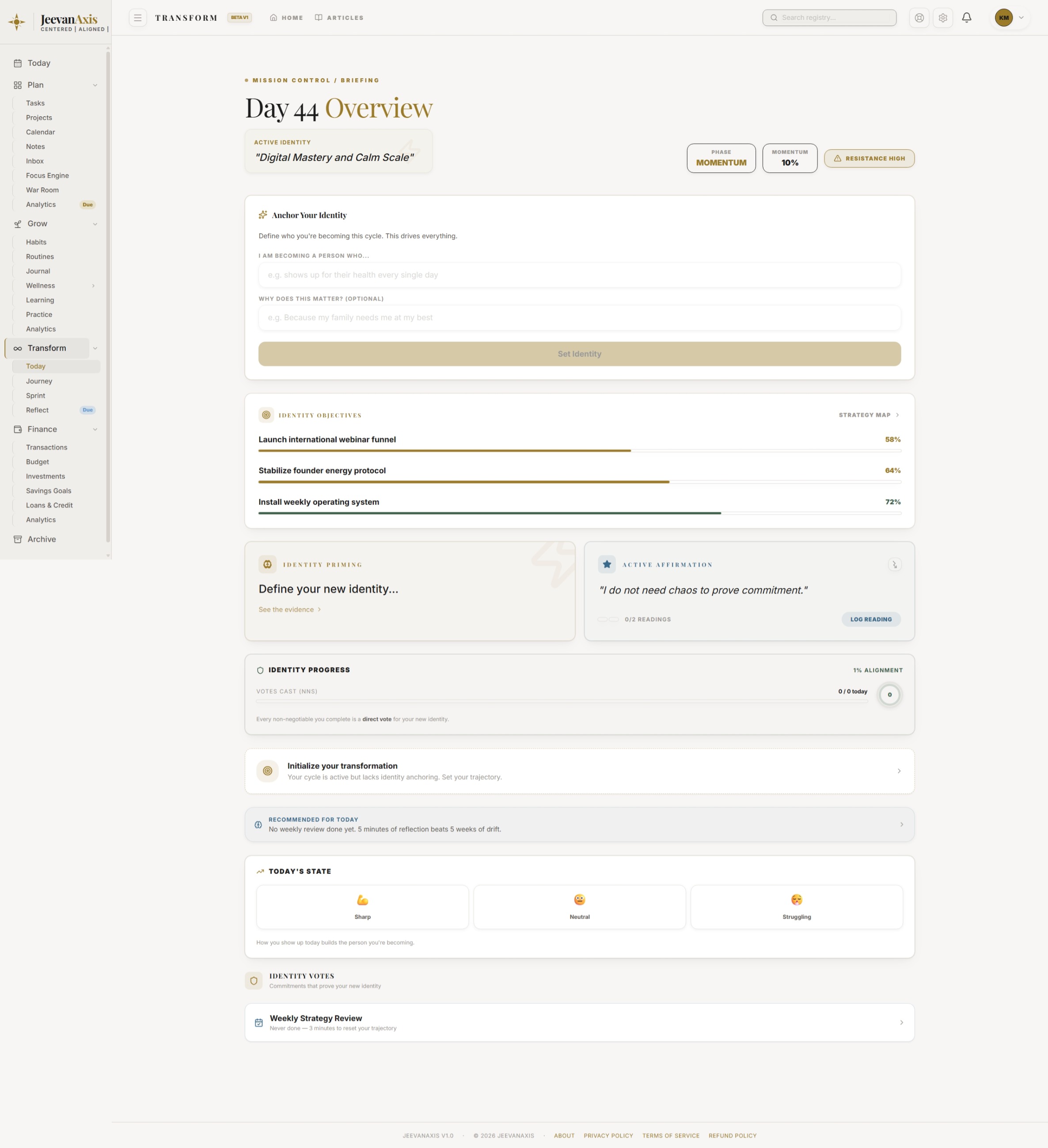
JeevanAxis Transform Module — unified dashboard with Identity Statement and Sprints

Section Protocol
Part 1: Context & Core Philosophy

Most self-improvement applications fail because they treat human change as a linear to-do list. They assume you will always have high energy, perfect motivation, and absolute clarity. When you experience high stress, a chaotic schedule, or a temporary setback, these linear apps become sources of guilt, leading to a complete dropout.

The JeevanAxis Transform Module is built on different assumptions. It is a progressive circadian operating system designed to act as an active companion. It matches your biological rhythms throughout the day, deploys protective guardrails during high friction, and guides your mindset back to stability when you lapse.

By using this module, you are transitioning from tactical task tracking to systemic identity evolution.

Section Protocol
Part 2: Circadian Loop (The Circadian Flow Tabs)

The Transform dashboard consolidates all features into four circadian phases that follow your daily energy patterns:

graph TD
    subgraph CircadianTimeline["The 24-Hour Circadian Timeline"]
        MorningTab["Morning Tab\n(06:00 - 12:00)"] --> ExecutionTab["Execution Tab\n(12:00 - 18:00)"]
        ExecutionTab --> EveningTab["Evening Tab\n(18:00 - 24:00)"]
        EveningTab --> MorningTab
        
        Crisis["Struggling state logged"] -.-> ThinkingTab["Thinking Room Tab\n(Anytime SOS)"]
        ThinkingTab -.-> |Restored clarity| MorningTab
    end

TAC1. Morning Briefing: Anchoring Your Focus

Your morning is about priming and protection. Under this tab, you protect your cognitive bandwidth before the noise of the day intervenes.

  • Morning Mode check-in: Log whether you wake up Sharp, Neutral, or Struggling. This sets the system's guardrails for the day.
  • Daily Non-Negotiables Checklist: A clear read-only view of today's anchors so they are top-of-mind.
  • Morning Journal: Guided prompts (default or blueprint-specific) to clear mental clutter and set today's primary objective.

TAC2. Execution Stack: Prove Your Identity

During the middle of the day, your focus shifts entirely to physical action, consistency, and metrics.

  • Identity Votes (NNs): Real-time tracking and check-offs of your keystone non-negotiable habits.
  • 21-Day Habit Sprints: High-focus, short-horizon sprints dedicated to establishing one critical behavior.
  • North Star Goals: Live visual progress bars tracking your multi-month objectives.

TAC3. Evening Debrief: Integrity & Honest Reflection

In the evening, you gather behavioral proof and audit your day's friction.

  • Resistance Mastery Score: Rate the internal friction you overcame today on a scale of 1–5.
  • Evidence Collector: Log one concrete action you took that proves your new identity.
  • Cheat Day Planner: Intentionally log rest days to prevent burnout and keep your streak healthy.

TAC4. Thinking Room: The SOS Lab

Your cognitive laboratory. When you experience a lapse, high stress, or negative emotional spirals, this tab provides clinical grounding:

  • ABC Cognitive Reframer: Deconstruct activating events and irrational beliefs to build rational alternatives.
  • SOS Grounding Protocol: Sudden distress exercises to reset focus.

Section Protocol
Part 3: Deep Feature Explanations, Usage, & Importance

To fully command this module, you must understand what each feature does, how to use it, and why it is critical for your personal evolution:

TAC1. Active Identity & Evolution Log

What It Is

The header card of your dashboard showing your Active Identity statement (e.g., "I am becoming a person who shows up for their health daily"), complete with an expandable drawer housing your supporting evidence, anti-patterns, and the "5 Whys" deep purpose chain.

How to Use It

  1. Review the statement first thing in the morning under the Morning Tab.
  2. Click "See the evidence" to read what you will never do (anti-pattern) and your core purpose.
  3. If you complete all Non-Negotiables, click the Identity Check buttons to log whether your actions matched your statement today.

Why It Is Critical for Your Journey

Goal setting builds outcomes, but identity shifts build behavior. Research in behavioral science shows that you cannot sustain a habit that contradicts your self-image. By actively reviewing who you are becoming and recording daily confirmation, you deliberately update your self-identity.

TAC2. Affirmation Sanctum

What It Is

A dedicated, high-contrast, gold-hued reading card in the Morning Tab that displays your active commitments and affirmations.

How to Use It

  1. Read the active affirmation slowly twice.
  2. Click "Log Reading" after each reading.
  3. Achieve 2 readings daily to change the card's state to "Synchronized" (green-tinted border).

Why It Is Critical for Your Journey

Your brain operates on neural plasticity. Unconscious negative self-talk is reinforced through repetition. The Affirmation Sanctum forces deliberate, conscious focus on your new beliefs, rewiring your neural pathways to support execution.

TAC3. Daily Non-Negotiables (NNs) & Identity Votes

What It Is

Your absolute baseline daily actions (1 at Level 1, up to 3 at Level 2). These are habits so simple that you must do them no matter how bad the day is.

How to Use It

  1. Review them in the Morning checklist.
  2. Mark them done under the Execution or Evening Tab.
  3. If you miss one, the system triggers Tier-1 Recovery (asking what blocker got in the way) or Tier-2 Recovery (focusing on your Minimum Viable Day) to protect your streak.

Why It Is Critical for Your Journey

In transformation, consistency beats intensity. Completing a tiny non-negotiable habit every single day deposits trust in your internal trust ledger. It proves to your subconscious that you are reliable, which builds deep self-trust.

TAC4. 21-Day Habit Sprints

What It Is

A focused, 21-day timeline dedicated to automating one single, high-leverage habit. It displays a progress board with 21 consecutive checkboxes.

How to Use It

  1. Accessible on Day 1 from the sidebar or Execution Tab.
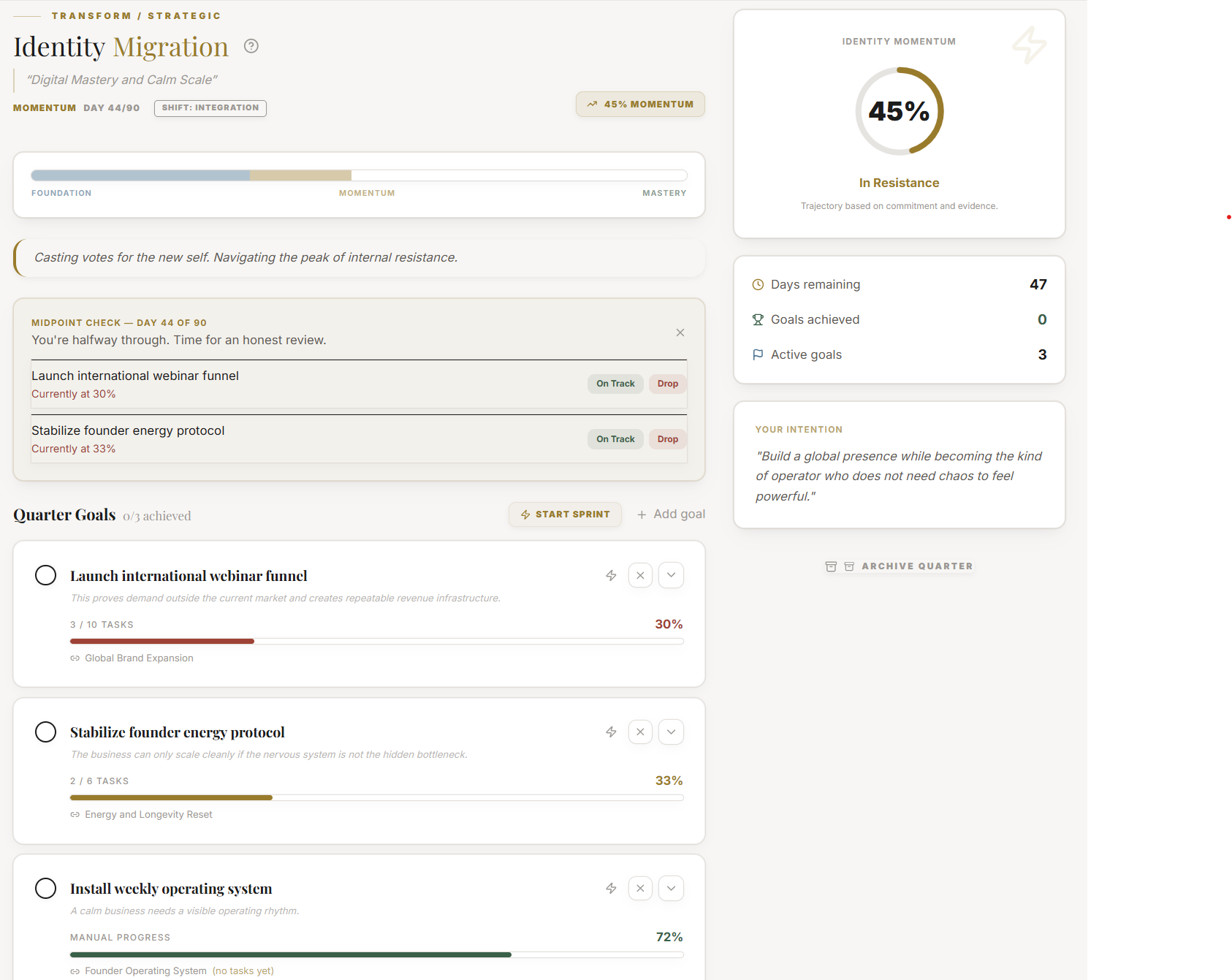
  2. Declare your sprint focus, define the "minimum viable" version of the habit, and select the difficulty.
  3. Log daily execution. The system tracks consecutive checkboxes. If you break the streak, it triggers recovery guides to reset.

Why It Is Critical for Your Journey

Cognitive load theory shows that trying to build multiple habits simultaneously leads to failure. Sprints isolate your willpower, focusing it on a single behavior for 21 days—the optimal scientific window required to build a neural habit pathway.

TAC5. Weekly Strategy Review (Reflect)

What It Is

A systemic, 3-minute review process (unlocked on Day 8) that closes the loop on your weekly performance.

How to Use It

  1. The sidebar sub-item Reflect will show a "Due" badge every Sunday.
  2. Complete the review by auditing goal progress, reflecting on weekly lessons, and writing next week's operational adjustments.
  3. The adjustment is then featured on your daily dashboard as a prominent reminder.

Why It Is Critical for Your Journey

Without deliberate feedback loops, people drift. The Weekly Strategy Review is your steering wheel, ensuring you reflect on friction, adjust parameters, and step into the next week with absolute intention.

TAC6. The Resistance Mastery Score

What It Is

An evening rating widget (scale of 1–5) that logs how much internal friction you overcame to complete your commitments today.

How to Use It

  1. Appears in the Evening Tab once your Non-Negotiables are complete.
  2. Select your score: 1 (Easy Day), 3 (Real Work), or 5 (War Zone).
  3. The system logs this score to Supabase to calculate your weekly momentum and drop-off risks.

Why It Is Critical for Your Journey

Friction is not a sign of failure; it is proof of active change. By reframing high resistance as a "win" rather than a struggle, you train your brain to associate effort with growth, building deep psychological resilience.

TAC7. Cheat Day Planner & Recovery

What It Is

An intentional rest planning panel in the Evening Tab.

How to Use It

  1. If your cycle state is healthy (Green), the Cheat Day Planner is active under the Evening Tab.
  2. Select a date to schedule a cheat day, locking in a deliberate rest window.

Why It Is Critical for Your Journey

Rigidity leads to breakage. By scheduling rest intentionally, you remove the guilt associated with missing a day. It teaches you that sustainability requires cyclic rest, keeping you in the game for the full 90 days.

TAC8. Emotional Transition Cycle & Plateau Protocols

What It Is

A dynamic visualization shown on your Execution Tab when you enter transition zones (e.g., Days 8–21 and Days 46–65).

How to Use It

  1. The system automatically detects your cycle day and renders this card.
  2. Read the stage insights (e.g., Valley of Despair, Informed Pessimism) to understand your current emotional state.
  3. Complete the suggested Plateau Protocol exercises if you feel your progress has flattened.

Why It Is Critical for Your Journey

Setbacks are predictable phases of change. By showing you exactly where you are in the emotional transition cycle, the system normalizes your struggles. It proves that feeling like quitting is a natural phase of rewiring, helping you push through the valley of despair.

TAC9. The Thinking Room: SOS & ABC Reframer

What It Is

A cognitive therapy toolkit (ABC Model) that deconstructs emotional reactions and irrational beliefs into rational actions.

How to Use It

  1. Access this tab anytime, or when prompted by logging a "Struggling" morning state.
  2. Input the Activating Event (A), identify your Irrational Belief (B), analyze the Consequences (C), and write your Rational Reframe.
  3. Save the session to your personal log to track your cognitive reframing history.

Why It Is Critical for Your Journey

Lapses are driven by emotions, not logic. When we slip, we catastrophize, triggering the "what the hell" effect where we completely abandon our goals. The ABC Reframer applies logic to cognitive distortions, short-circuiting emotional spirals and getting you back to execution immediately.

TAC10. Relationship Manager & Social Audit

What It Is

A weekly diagnostic tool under the Execution Tab that audits your social environment.

How to Use It

  1. Define your primary Transformation Partner (accountability partner).
  2. Rate how supportive or draining your environment is.
  3. Conduct a quick weekly audit of key relationships to ensure they align with your identity shift.

Why It Is Critical for Your Journey

Environment beats willpower. If your immediate social circle resists your new identity, your transformation will fail. The Relationship Manager forces you to bring conscious awareness to your social inputs, helping you design an environment that pulls you forward.

Section Protocol
Part 4: System Dataflows & Logic Maps

To understand how your actions translate into transformation progress, study this technical map:

TACHigh-Performance Circadian Loop

flowchart TD
    subgraph CircadianLoop["Circadian Loop (24-Hour Cycle)"]
        Morning[Morning Check-in state logged] --> |If Struggling| SOS[Struggling state triggers SOS / Reframer]
        Morning --> |If Sharp/Neutral| Brief[Daily Briefing & Journal Prompts active]
        Brief --> |Define daily intention| Exec[Execution phase: Habits, Sprints & Goals active]
        Exec --> |Log NN completion| Debrief[Evening Debrief: Log Resistance & Evidence]
        Debrief --> |Calculate momentum score| DB[(Supabase DB update)]
        DB --> |Reset state at midnight| Morning
    end

TACThe Trust Ledger Compounding Loop

flowchart TD
    subgraph TrustCompounding["The Trust Ledger Compounding Loop"]
        Commit[Make private commitment] --> Action[Execute baseline action]
        Action --> |Mark NN/Sprint Done| Deposit[Deposit trust in internal ledger]
        Deposit --> Trust[Self-Trust grows]
        Trust --> Identity[Identity shifts: I am reliable]
        Identity --> Ease[Future commitments feel natural]
        Ease --> Commit
        
        ActionFail[Skip action] --> |No log / Avoidance| Withdraw[Withdraw trust from ledger]
        ActionFail --> |Honest log & MVD done| Recovery[Tier-2 Recovery: Minimum Viable Day]
        Recovery --> Deposit
        Withdraw --> Doubt[Self-doubt compounds]
        Doubt --> Harder[Future commitments feel harder]
        Harder --> Commit
    end

Common Traps

Reflection Prompts

Section Protocol
Summary

"

Executive Summary

The Transform cockpit integrates circadian workflow, progressive activation locks, environment audits, and cognitive reframing into one cohesive cockpit.

By checking in daily, you actively update your internal trust ledger, shifting your transformation from a series of high-friction tasks to an automated, identity-driven operational flow.

Intelligence Pipeline

Transformation and Inner Work

Intelligence Protocol By

JEEVANAXIS

Ready to Deploy Your Life OS?

Experience the full power of integrated intelligence. Stop managing apps and start operating your life.

Launch Command Center