Return to Intelligence Bank
Intelligence Brief
ID: HOW-TO-CONDUCT-STRATEGIC-REVIEWS

How to Conduct Strategic Reviews

Audit your week, analyze your execution data, and adjust your parameters for the next cycle.

Operation ZoneTRANSFORM MODULE
Read Duration9 MIN
REVIEWSTRATEGYAUDIT

How to Conduct Strategic Reviews

Operational Directive

Section Protocol
The Necessity of the Strategic Review

Execution without reflection is merely motion.

You can work intensely, crossing off tasks and generating massive output, but if that output is not aligned with your higher-order objectives, you are efficiently moving in the wrong direction.

The Strategic Review is the mechanism by which you guarantee alignment.

It is a deliberate pause in the operational cadence, designed to elevate your perspective from the granular details of daily execution to the macro-level architecture of your life and work.

During this period, you transition from the role of the operator to the role of the architect.

You are no longer doing the work; you are analyzing the system that produces the work.

Without a consistent Strategic Review, your systems will inevitably degrade through entropy.

Inefficiencies will accumulate, bad habits will quietly re-establish themselves, and your trajectory will slowly drift off course.

The Strategic Review is the corrective force that forces you back into alignment.

Section Protocol
The Psychology of Self-Correction

Conducting a rigorous Strategic Review requires a specific psychological posture.

The human ego inherently resists acknowledging failure or inefficiency.

When reviewing a week of suboptimal performance, the default reaction is often defensiveness, rationalization, or avoidance.

To execute this protocol effectively, you must decouple your self-worth from your operational output.

You must view yourself not as a flawed individual, but as a complex system that requires debugging.

When a system fails to produce the desired result, an engineer does not experience shame; they experience curiosity. They search for the broken component.

You must adopt this exact mindset during the Strategic Review.

A failure to execute a Non-Negotiable or achieve a Daily Objective is not a moral failing; it is a data point indicating a flaw in your system architecture, your environment, or your behavioral protocols.

By neutralizing the emotional response, you allow clear, clinical analysis to drive your adjustments.

Section Protocol
The Weekly Cadence

The optimal rhythm for the Strategic Review is weekly.

A daily review is too frequent; it lacks sufficient data to identify meaningful trends and often devolves into micromanagement.

A monthly review is too infrequent; by the time you identify a systemic failure, the damage has already compounded over four weeks.

The seven-day cycle provides the perfect balance: enough data to analyze patterns, but a short enough feedback loop to implement rapid corrections.

Tactical Logic Visualization
SYNTHESIZING DIAGRAM…

The Strategic Review should be scheduled at a fixed time every week.

For most high performers, Sunday afternoon or evening is ideal.

It serves as a psychological boundary, formally closing the previous week and initializing the parameters for the week ahead.

This prevents the anxiety of the upcoming week from bleeding into your rest period, as all planning and processing is contained within this specific time block.

Section Protocol
The Architecture of the Perfect Sunday

Integrating the Strategic Review into your Sunday requires careful architectural design.

Sunday should primarily serve as a day of recovery, decompression, and preparation.

If the Strategic Review is perceived as a burdensome extension of the workweek, you will subconsciously resist it.

The ideal architecture separates the day into distinct phases.

The morning and early afternoon should be fiercely protected for rest, family, or recreational pursuits.

The Strategic Review should be positioned as a transitional activity in the late afternoon or early evening—a bridge between the rest phase and the upcoming execution phase.

Create a specific ritual around the review.

Change your physical environment, perhaps by moving to a different room or a coffee shop.

Ensure all digital distractions are eliminated.

This dedicated block, usually requiring 60 to 90 minutes, should feel like a high-level strategic summit with yourself, not merely another administrative task to be checked off.

Section Protocol
Auditing Goal Progress

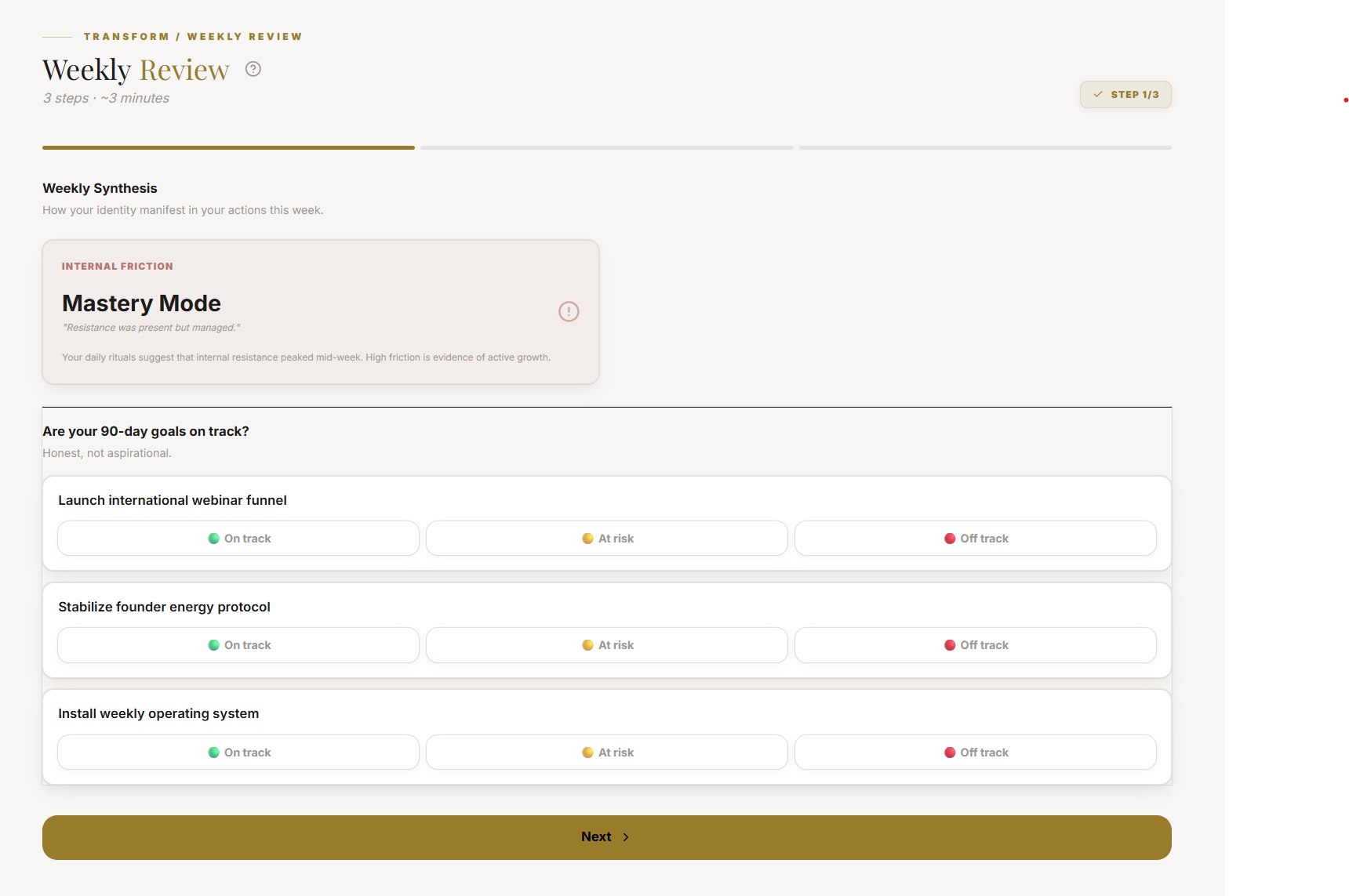
The core of the Strategic Review is the ruthless auditing of your progress against your stated objectives.

This is not an exercise in self-justification or emotional processing.

It is a clinical analysis of the data.

You must confront the objective reality of your execution.

Did you hit your targets?

Did you maintain compliance with your Non-Negotiables?

Did you execute the protocols you committed to?

Tactical Logic Visualization
SYNTHESIZING DIAGRAM…

If there is a discrepancy between your intent and your execution, you must investigate it without ego.

Was the failure due to a flawed system?

Did you allocate insufficient time?

Were you derailed by an unexpected external variable?

Or was it a simple behavioral failure—a lack of discipline or focus?

Accurately diagnosing the root cause is the prerequisite for implementing an effective solution.

Common Traps

Section Protocol
Analyzing Long-Term Trends vs Short-Term Noise

As you conduct your weekly audits, you will accumulate historical data.

A critical skill developed through consistent Strategic Reviews is the ability to distinguish between long-term systemic trends and short-term operational noise.

A single week of poor execution may simply be noise—the result of a transient illness, an unexpected external crisis, or a temporary dip in motivation.

It does not necessarily indicate a broken system.

However, if you fail to execute a specific Non-Negotiable for three consecutive weeks, that is a trend.

That indicates a structural flaw in your protocol, your environment, or your scheduling.

You must train yourself to look for these patterns.

Are you consistently overestimating your capacity on Tuesdays?

Are you consistently failing to execute your recovery protocols during high-stress periods?

Identifying these macro-trends allows you to make fundamental architectural changes rather than superficial daily adjustments.

Section Protocol
Reflecting on Weekly Lessons

Experience alone does not produce wisdom; evaluated experience produces wisdom.

The Strategic Review is the forge where raw experience is hammered into usable protocols.

You must actively extract the signal from the noise of the past seven days.

What did you learn about your own capacity?

What unexpected friction points repeatedly slowed your progress?

What actions generated disproportionate leverage and results?

By documenting these insights, you build an evolving database of personal operational intelligence.

If you consistently struggle to maintain focus at 3:00 PM, that is a data point.

If a specific type of task consistently takes twice as long as estimated, that is a data point.

The Strategic Review is where you aggregate these data points and update your internal models of reality.

Section Protocol
Setting Operational Adjustments

Insight is useless without implementation.

The final phase of the audit process is translating your reflections into concrete operational adjustments for the next cycle.

If you identified a recurring point of friction, you must design a system or a protocol to eliminate it.

This often involves the creation of If/Then rules within your Protocol Engine.

If a specific type of distraction is derailing your deep work, what physical or digital barrier will you implement this week to prevent it?

Tactical Logic Visualization
SYNTHESIZING DIAGRAM…

The goal is continuous, incremental optimization.

You are constantly tweaking the parameters of your operational system, testing new variables, and observing the results.

Over time, these micro-adjustments compound into massive improvements in efficiency, focus, and overall output.

Section Protocol
Closing the Feedback Loop

The Strategic Review concludes with the formal initialization of the upcoming week.

This requires transferring all insights, adjustments, and selected objectives into your operational systems (calendar, task manager, Protocol Engine).

You must clear your working memory entirely.

Capture all loose ends, process all open loops, and ensure that every commitment is documented and scheduled.

Tactical Logic Visualization
SYNTHESIZING DIAGRAM…

When the Strategic Review is complete, you should experience a profound sense of cognitive relief.

The past week is archived, the lessons are extracted, and the path forward is clearly defined and ready for execution.

Section Protocol
Execution Checklist

Follow this sequence to execute a comprehensive and effective Strategic Review.

Integration Checklist

Section Protocol
Reflection & Recalibration

Use these questions to pressure-test the quality of your review.

Reflection Prompts

"

Executive Summary

The Strategic Review is the critical feedback loop that prevents operational drift and ensures your daily actions compound toward your ultimate objectives.

By ruthlessly auditing your performance, extracting actionable lessons, and continuously optimizing your systems, you elevate yourself from a reactive operator to a strategic architect.

Never skip this protocol.

Intelligence Pipeline

Transform Module

Intelligence Protocol By

JEEVANAXIS

Ready to Deploy Your Life OS?

Experience the full power of integrated intelligence. Stop managing apps and start operating your life.

Launch Command Center