How to Use Thinking Frameworks
Turn famous mental models — Ikigai, SWOT, First Principles, and more — into guided worksheets that double as decision lenses.
How to Use Thinking Frameworks
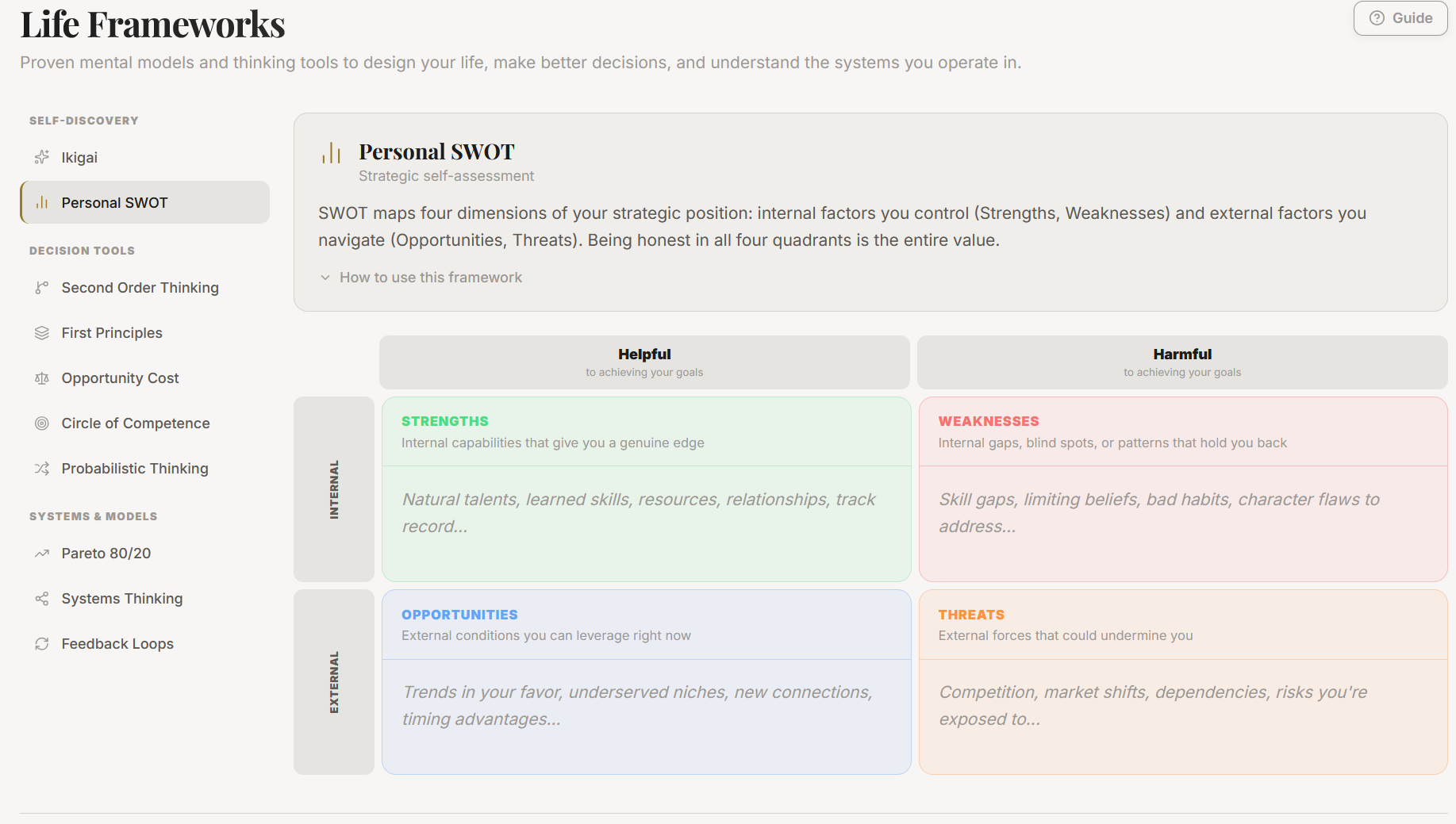
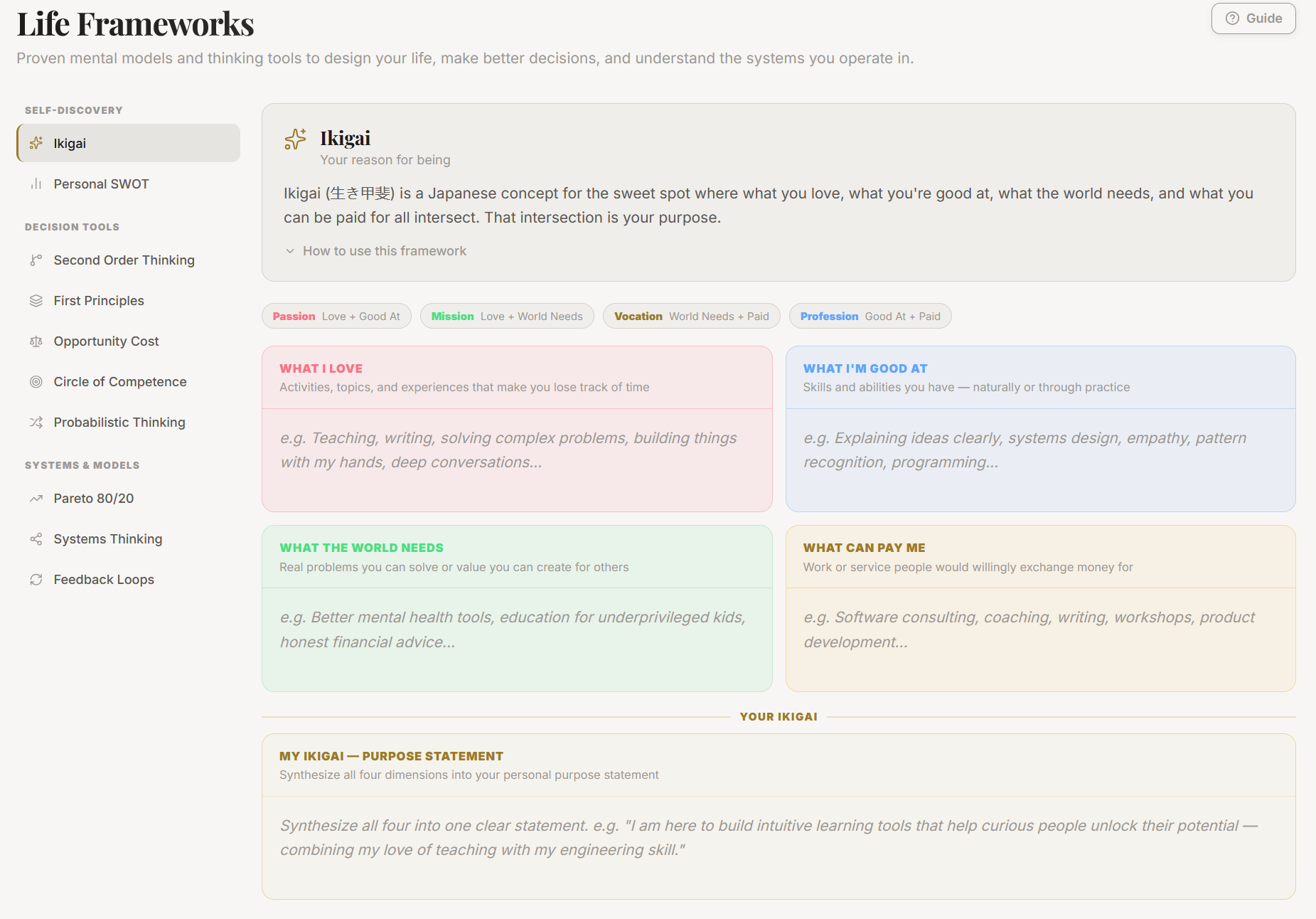
Everyone has heard of Ikigai, first-principles thinking, or a personal SWOT. Almost no one actually works through them. The Frameworks section turns famous mental models into guided worksheets you fill in — and the decision-oriented ones double as the lenses you can attach to entries in your Decision Journal.
Operational Directive
Finish one framework properly rather than half-filling five. A completed worksheet produces an insight you can act on; a collection of started ones produces nothing but the feeling of productivity.
Section ProtocolThe three families
| Family | What it helps with | Examples |
|---|---|---|
| Self-Discovery | Understanding yourself and your direction | Ikigai, Personal SWOT |
| Decision Tools | Making a specific hard choice | First Principles, Second-Order Thinking, Opportunity Cost |
| Systems and Models | Seeing structure and leverage | Systems Thinking, Feedback Loops, Pareto, Circle of Competence |
Section ProtocolHow it works
Pick a framework that fits the problem in front of you. Each one presents a series of prompts — its worksheet fields — that save as you go. When you finish, some frameworks produce a short synthesis that pulls your answers together. Carry that insight straight into a goal or a decision; the point is not the worksheet, it is what you do next.
The decision-family frameworks (First Principles, Second-Order Thinking, Opportunity Cost, and the like) appear as selectable lenses in the Decision Journal, so you can apply a structured model to a real choice and keep the worked reasoning attached to it.
Section ProtocolWhen to reach for one
Not every day. Frameworks are for when you are stuck, choosing a direction, or want to pressure-test a plan you are about to commit to. Using a heavy model on a light problem is its own kind of procrastination. Match the tool to the weight of the question.
⚠Common Traps
Section ProtocolWorked example
Meera is weighing a career move. She works through a Personal SWOT to surface her real strengths and the threats she has been avoiding, then attaches a First Principles lens to the decision itself in the Decision Journal — stripping the choice down to what she actually knows versus what she has assumed. The synthesis makes it obvious that her hesitation was fear dressed as prudence. She makes the call and logs the prediction.
Reflection Prompts
Intelligence Pipeline
Connected Intelligence
Ready to Deploy Your Life OS?
Experience the full power of integrated intelligence. Stop managing apps and start operating your life.
Launch Command Center