How to Read Your Grow Analytics
Visualize your long-term behavioral changes through habit heatmaps, streak trends, and correlation data.
How to Read Your Grow Analytics
Operational Directive
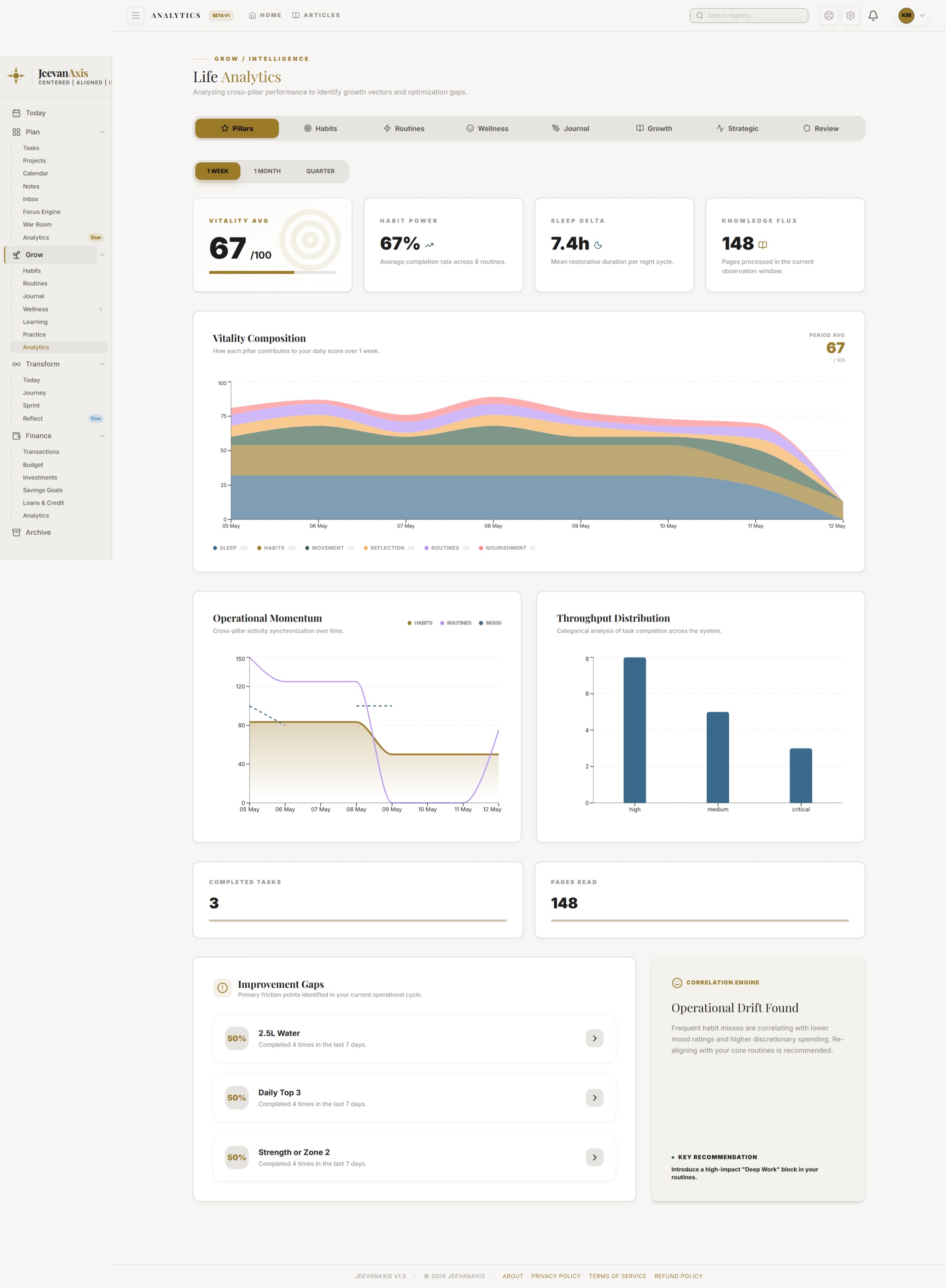
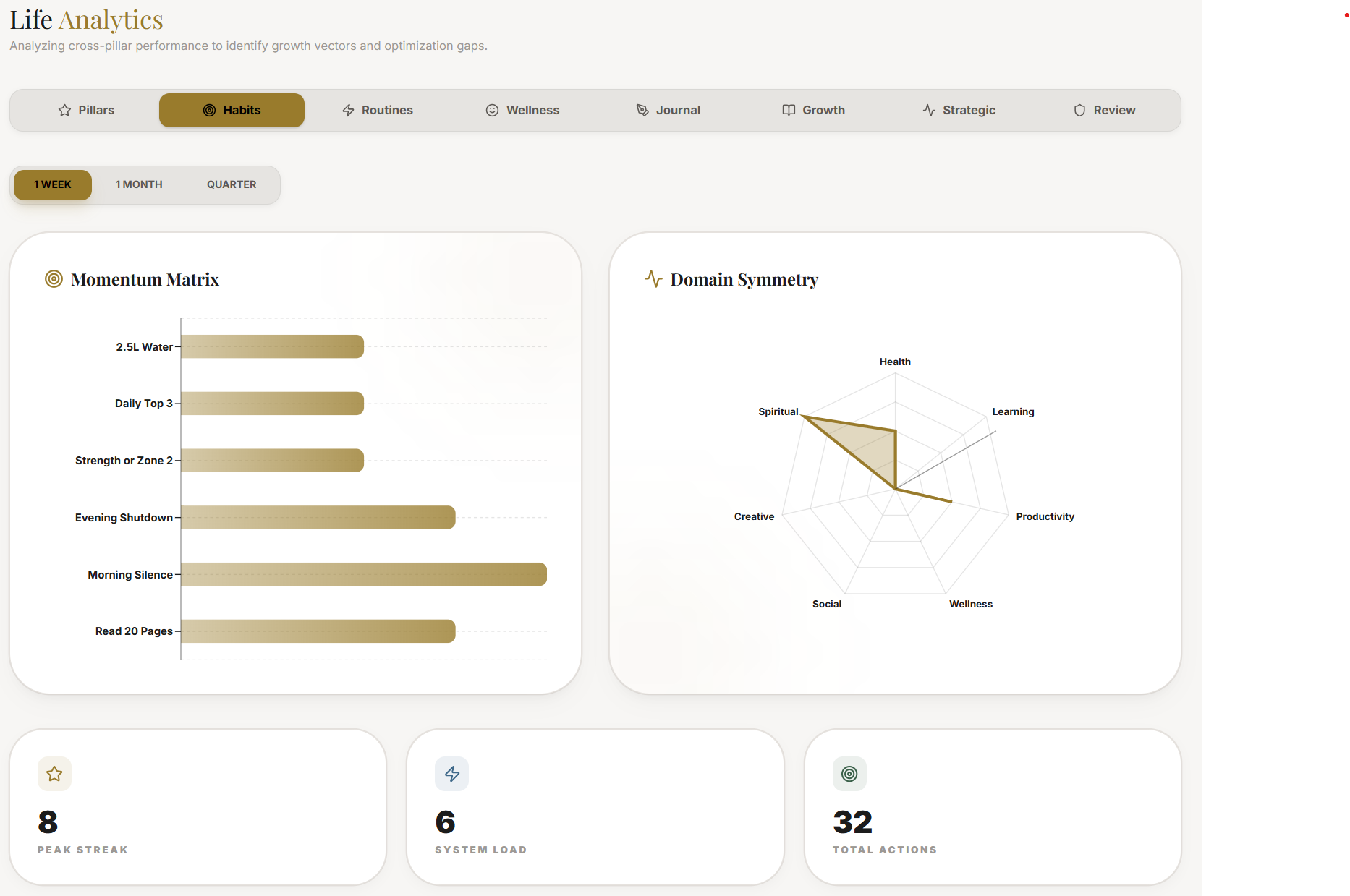
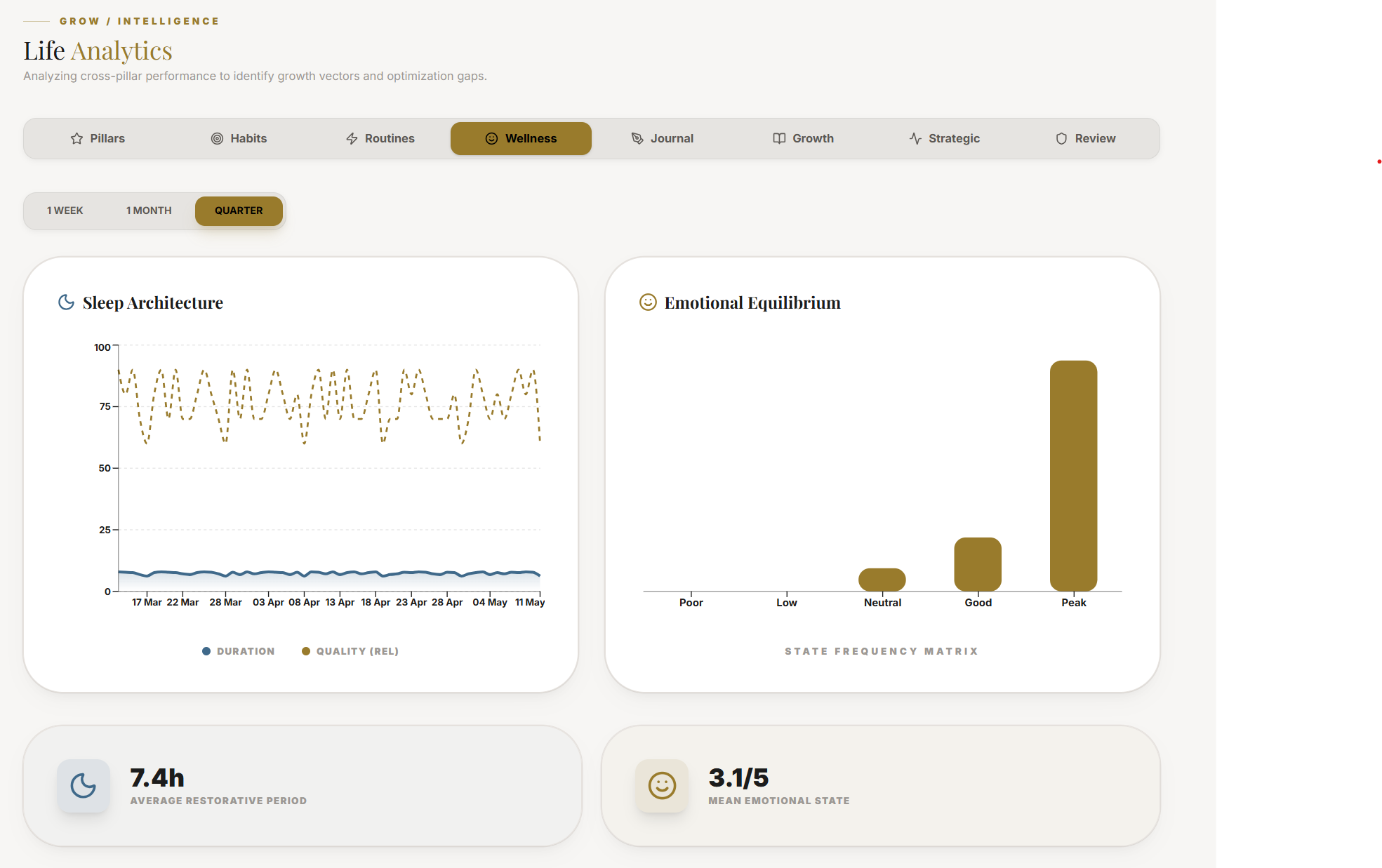
Grow Analytics visualizes your long-term behavioral changes. This guide explains how to read heatmap calendars, streak trends, and correlation data to understand what drives your best days.
Section ProtocolThe Architecture of Self-Awareness
Data without analysis is just noise. You have been meticulously logging your habits, tracking your sleep, maintaining your Learning Log, and monitoring your Vitality Score. Now, you possess a dataset. The Grow Analytics dashboard is where that dataset is transmuted into self-awareness and actionable strategy.
Most people live in a reactive loop, confused as to why some weeks are incredibly productive while others feel like a grinding struggle. They rely on vague feelings and flawed memory to diagnose their performance. Grow Analytics removes the guesswork. It provides empirical evidence of your behavioral patterns.
This dashboard is not designed for passive viewing. It is an active diagnostic tool. By interrogating the heatmaps, analyzing streak momentum, and uncovering hidden correlations, you can reverse-engineer your best days and systematically eliminate the variables that cause you to fail.
This guide will teach you how to read the visual data presented in the Grow Analytics module, ensuring you extract maximum strategic value during your Weekly War Room and monthly reviews.
Section ProtocolReading the Heatmap Calendars
The Heatmap Calendar is the most visceral representation of your consistency. It provides a macro-view of your behavioral adherence over months and years, instantly highlighting patches of density and voids of inaction.
When you look at the heatmap for a specific habit (e.g., 'Morning Deep Work'), do not just look at the current week. Zoom out. Look for the tectonic shifts in your behavior.
Observe the weekends. Does your heatmap consistently go dark on Saturdays and Sundays? If so, your system is fragile, reliant entirely on the structure of the workweek.
Look for the 'cascade effect.' Often, a blank spell in one habit (e.g., Sleep) will be immediately followed by a blank spell in another (e.g., Exercise). The heatmap visually proves that behaviors do not exist in isolation; they are deeply interconnected. Identifying these cascade triggers allows you to intervene before a minor slip becomes a total system failure.
Section ProtocolStreak Trend Analysis: Beyond the Number
Streaks are powerful psychological motivators, but the raw streak number can be misleading. A 30-day streak that was agonizing to maintain is very different from a 30-day streak that felt effortless. Grow Analytics contextualizes your streaks.
The most critical metric is not your longest streak; it is your 'Recovery Rate.' When a streak inevitably breaks, how many days does it take you to initiate a new one?
Elite performers do not have perfect streaks; they have incredibly fast recovery rates. If your analytics show that a broken habit takes an average of 6 days to restart, you have a massive friction problem in your initiation sequence. The goal is to reduce that recovery rate to 1 day. A slip is a slip; a two-day slip is the beginning of a new, negative habit.
Analyze your historical averages. Are your median streak lengths increasing over time? If your average streak for a habit was 4 days last quarter and is 9 days this quarter, your baseline discipline is measurably improving, regardless of whether you hit a massive record.
Section ProtocolUnlocking Correlation Data
This is the most advanced and powerful feature of the Grow Analytics module. Correlation data mathematically links your various inputs to reveal the hidden architecture of your performance.
You might believe that waking up at 5 AM makes you more productive. The correlation engine will test that hypothesis. It will cross-reference the days you woke up at 5 AM with your Vitality Score and your deep work output.
Often, the data will contradict your assumptions. You may find that waking up at 5 AM actually correlates negatively with your afternoon focus, whereas a solid 8 hours of sleep, regardless of wake time, has a +0.8 correlation with high output.
Pay close attention to strong negative correlations. If consuming alcohol has a -0.9 correlation with your next-day Vitality Score, the data is presenting you with an unavoidable truth. You can no longer pretend that "a couple of drinks doesn't affect me."
Use correlations to build your personal operating manual. Find the 2-3 keystone inputs that have the highest positive correlation with your desired outputs, and ruthlessly prioritize them.
Section ProtocolIntegrating Analytics into the Weekly War Room
Data is useless if it is not reviewed systematically. The Weekly War Room is the designated operational cadence for analyzing this information.
Do not look at the analytics dashboard every day. Daily fluctuations create emotional reactivity. Analytics are for macro-adjustments, not micro-management. Reserve your deep dive for your weekly review session.
During the War Room, pull up the dashboard. Ask specific questions of the data:
- ▶"Why did my Vitality Score collapse on Thursday?"
- ▶"Which habit had the lowest completion rate this week, and what is the friction point?"
- ▶"Is there a correlation between my high-stress days and my lack of evening reading?"
The answers to these questions should directly inform your planning for the upcoming week. If the data shows you consistently fail to exercise on Wednesday evenings, do not just 'try harder' next Wednesday. Change the protocol. Move the workout to Wednesday morning, or change the location. Use the data to engineer a solution, not to induce guilt.
Section ProtocolCommon Pitfalls and How to Avoid Them
Avoid these analytical errors that can lead to incorrect conclusions and wasted effort.
⚠Common Traps
Section ProtocolThe Analytics Review Checklist
Follow this procedure during your Weekly or Monthly review to extract maximum value from the Grow Analytics dashboard.
✓Integration Checklist
Section ProtocolEvaluate Your Analytical Approach
Consider how objectively you evaluate your own performance and behavior.
Reflection Prompts
Executive Summary
▸Grow Analytics transforms your behavioral data into an actionable operating manual.
▸By analyzing heatmaps for consistency, interrogating streak recovery rates, and leveraging correlation data to find hidden performance drivers, you eliminate the guesswork from self-improvement.
▸Stop relying on feeling and start relying on empirical evidence.
▸Integrate this data review into your Weekly War Room to systematically engineer your environment and protocols for inevitable success.
Intelligence Pipeline
View Your Heatmaps →
Examine the heatmap for your most important habit. Identify your longest gap in the last 60 days.
Check Correlations →
Look at the top factors correlating with a High Vitality Score. Plan to execute the #1 factor tomorrow.
Schedule War Room →
Block off 30 minutes this Sunday specifically for a deep dive into your Grow Analytics.
Connected Intelligence
Ready to Deploy Your Life OS?
Experience the full power of integrated intelligence. Stop managing apps and start operating your life.
Launch Command Center