Return to Intelligence Bank
Intelligence Brief
ID: HOW-TO-READ-VITALITY-SCORE

How to Read and Optimize Your Vitality Score

Understand the 0-100 gauge of your biological and psychological readiness calculated from 5 core inputs.

Operation ZoneGROW MODULE
Read Duration10 MIN
VITALITY-SCOREANALYTICSOPTIMIZATIONHEALTH

How to Read and Optimize Your Vitality Score

Operational Directive

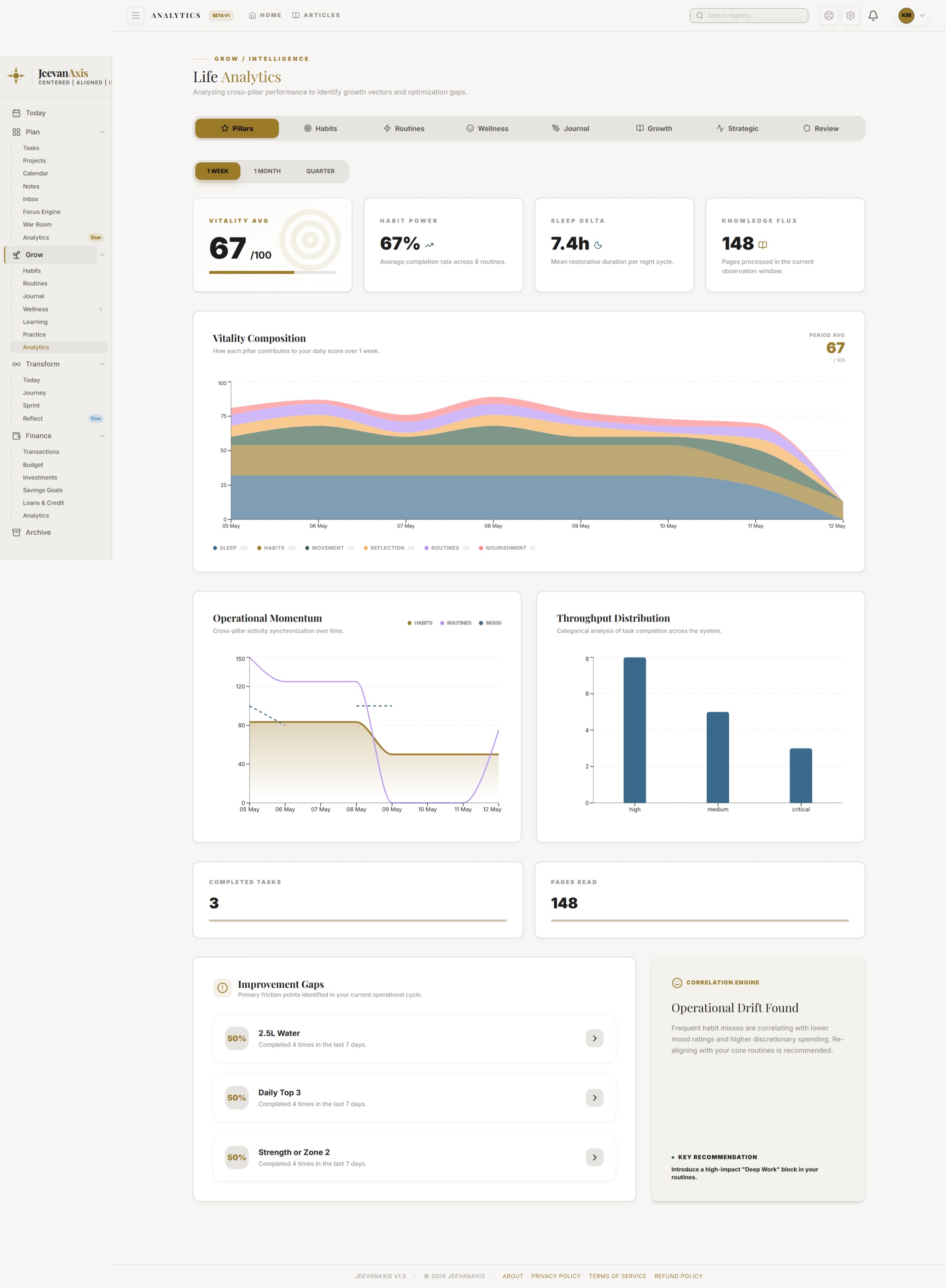
The Vitality Score is a 0-100 gauge of your biological and psychological readiness, calculated from sleep, habits, exercise, nutrition, and journaling. This guide breaks down the math and shows how to improve it.

JeevanAxis Vitality Score

Section Protocol
The Dashboard of Your Human Machine

You would not drive a high-performance vehicle without looking at the dashboard. You monitor the fuel gauge, the engine temperature, and the tire pressure. Yet, most people operate their most critical asset—their mind and body—completely blind. They guess at their readiness. They mistake fatigue for laziness or caffeine-induced anxiety for actual energy.

The Vitality Score is your dashboard. It is an algorithmic synthesis of your foundational behaviors, compressed into a single, brutally honest number between 0 and 100. It removes self-deception from the equation. When your score is 92, you have the biological clearance to push yourself to the absolute limit. When your score is 45, the system is flashing red; attempting deep work or heavy physical exertion is not just inefficient, it is reckless.

This score is not arbitrary. It is derived from five critical inputs: Sleep Quality, Habit Completion, Exercise Frequency, Nutrition Consistency, and Journal Regularity. These are the pillars of peak performance. The JeevanAxis engine weights these inputs dynamically to give you a real-time assessment of your operational capacity.

Understanding how to read this score, decode its constituent parts, and systematically optimize the weakest links is the essence of mastering the Grow Module. This guide will dismantle the Vitality Score mechanics so you can wield it effectively.

Section Protocol
The Five Inputs of Vitality

To manipulate the output, you must understand the inputs. The Vitality Score is a composite, but its true utility lies in examining the underlying radar chart that feeds it.

Tactical Logic Visualization
SYNTHESIZING DIAGRAM…
  1. Sleep Quality (The Anchor): This is heavily weighted because sleep is the ultimate performance-enhancing state. Without adequate rest, every other metric degrades. The algorithm looks at duration, consistency of sleep schedule, and subjective quality ratings.
  2. Habit Completion (The Momentum Metric): This measures your adherence to your daily non-negotiables. It reflects discipline. High habit completion indicates strong executive function and forward momentum.
  3. Exercise Frequency (The Output Metric): Physical exertion drives physiological adaptation. This input tracks your consistency in moving your body, whether it is heavy resistance training, cardiovascular work, or active recovery.
  4. Nutrition Consistency (The Fuel Metric): You cannot outwork a terrible diet. This metric tracks your adherence to your nutritional protocols, monitoring the stability of the fuel you provide your system.
  5. Journal Regularity (The Clarity Metric): Cognitive load must be managed. Regular journaling and reflection act as a pressure release valve for the mind, ensuring psychological readiness and focus.

Section Protocol
Decoding the Radar Chart

The single number (e.g., 78) is useful for a quick glance, but the Radar Chart is where the tactical analysis happens. The Radar Chart visually maps the five inputs, instantly revealing the asymmetry in your routines.

Tactical Logic Visualization
SYNTHESIZING DIAGRAM…

A perfectly optimized life yields a large, symmetrical pentagon. But reality is rarely perfect. You will often see a 'collapsed axis.'

For example, your Habit, Exercise, and Nutrition axes might be pushed to the perimeter, indicating strong discipline. However, if your Sleep axis is collapsed near the center, the entire system is compromised. Your high score in exercise is essentially being fueled by cortisol and adrenaline, a state that is unsustainable and precedes burnout.

The Radar Chart forces you to confront your blind spots. It prevents you from using success in one area (e.g., crushing workouts) to rationalize failure in another (e.g., sleeping 4 hours a night). The goal is structural integrity.

Section Protocol
Analyzing the 30-Day Trend Line

Day-to-day fluctuations are inevitable. A single bad night of sleep will dent your score, but it does not indicate systemic failure. The 30-Day Trend Line is the ultimate arbiter of truth.

Tactical Logic Visualization
SYNTHESIZING DIAGRAM…

The trend line smooths out the noise and reveals your trajectory. Are you slowly degrading over the course of the month? Or are you steadily building resilience?

When you observe a downward slope, it is a leading indicator of burnout. Your Vitality Score will often begin to decline days or weeks before you consciously register the physical or mental symptoms of exhaustion.

Use the trend line predictively. If the slope is negative, preemptively schedule recovery days. Do not wait until the system breaks to attempt to fix it. Deliberate down-regulation is a hallmark of elite performance.

Section Protocol
The Strategy: Optimize the Lowest Input

When your score is suboptimal, the instinct is often to work harder at the things you are already good at. If you are stressed, you might try to hit the gym harder. This is a strategic error. The highest ROI comes from optimizing the lowest input.

Tactical Logic Visualization
SYNTHESIZING DIAGRAM…

If your Nutrition score is at 90 but your Sleep score is at 30, improving your diet further will yield negligible gains to your overall Vitality. However, implementing a strict digital sunset to improve your sleep from 30 to 60 will radically transform your cognitive baseline.

Always attack the collapsed axis first. This is the bottleneck in your human system. Once you elevate the lowest input, you raise the floor of your performance, creating a more stable foundation for high-level output.

Section Protocol
Calibrating Output to Vitality

Your Vitality Score should dictate your daily planning. It is foolish to schedule your most demanding deep work on a day when your Vitality is 42.

When Vitality is High (85-100): This is the time for maximum exertion. Tackle the hardest cognitive tasks. Push for personal records in the gym. Have the difficult conversations. Your system has the resilience to handle massive stress.

When Vitality is Moderate (60-84): Maintain the baseline. Execute standard operating procedures. Focus on consistency rather than heroic efforts.

When Vitality is Low (<60): Pivot to preservation mode. Cancel non-essential meetings. Shift deep work to administrative tasks. Prioritize recovery protocols (sleep, hydration, light mobility). A low score is a mandate to rest, not a challenge to push through.

Section Protocol
Common Pitfalls and How to Avoid Them

The Vitality Score is a tool, and like any tool, it can be misused. Be aware of these common traps.

Common Traps

Section Protocol
The Vitality Optimization Checklist

Use this checklist to systematically improve your baseline score over the next two weeks.

Integration Checklist

Section Protocol
Evaluate Your Baseline

Reflect on your current operational state and how you monitor your readiness.

Reflection Prompts

"

Executive Summary

The Vitality Score is your operational dashboard, synthesizing Sleep, Habits, Exercise, Nutrition, and Journaling into a single readiness metric.

By analyzing the Radar Chart to identify your weakest inputs and monitoring the 30-Day Trend Line for burnout warnings, you can systematically engineer peak performance.

Stop guessing at your energy levels and start calibrating your daily output to your biological reality.

Always attack your lowest score first to build a resilient, high-functioning system.

Intelligence Pipeline

Ready to Deploy Your Life OS?

Experience the full power of integrated intelligence. Stop managing apps and start operating your life.

Launch Command Center