Return to Intelligence Bank
Intelligence Brief
ID: HOW-TO-USE-LEARNING-LOG

How to Use the Learning Log for Knowledge Retention

Capture key insights from books, articles, and videos, and extract actionable insights to apply to your projects.

Operation ZoneGROW MODULE
Read Duration8 MIN
LEARNINGINSIGHTSBOOKSKNOWLEDGE

How to Use the Learning Log for Knowledge Retention

Operational Directive

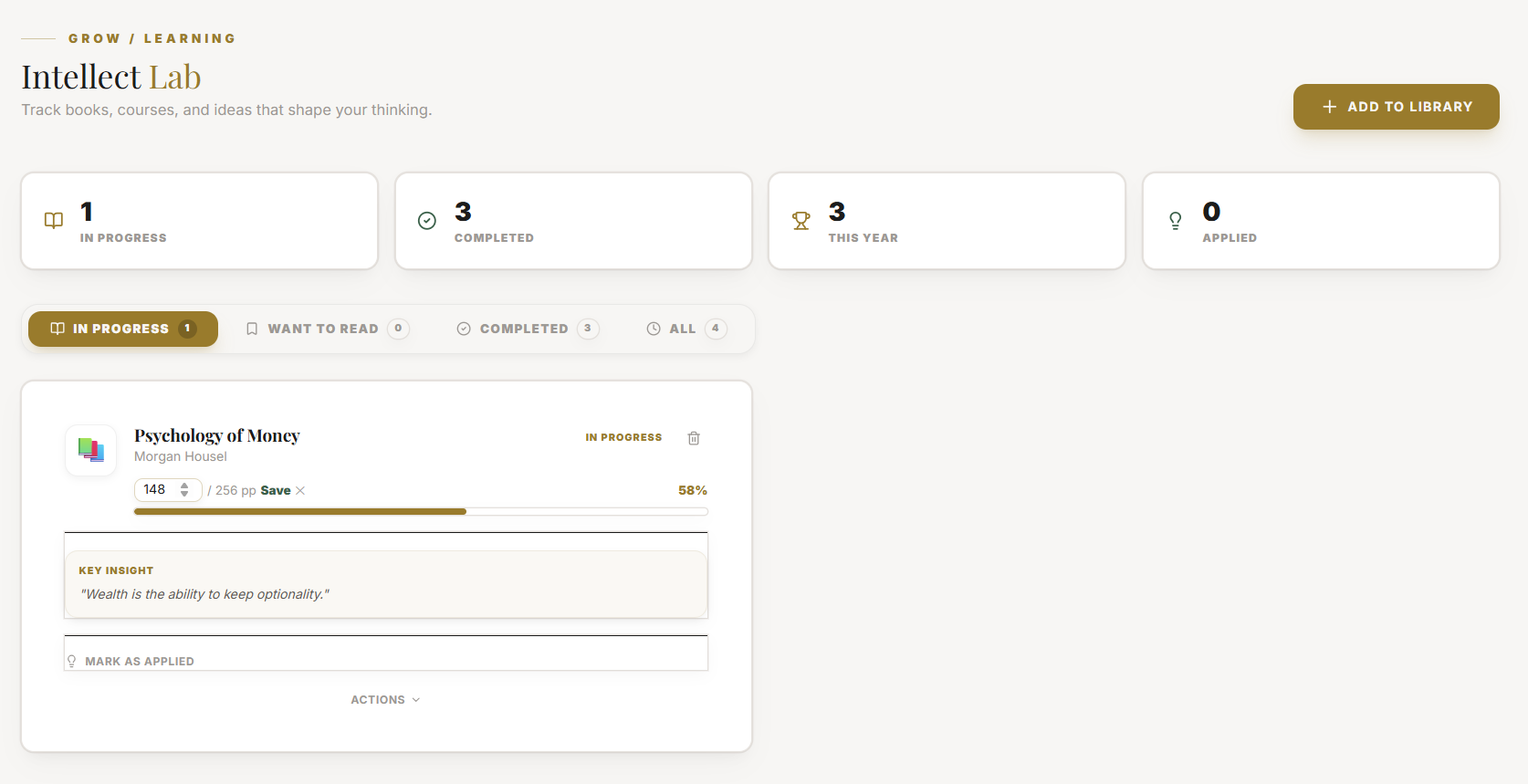
The Learning Log captures key insights from books, articles, and videos. This guide shows how to log sources, extract actionable insights, and apply them to your projects.

JeevanAxis Learning Log

Section Protocol
The Philosophy of Active Capture

Knowledge without application is merely entertainment. In the modern era, we are bombarded with an unprecedented volume of information—articles, podcasts, videos, and books. We consume voraciously, yet retain a fraction of what we ingest. The Learning Log within the JeevanAxis Grow Module is designed to fundamentally alter your relationship with information. It transitions you from a passive consumer into an active architect of your intellectual growth.

When you passively read a book or watch a video, the half-life of that knowledge is startlingly short. Within days, the nuances fade, leaving only a vague conceptual imprint. The Learning Log arrests this decay. By forcing you to articulate what you have learned in your own words, you strengthen the neural pathways associated with that information.

This process is not about transcribing entire chapters or taking exhaustive notes. It is about extraction and distillation. You are panning for gold. When you encounter a concept that shifts your perspective, solves a lingering problem, or provides a new mental model, that is the raw material the Learning Log demands.

The goal is to build an external brain, a repository of high-signal insights that you can query, combine, and deploy. Every entry in your Learning Log should be treated as an asset—a tool you are sharpening for future battles. The following sections will guide you through the optimal workflow for utilizing this powerful feature.

Section Protocol
The Input Pipeline: Categorizing Your Sources

Before you can extract value, you must organize the influx of data. The Learning Log allows you to categorize your inputs efficiently. Understanding the taxonomy of your sources is the first step toward effective knowledge management.

Tactical Logic Visualization
SYNTHESIZING DIAGRAM…

Different sources require different capture strategies. A dense philosophical text will yield insights differently than a tactical business podcast.

  1. Books and Long-form Text: These are your heaviest investments. Do not rely on memory. Highlight extensively, but more importantly, write marginalia. When you finish a reading session, immediately transfer the 1-3 most profound insights into the Learning Log.
  2. Podcasts and Audio: Audio is notoriously difficult to capture because you are often multi-tasking (driving, exercising). Use voice memos to capture fleeting thoughts, then process these into the Learning Log when you are back at your workstation.
  3. Videos and Lectures: Treat these like a university course. Pause frequently. If a visual model is presented, describe it in your Learning Log or replicate the core logic.
  4. Articles and Papers: These are high-velocity inputs. Read them with a specific question in mind. If the article answers the question, log the answer and discard the rest.

By actively categorizing your sources, you prime your brain to anticipate the type of extraction required.

Section Protocol
Distillation: From Raw Data to Key Insights

The most critical field in the Learning Log is the 'Key Insight'. This is where synthesis happens. A poor insight is just a summary. A powerful insight is a truth you can wield.

Tactical Logic Visualization
SYNTHESIZING DIAGRAM…

When crafting your Key Insight, avoid the temptation to copy and paste the author's words directly. While a direct quote can be powerful, it often allows your brain to bypass the hard work of understanding. Force yourself to articulate the concept as if you were explaining it to an intelligent peer.

Ask yourself: "What is the fundamental mechanism at play here?" If an author spends twenty pages describing a historical event to illustrate the concept of 'compounding,' your insight should not be about the historical event. It should be a crisp definition of compounding and the specific variables that govern it.

Keep your insights atomic. One idea per entry. If a chapter contains three brilliant ideas, create three separate Learning Log entries. This atomization makes your knowledge base modular and highly searchable. You can mix and match atomic insights to form new, original thoughts later.

Section Protocol
The Crucible: The Application Note Field

Knowledge becomes power only through application. The 'Application Note' field is what separates the JeevanAxis Learning Log from a standard note-taking app. This field demands that you bridge the gap between theory and practice.

Tactical Logic Visualization
SYNTHESIZING DIAGRAM…

An insight is inert until you attach it to a specific context in your life. The Application Note forces you to answer the question: "How does this change my behavior, my decisions, or my projects?"

If you log an insight about 'time-blocking,' your Application Note should not say, "I should try this." It should say, "I will time-block 9 AM to 11 AM tomorrow for deep work on the Q3 Marketing Strategy, disabling all Slack notifications."

If you log an insight about 'negotiation leverage,' your Application Note might read: "In the upcoming vendor meeting on Tuesday, I will use this concept by establishing my BATNA before entering the room."

The specificity of the Application Note dictates the likelihood of implementation. Vague applications lead to inaction. Concrete, time-bound applications drive behavioral change.

Section Protocol
Retrieval: Engineering Serendipity

A massive repository of insights is useless if you cannot retrieve the right information at the right time. The true power of the Learning Log emerges when you have accumulated hundreds of entries and begin to see unexpected connections.

Tactical Logic Visualization
SYNTHESIZING DIAGRAM…

Use tags ruthlessly. Tag by topic (e.g., #leadership, #psychology, #design), but also tag by context (e.g., #writing, #decision-making, #conflict-resolution).

When facing a new project or a difficult problem, make it a habit to query your Learning Log first. Search for keywords related to the problem. You will often find that an insight you logged months ago from a seemingly unrelated field provides the exact mental model you need to break the impasse.

This process engineers serendipity. It allows ideas from disparate domains to collide and cross-pollinate, fostering true creativity.

Section Protocol
Building the Learning Habit

Consistency is the bedrock of growth. The Learning Log is not designed for sporadic bursts of intense studying; it is built for continuous, daily incremental improvement.

Integrate the Learning Log into your daily routine. Perhaps it is 15 minutes every evening where you process the highlights from your day's reading. Or perhaps it is a Sunday ritual where you distill the most important concepts you encountered throughout the week.

The friction must be minimal. Keep the app accessible. When an idea strikes, capture it immediately, even if it is just a rough draft, and refine it during your dedicated processing time.

Over months and years, this daily habit will construct an intellectual fortress. You will no longer be someone who just reads books; you will be someone who absorbs them, weaponizes their concepts, and deploys them to achieve your goals.

Section Protocol
Common Pitfalls and How to Avoid Them

Even with the best intentions, it is easy to fall into traps that undermine the effectiveness of the Learning Log. Be vigilant against these common failure modes.

Common Traps

Section Protocol
The Optimal Workflow Checklist

Follow this checklist to ensure you are maximizing the ROI of every minute you spend learning.

Integration Checklist

Section Protocol
Evaluate Your Knowledge Systems

Take a moment to critically assess your current relationship with information consumption.

Reflection Prompts

"

Executive Summary

The Learning Log is the engine of your intellectual compounding.

By rigorously capturing, distilling, and applying high-signal information, you transition from passive consumption to active mastery.

The true value lies not in the volume of data stored, but in the precision of the Application Notes that translate theory into tangible behavioral change.

Treat your Learning Log as an active asset, query it frequently, and let it drive your daily decisions.

Intelligence Pipeline

Ready to Deploy Your Life OS?

Experience the full power of integrated intelligence. Stop managing apps and start operating your life.

Launch Command Center