How to Use the Knowledge Base (Zettelkasten)
Build a second brain using interconnected notes, bidirectional linking, and a network graph for emergent ideas.
How to Use the Knowledge Base (Zettelkasten)
Operational Directive
A personal knowledge base ensures your ideas compound rather than expire. This guide teaches you how to build a Zettelkasten using bidirectional links and network graphs.
Section ProtocolThe Compounding Nature of Knowledge
Most note-taking systems are designed like filing cabinets: hierarchical, rigid, and ultimately disconnected. You create a folder, you place a document inside, and unless you explicitly search for it, that document remains isolated and inert.
The JeevanAxis Knowledge Base operates on a fundamentally different paradigm. It is designed as a network, mimicking the associative structure of the human brain. This is the essence of the Zettelkasten method.
Knowledge does not grow linearly; it compounds. When you connect two disparate ideas, you create a third, emergent concept.
The value of a Knowledge Base is not measured by the sheer volume of notes it contains, but by the density and quality of the connections between those notes.
By utilizing bidirectional linking, the Knowledge Base ensures that every piece of information is contextualized, easily discoverable, and actively contributes to your intellectual development.
Your objective here is not simply to store information, but to build an external cognitive engine. This requires a shift in how you interact with the content you consume.
You must transition from a passive collector of facts to an active synthesizer of ideas. Every article read, every book finished, every significant insight must be distilled, atomized, and integrated into the network.
Section ProtocolCore Principles of the Zettelkasten
To build a functional Zettelkasten within the JeevanAxis Knowledge Base, you must adhere to several strict principles. Deviating from these principles will result in a return to the chaotic filing cabinet model.
- ▶The Principle of Atomicity: A note should contain one, and only one, core idea. If a note becomes too long or begins addressing multiple distinct concepts, it must be split.
Atomic notes are the fundamental building blocks of your network. They are modular, allowing them to be combined and recombined in various contexts.
- ▶The Principle of Connectivity: An orphaned note is a useless note. Every new note must be linked to at least one existing note.
If you cannot find a connection, you must question whether the note is truly valuable. Links provide the pathways for traversal and discovery. They are the synapses of your external brain.
- ▶The Principle of Autonomy: While notes must be connected, they must also be understandable in isolation. The logic and context of the idea must be contained entirely within the note itself.
Do not rely on the surrounding structure to provide meaning, as the structure will change as the network evolves.
Section ProtocolConstructing the Network
The mechanics of building the network rely heavily on bidirectional linking. When you create a link from Note A to Note B, the system automatically creates a backlink from Note B to Note A. This ensures that relationships are inherently reciprocal.
When writing a note, actively scan your existing knowledge base for related concepts. Ask yourself: "In what context will I want to stumble upon this idea again?" Link it to those contexts.
Over time, clusters of related notes will naturally form around specific topics. These clusters represent areas of deep understanding and expertise.
Do not force a rigid taxonomy onto the network prematurely. Allow the structure to emerge organically from the connections.
Use index notes or Maps of Content (MOCs) only when a specific cluster becomes too dense to navigate efficiently. An index note simply serves as a central hub, providing a curated list of links to related atomic notes.
⚠Common Traps
Section ProtocolNavigating the Network Graph
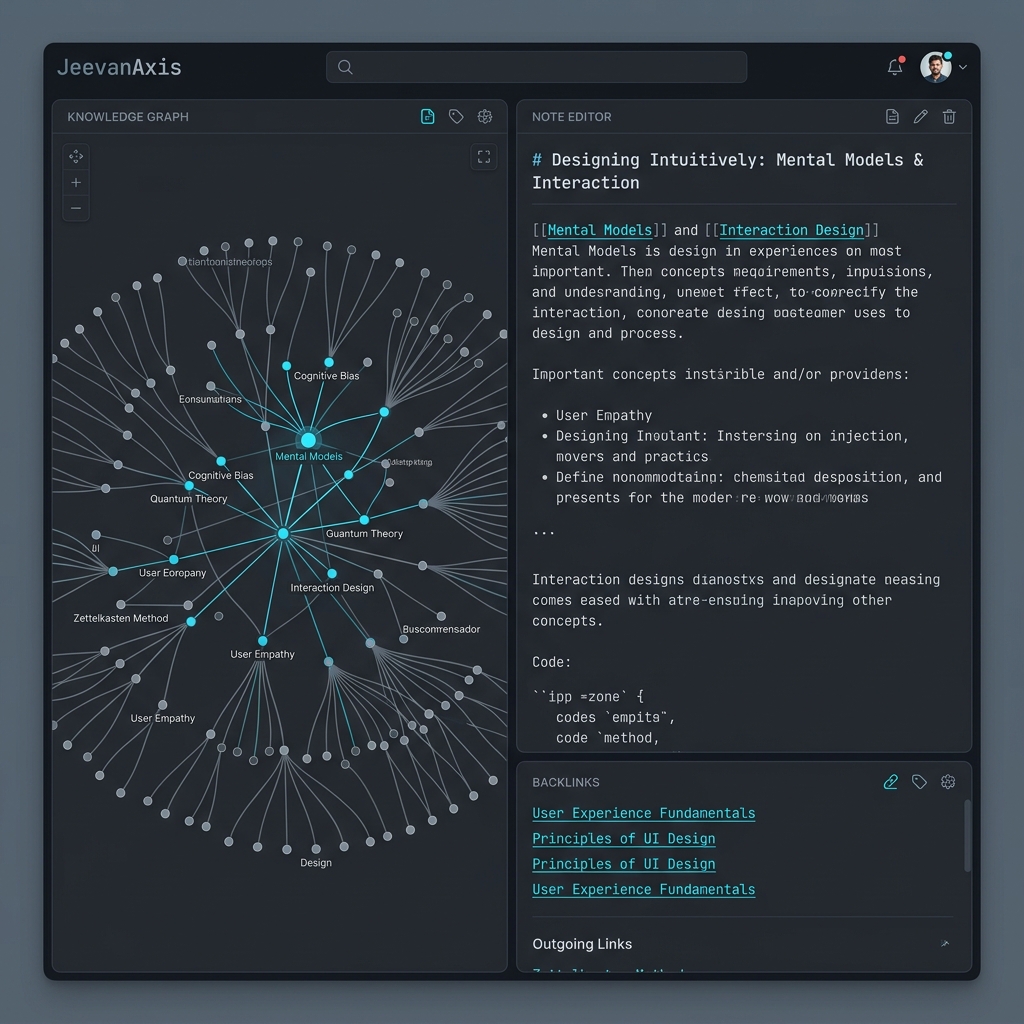
The Network Graph is the visual representation of your Zettelkasten. It provides a macro-level view of your knowledge, displaying nodes (notes) and edges (links). This is not just a cosmetic feature; it is a powerful analytical tool.
By examining the graph, you can identify central hubs—notes with a high degree of connectivity. These are your foundational concepts, the pillars of your understanding.
Conversely, you can identify sparse areas or isolated clusters, indicating areas where your knowledge is fragmented or underdeveloped.
Use the graph to intentionally create serendipity. Trace paths between seemingly unrelated concepts. Often, the most profound insights arise from connecting disciplines that are traditionally separated.
The visual nature of the graph makes these non-obvious connections apparent.
Section ProtocolThe Idea Emergence Process
When you link enough atomic notes together, the system begins to push ideas back to you. This is the phenomenon of emergence.
Instead of starting from a blank page, you start from a dense web of interconnected thoughts. The Knowledge Base acts as a conversational partner.
As you navigate through backlinks, you will often find that an idea you wrote months ago perfectly solves a problem you are facing today. The network bridges the temporal gap between your past self and your present context.
This makes content creation—whether writing an essay, planning a project, or making a strategic decision—frictionless and highly robust.
✓Integration Checklist
Section ProtocolAtomic Note Anatomy
The structure of an individual note must be disciplined. The title should be a complete thought or a declarative statement, not just a topic. "Capitalism" is a poor title. "Capitalism requires infinite growth in a finite system" is a strong title.
The body should elaborate on the title using your own words. It should be concise and focused entirely on the single atomic idea.
Finally, the bottom of the note should contain references to the source material and outbound links to related notes in your network. This rigorous anatomy ensures that every note is high-value and easily synthesizable.
Reflection Prompts
Executive Summary
▸The JeevanAxis Knowledge Base is designed to externalize and compound your intellect using the principles of the Zettelkasten method.
▸By focusing on atomicity, bidirectional connectivity, and organic emergence, you transition from passive information storage to active knowledge synthesis.
▸The network graph provides the analytical capability to visualize your thought patterns and identify non-obvious insights.
▸Operating this system requires discipline: you must rewrite, link, and synthesize consistently to realize its full potential.
▸The ultimate reward is a mind capable of compounding original thought.
Intelligence Pipeline
Connected Intelligence
Ready to Deploy Your Life OS?
Experience the full power of integrated intelligence. Stop managing apps and start operating your life.
Launch Command Center