How to Use the Brain Dump
Rapidly capture thoughts and tasks to clear your mind, then process them into your action system later.
How to Use the Brain Dump
Operational Directive
The Brain Dump acts as a cognitive release valve. This guide shows you how to separate idea capture from processing to maintain extreme focus.
Section ProtocolThe Necessity of a Cognitive Release Valve
The human brain is optimized for processing information, not storing it. Attempting to hold tasks, ideas, anxieties, and random data points in working memory is highly inefficient and creates significant cognitive load.
This mental friction reduces your capacity for deep work, problem-solving, and sustained focus. The JeevanAxis Brain Dump is engineered specifically to eliminate this load. It serves as an immediate, zero-friction cognitive release valve.
When you are engaged in deep work and a random thought occurs—a task you forgot to do, a brilliant idea for a project, or a sudden realization—you face a choice.
You can either interrupt your current workflow to process that thought, thereby destroying your focus, or you can try to remember it, thereby tying up valuable cognitive resources.
The Brain Dump provides a third option: capture it instantly, without processing, and immediately return to the task at hand.
This separation of capture and processing is the fundamental principle of the Brain Dump. It is an inbox for your mind. It is designed to be chaotic, unorganized, and temporary.
The goal is speed. Get the thought out of your head and into the system as quickly as possible, trusting that the system will handle the processing at a designated later time.
Section ProtocolThe Architecture of Rapid Capture
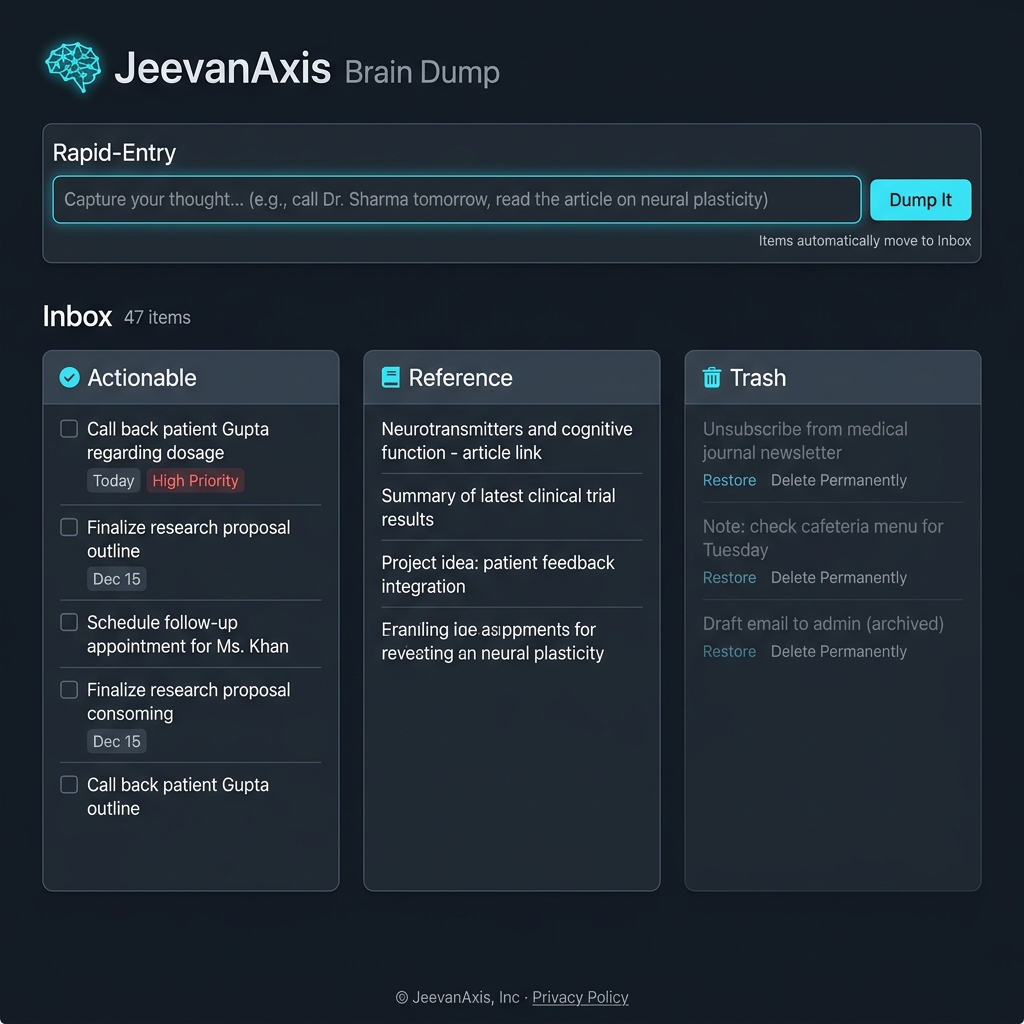
The Brain Dump interface is intentionally minimalist. It lacks formatting options, categorization tags, or complex metadata fields.
These features require decision-making, and decision-making creates friction. Friction is the enemy of rapid capture. When you open the Brain Dump, you should see nothing but a text input field and a submit button.
You must train yourself to reflexively use this tool. Whenever you feel the cognitive pressure of uncaptured information building up, execute a brain dump.
Write down everything. Do not filter. Do not judge. Do not attempt to organize. If you are anxious about an upcoming meeting, write it down. If you remember you need to buy milk, write it down. If you have an idea for a new business, write it down.
The act of writing it down in a trusted system physically relieves the cognitive burden. You no longer have to expend mental energy trying to remember it.
You can confidently close the Brain Dump and return to your primary objective, secure in the knowledge that the information is safe and will be dealt with appropriately during the processing phase.
Section ProtocolThe Processing Protocol: Action, Reference, Trash
Capturing information is only half the equation. A Brain Dump that is never processed rapidly becomes a graveyard of lost ideas and forgotten tasks, ultimately destroying trust in the system.
You must establish a rigorous, recurring protocol for processing the inbox to zero.
Processing is a distinct activity that requires dedicated time and focus. During processing, you must evaluate every single item in the Brain Dump and make a definitive decision about its nature and its destination.
This triaging process relies on a strict trichotomy: Action, Reference, or Trash.
- ▶
Action: Does this item require me to do something? If yes, it is a task. It must be translated into a clear, actionable step and moved to the Plan module. "Buy milk" becomes a task. "Fix the website" becomes a project with defined sub-tasks.
- ▶
Reference: Is this item valuable information that I need to keep, but does not require immediate action? If yes, it is reference material. It must be distilled, rewritten if necessary, and moved to the Knowledge Base, ensuring proper bidirectional links are established.
- ▶
Trash: If the item requires no action and holds no long-term value, it must be deleted immediately. Do not hoard irrelevant data. Be ruthless in your curation. Often, the act of writing down an anxiety is enough to resolve it; the note itself can then be discarded.
⚠Common Traps
Section ProtocolEstablishing the Habit Loop
The effectiveness of the Brain Dump is directly proportional to the strength of the habit. It must become a reflex. You must trust the system completely.
If you doubt whether you will actually process the items later, you will continue trying to hold them in your working memory, negating the entire purpose of the tool.
To establish this trust, your processing routine must be inviolable. Schedule it. Treat the processing phase as a non-negotiable appointment with yourself.
For many, a daily review at the end of the workday is optimal. This ensures that you start the next day with a clear mind and a zeroed-out inbox.
When you successfully decouple capture from processing, you unlock a significant increase in cognitive bandwidth. You are no longer distracted by the constant background noise of unmanaged thoughts. You achieve clarity, focus, and the capacity for sustained execution.
Section ProtocolReduction of Cognitive Load
Physiologically, stress is often generated by open loops—commitments we have made to ourselves but have not tracked in a trusted system.
The Zeigarnik effect states that people remember uncompleted or interrupted tasks better than completed tasks. The Brain Dump short-circuits this effect.
By capturing the open loop, your brain registers the task as "handled" even if it hasn't been completed yet. This dramatically reduces background anxiety and allows your prefrontal cortex to allocate all its energy toward the task immediately in front of you.
Section ProtocolTriaging Matrix Execution
For ultimate efficiency during the processing phase, apply a strict algorithmic approach to triaging.
When you encounter an actionable item, ask the critical question: "Will this take less than two minutes to complete?" If the answer is yes, do not move it to the Plan module. Do it immediately. The overhead of tracking a two-minute task is greater than the effort of simply executing it.
If it takes more than two minutes, defer it by explicitly defining the next physical action required and placing it in your task manager. If it is reference material, process it into an atomic note for your Knowledge Base. If it is neither, destroy it.
✓Integration Checklist
Reflection Prompts
Executive Summary
▸The Brain Dump is an essential cognitive release valve designed to free up working memory and maintain extreme focus.
▸By strictly separating the act of zero-friction capture from the deliberate act of processing, you eliminate the cognitive load of holding onto unorganized information.
▸Success requires ruthless adherence to a processing protocol where every captured item is triaged into Action, Reference, or Trash.
▸Establishing this habit is foundational for achieving clarity and operating the JeevanAxis system effectively.
▸Empty your mind to fill your output.
Intelligence Pipeline
Connected Intelligence
Ready to Deploy Your Life OS?
Experience the full power of integrated intelligence. Stop managing apps and start operating your life.
Launch Command Center