How to Create Morning and Evening Routines
Franklin's two questions — what good shall I do, what good have I done — bracket every day. The 3×3 method for morning and evening hinges.
How to Create Morning and Evening Routines
In his autobiography, Benjamin Franklin reproduced a page from his daily schedule that has been studied ever since — not for its time slots, but for the two questions bracketing it.
The morning block, 5 to 8 a.m., opens with: "The Morning Question: What good shall I do this day?" — followed by washing, addressing "Powerful Goodness," planning the day's business, and breakfast. The evening block holds its mirror: "Evening Question: What good have I done to-day?" — followed by putting things in their places, music or diversion, and an examination of the day.
Notice the architecture. Franklin didn't design a productivity gauntlet — no cold plunges, no 4 a.m. heroics. He built two hinges: a deliberate opening that aims the day before the world does, and a deliberate closing that settles accounts before sleep. Everything between the hinges could be chaos — colonial politics, a printing business, a revolution — but the day was entered and exited on purpose.
That's the whole secret of morning and evening routines, and it's why they outrank nearly every other habit intervention: they occupy the two slots where you have maximum leverage and minimum interference — before the day's demands arrive, and after they've gone.
Section ProtocolWhy the bookends carry the book
The morning sets the day's defaults. The first thirty waking minutes are disproportionately formative — cortisol is naturally peaking (the "cortisol awakening response"), the mind is unclaimed, and whatever enters first tends to govern: check the phone and you've installed the world's agenda; move, hydrate, and write one intention and you've installed yours. There's a second mechanism: a morning routine is a streak of immediate wins — bed made, water drunk, body moved — and progress, even micro-progress, is the strongest known mood-and-motivation fuel. You arrive at the day's first real task already someone who has kept three promises.
The evening determines the morning. This is the part every "miracle morning" guide undersells: the 6 a.m. routine is actually built at 10 p.m. — the phone parked, the lights-out honored, tomorrow's priorities ranked while judgment is still warm, the kit laid out. An evening routine is a gift package addressed to tomorrow-you. And its closing move — Franklin's evening question, a few honest lines — is what lets the day actually end: accounts settled, loops parked on paper, instead of being carried into bed to circle for an hour.
The traditions converge here with unusual unanimity. Ayurveda's dinacharya prescribes the day's opening and closing rituals in detail; the Stoics ran a morning preview (Marcus Aurelius, rehearsing the day's difficulties in advance) and an evening review (Seneca: "I examine my entire day"); monastic hours begin and end in structured practice. Nobody's tradition micromanages 2 p.m. Everyone's tradition owns the hinges.
Section ProtocolBuilding yours: the 3×3 method
Ignore the influencer stack — the two-hour "miracle morning" is a fantasy-self plan that dies on the first school morning. Build each hinge from three moves of three-ish minutes, chosen from three categories:
Morning — body, mind, aim:
- ▶Body: water first; then any movement — stretches, a short walk, surya namaskars.
- ▶Mind: two minutes of quiet — breath, prayer, a settling practice — before any input.
- ▶Aim: Franklin's question in modern form — today's one written priority. One sentence. Before the phone unlocks. (Make the phone physically unavailable until the three moves are done; this single rule is half the routine's power.)
Evening — close, prepare, settle:
- ▶Close: five minutes of shutdown — tomorrow's top three ranked, open loops captured, workspace reset. Cal Newport's "shutdown ritual" research-adjacent advice applies: an explicit end-of-work marker measurably reduces evening rumination.
- ▶Prepare: lay out tomorrow's friction-removers — clothes, bag, breakfast plan. Decisions moved from the weak moment to the strong one.
- ▶Settle: screens down, lights down, and the evening question — three honest lines in a journal. Then the descent ramp to sleep.
Nine minutes a hinge. Anchor each to an immovable event (morning: waking itself; evening: dinner's end or a phone alarm), start at the two-minute versions, and let each hinge thicken only after it survives a month of real life — including the bad weeks, which are, as always, the weeks the routine exists for.
Section ProtocolGuard the hinges, forgive the middle
Two calibrations keep routines humane. First: the routine serves the day, not the reverse. If the checklist itself becomes a stressor — missed steps spawning guilt — shrink it back to its two-minute core; a routine's value is the aiming and the settling, not the item count. Second: protect the hinges especially when the middle collapses. On the deranged days — travel, deadlines, sick kids — the middle of the day will be chaos regardless; the temptation is to abandon the bookends too. Invert it: on exactly those days, the ninety-second morning aim and the three evening lines are what keep the day from becoming the week.
Franklin, by his own cheerful admission, fell short of his schedule constantly — the printing business, he noted, kept wrecking the middle blocks. He kept the questions anyway, for decades. What good shall I do this day? What good have I done today? The middle of a life is mostly weather.
The hinges are yours.
Reflection Prompts
Intelligence Pipeline
Build your hinges in JeevanAxis →
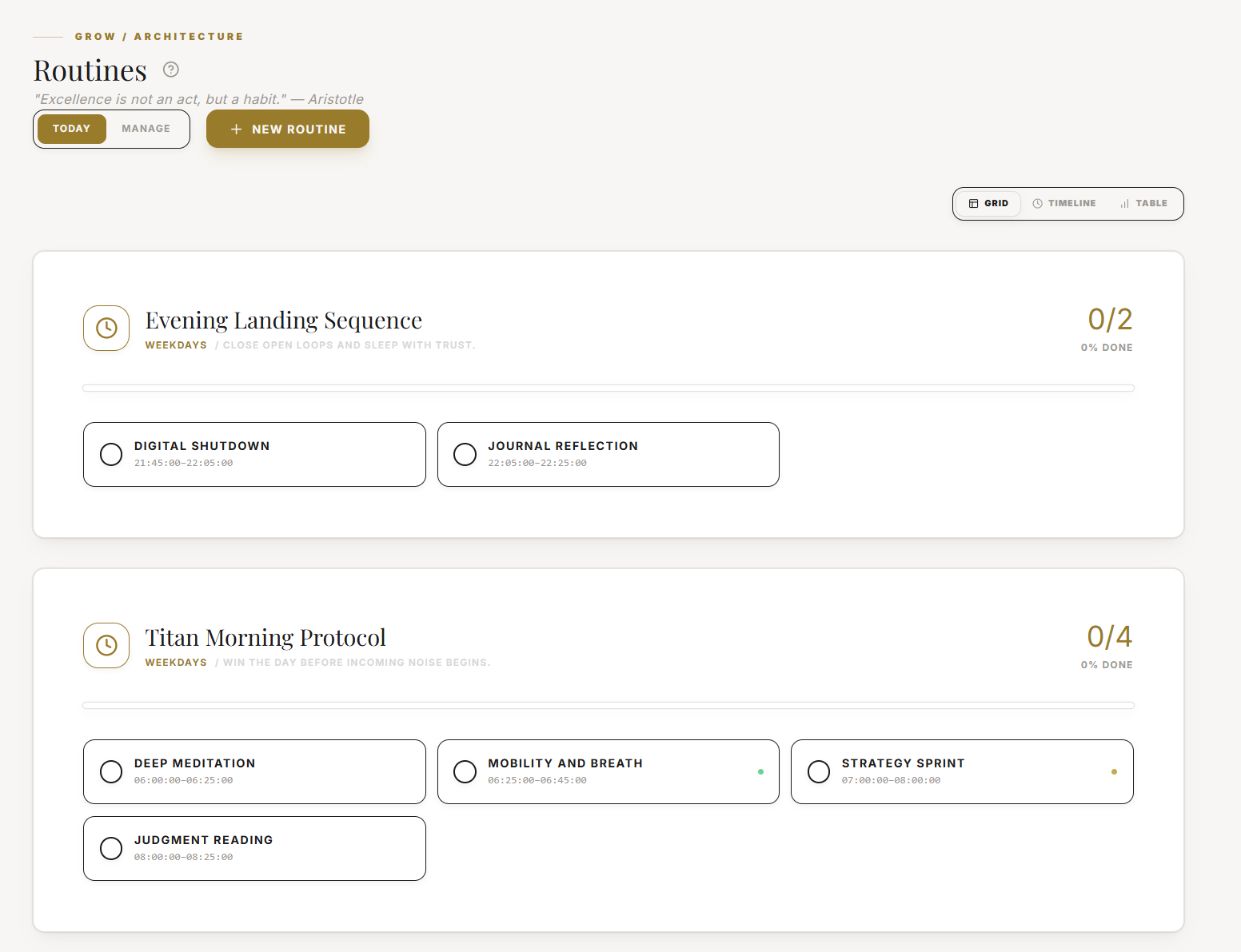
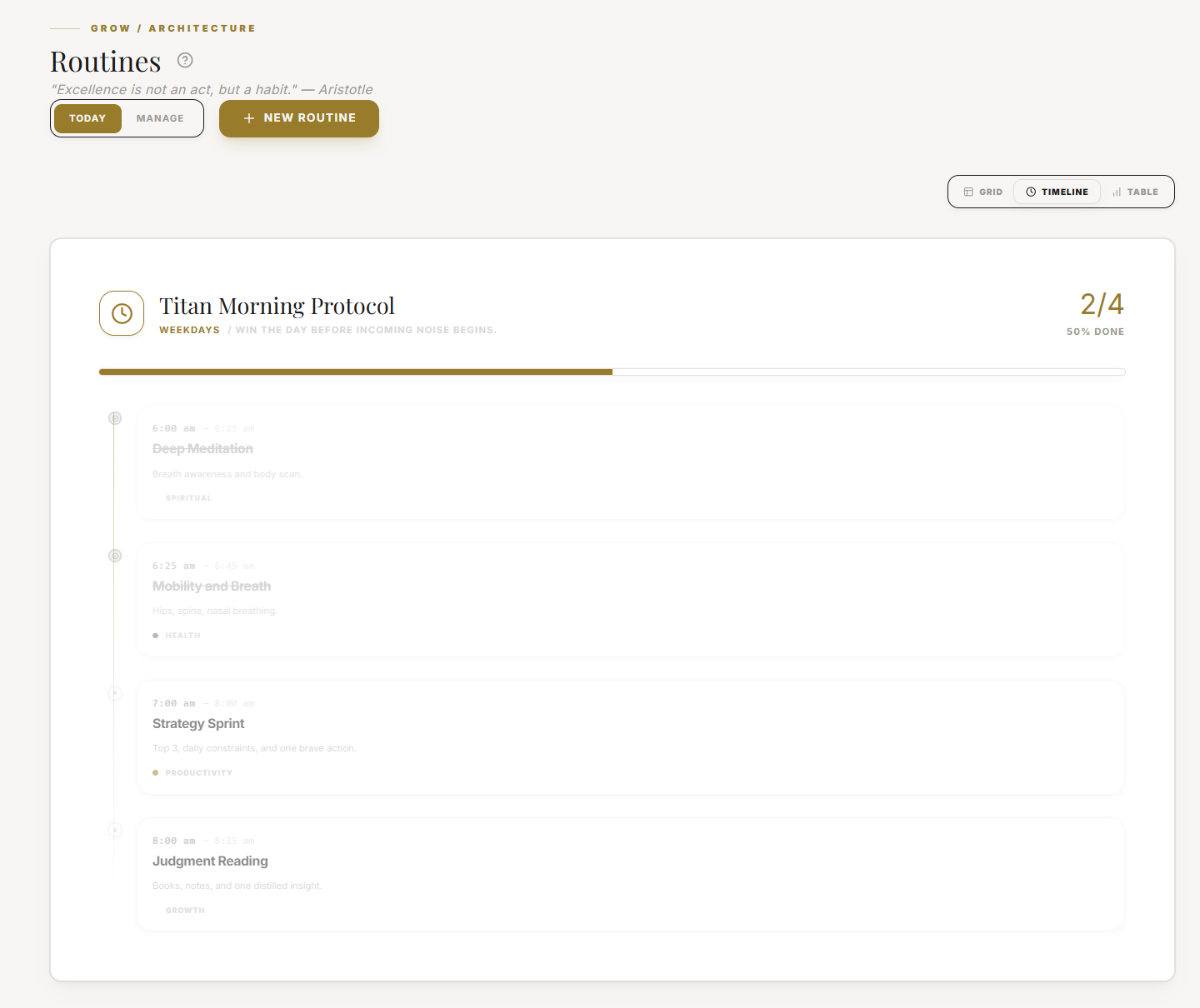
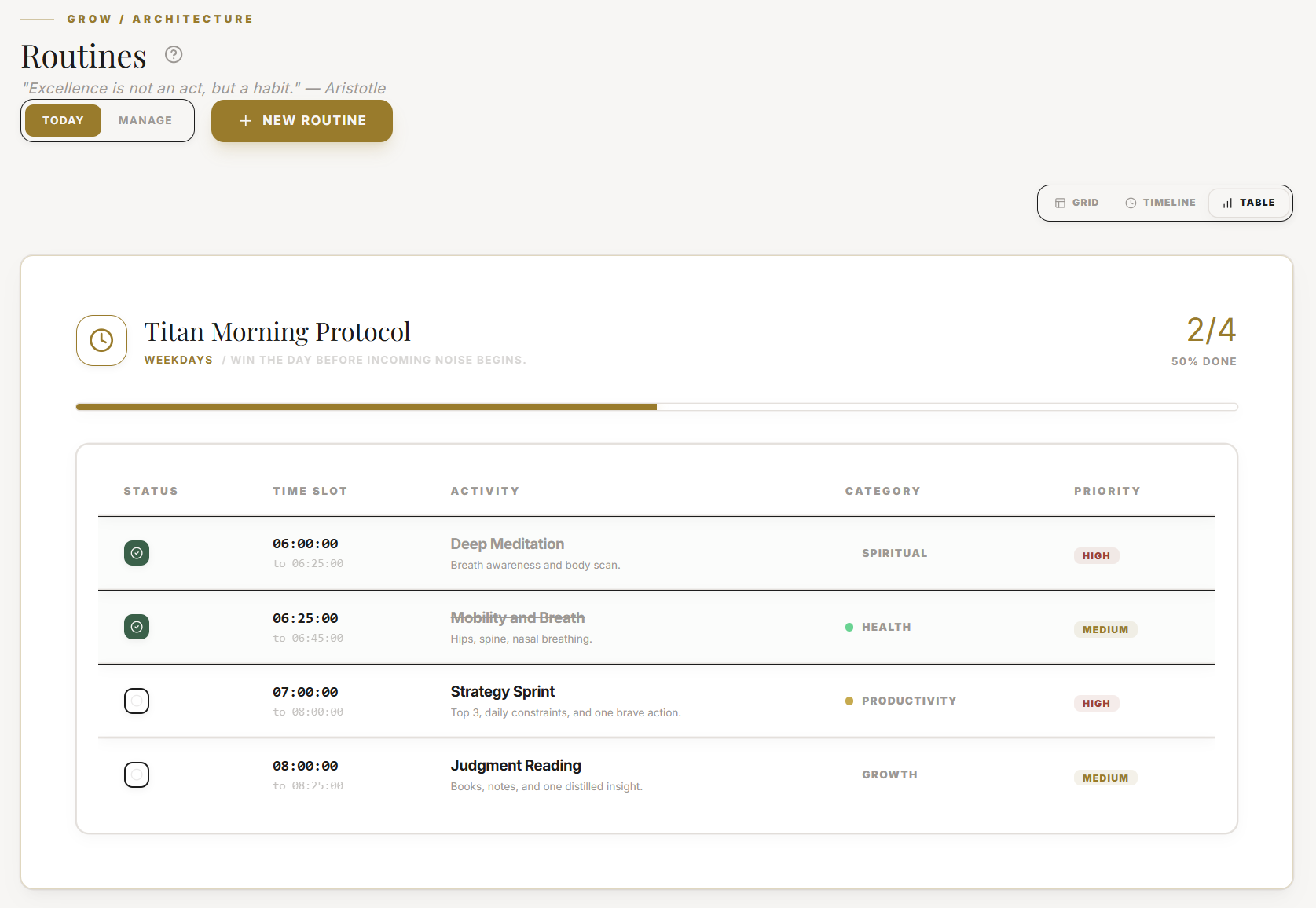
Morning and evening routine checklists with time-of-day contextual shortcuts — the bookends, systematized.
Read next: The Difference Between Habits, Routines, and Rituals Coming soon
Why the three layers do different jobs — and how the bookends use all three.
Connected Intelligence
Ready to Deploy Your Life OS?
Experience the full power of integrated intelligence. Stop managing apps and start operating your life.
Launch Command Center