How to Conduct the Daily Briefing
Prime your morning, review your non-negotiables, and protect your focus before the day begins.
How to Conduct the Daily Briefing
Operational Directive
Section ProtocolThe Philosophy of the Morning
The first sixty minutes of your day dictate the trajectory of the next fourteen hours.
When you wake, your mind is highly impressionable.
The cortisol awakening response is active, preparing your biology for the demands of existence.
If you allow the external world—in the form of emails, news, or social media—to dictate this initial input, you instantly surrender your agency.
You become a reactive entity, constantly responding to the priorities of others rather than executing your own.
The Daily Briefing is the structural countermeasure to this chaos.
It is a deliberate, systematic protocol designed to establish an operational baseline before you engage with the world.
It forces you to confront reality, assess your current biological and cognitive capacity, and lock in the non-negotiable actions that drive forward momentum.
Think of it as the pre-flight checklist for a high-performance aircraft.
A pilot does not simply ignite the engines and hope for the best.
They systematically verify the integrity of the critical systems, calculate the necessary parameters for the flight, and establish contingencies for potential failures.
Your mind and body require the same level of rigorous preparation.
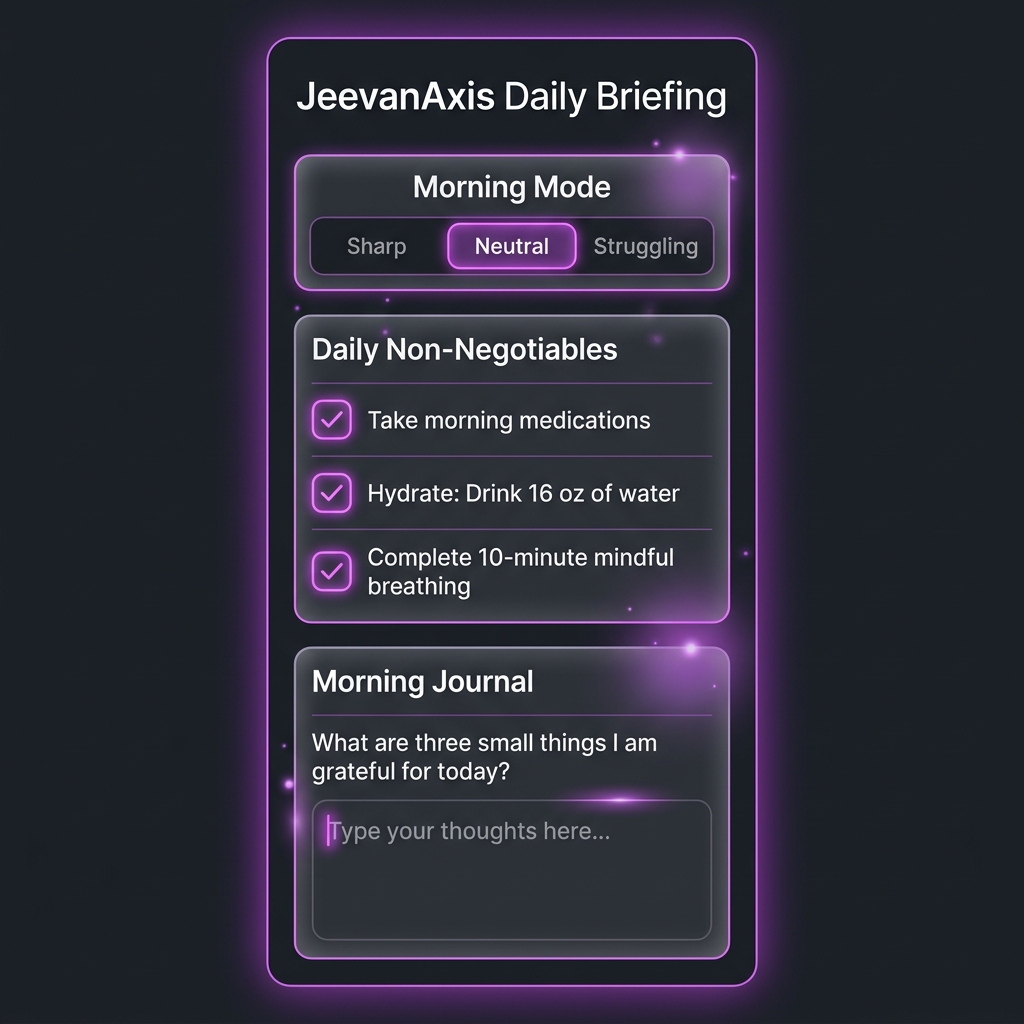
Section ProtocolThe Neuroscience of the Morning
To understand the absolute necessity of the Daily Briefing, one must understand the basic neuroscience of the waking brain.
Upon waking, your brain transitions from the delta and theta waves of sleep into the alpha and eventually beta waves of alert consciousness.
During this transitional phase, the brain is highly neuroplastic and susceptible to priming.
If the first action you take is to consume high-dopamine, high-stress information—such as a frantic email from a client or the endless scroll of a social media feed—you are actively wiring your brain for reactivity and distraction for the remainder of the day.
You are spiking your dopamine baseline artificially and triggering an unnecessary stress response.
The Daily Briefing leverages this neuroplastic window for strategic advantage.
By engaging in a structured, deliberate sequence of actions—assessing your state, reviewing your goals, and defining your objective—you are priming your dopaminergic system for focused execution.
You are training your brain to seek the reward of completing meaningful, high-leverage tasks rather than cheap digital stimulation.
This is not merely a psychological trick; it is a physiological reprogramming of your reward circuitry.
Section ProtocolAssessing Your Morning Mode
You are a biological system, not a machine.
Your capacity for output fluctuates based on sleep quality, physical recovery, residual stress, and nutritional status.
The Daily Briefing begins with a ruthlessly objective assessment of your current state.
The objective here is not to artificially inflate your energy levels through excessive stimulation, but to align your expectations and operational strategy with your physiological reality.
We categorize this biological baseline into three distinct operational states: Morning Modes.
TACSharp Mode
When you wake up in Sharp Mode, your system is fully optimized.
You have achieved restorative sleep, your mind is clear, and your physical energy is abundant.
This is a state of maximum cognitive bandwidth.
The protocol dictates that you must fiercely protect this state.
Do not squander Sharp Mode on low-leverage administrative tasks, email processing, or trivial communications.
Immediately direct this concentrated energy toward your most complex, high-impact objectives.
TACNeutral Mode
Neutral Mode is the standard operating baseline.
You are neither exceptionally energized nor severely depleted.
The majority of your days will fall into this category.
The strategy here is steady, disciplined execution.
You process your standard routine, execute your Non-Negotiables, and chip away at your primary objectives with consistent effort.
TACStruggling Mode
Struggling Mode occurs when your system is compromised.
This could be due to sleep deprivation, illness, intense psychological stress, or physical exhaustion.
In this state, your cognitive bandwidth is severely limited.
Attempting to force high-level output in Struggling Mode often leads to errors, frustration, and further depletion.
The protocol requires a shift from optimization to survival.
You must trigger your Minimum Viable Day (MVD) protocols, executing only the absolute minimum required to prevent systemic collapse, and ruthlessly eliminating all non-essential friction.
Section ProtocolThe Daily Non-Negotiables Check
Once your operational mode is established, you must immediately confront your Non-Negotiables.
These are the foundational actions that maintain the structural integrity of your system.
They are not aspirational goals or "nice-to-haves."
They are the absolute minimum behavioral standards you have committed to upholding, regardless of the circumstances.
Whether your Non-Negotiables include a specific physical training protocol, a period of uninterrupted deep work, or a dietary parameter, they must be explicitly reviewed and locked in during the Daily Briefing.
The danger lies in allowing the friction of the day to erode these standards.
If a Non-Negotiable is at risk due to an unexpected external demand, you must immediately formulate a contingency plan.
The standard is absolute compliance.
By forcing this confrontation during the morning phase, you ensure that these critical inputs are prioritized before the reactive demands of the day can intervene.
⚠Common Traps
Section ProtocolThe Role of Micro-Wins
Momentum is a critical factor in sustained execution.
The Daily Briefing serves as the primary generator of this momentum.
By simply completing the briefing—by successfully navigating the assessment, the review, and the planning phase—you secure your first psychological victory of the day.
This micro-win is essential.
It establishes a pattern of successful execution early in the sequence.
It proves to your subconscious that you are capable of adhering to a structured protocol, which builds self-efficacy and confidence.
This momentum then cascades into the execution of your first Non-Negotiable, and subsequently into the pursuit of your Daily Objective.
Do not underestimate the compounding power of these small, deliberate victories.
Section ProtocolMorning Journal Priming
The human mind, left unguided, defaults to entropy.
It will naturally gravitate toward anxiety, rumination, or the path of least resistance.
Morning Journal Priming is a tactical mechanism for directing cognitive focus and overriding this default state.
It is fundamentally different from passive, reflective journaling.
Priming is an aggressive, forward-looking exercise.
It is the act of extracting intent from the abstract and forging it into concrete directives.
During this phase, you must articulate the specific outcomes you demand from the day.
What is the single most important objective?
What potential obstacles—both internal and external—are likely to arise, and what pre-planned countermeasures will you deploy against them?
What is the dominant operating principle or mindset you must embody to succeed today?
By physically writing these parameters down, you externalize the cognitive load, freeing up working memory while simultaneously committing your subconscious to the required actions.
Section ProtocolSetting the Daily Objective
With your state assessed and your mind primed, you must now lock onto your primary target.
The Daily Objective is the single most critical task that, if accomplished, would render the day a success, regardless of what else occurs.
This requires extreme focus and the willingness to ignore seemingly urgent but ultimately unimportant demands.
The Daily Objective must be hyper-specific.
It must be binary (either it is done, or it is not).
It must be entirely within your sphere of control.
Once selected, this objective becomes the gravitational center of your day.
All other actions, meetings, and communications orbit around its execution.
If the Daily Objective is not met, the day cannot be considered a total success.
Section ProtocolTroubleshooting Common Failures
No system is immune to disruption, and the Daily Briefing will occasionally fail.
The mark of a robust operator is not the absence of failure, but the speed of recovery.
The "Slept In" Scenario:
If you oversleep and the timeline is compressed, do not abandon the briefing entirely.
Execute a truncated version.
Log your Morning Mode, identify your Daily Objective, and immediately begin execution.
A 60-second rapid briefing is infinitely better than chaotic, reactive initiation.
The "Morning Crisis" Scenario:
If a legitimate emergency occurs immediately upon waking (e.g., a critical server failure, a family medical issue), the Daily Briefing must be bypassed to address the immediate threat.
However, once the crisis is stabilized, you must perform a delayed briefing to recalibrate and establish order for the remainder of the day.
The "Apathy" Scenario:
There will be days when you simply do not want to execute the briefing.
Your mind will attempt to convince you that it is unnecessary.
This is the moment where discipline must supersede motivation.
Rely on the mechanical nature of the checklist.
Do not think about the briefing; simply execute the first step, then the next.
Action precedes motivation.
Section ProtocolPreventing Cognitive Overload
The final phase of the Daily Briefing is entirely defensive.
You must analyze your schedule from a high-level perspective and identify potential points of cognitive overload or systemic failure.
Are there dense blocks of back-to-back meetings that will rapidly deplete your mental reserves?
Are you attempting to schedule complex, deep-work tasks during periods where your energy typically dips?
Are there complex logistical transitions that lack sufficient buffer time?
By identifying these friction points in advance, you can deploy preemptive countermeasures.
This might involve artificially inserting buffer blocks between intense sessions, pre-committing to a specific recovery protocol (such as a brief walk or breathwork session), or simply adjusting your expectations for output during those specific periods.
Architecting the day defensively prevents minor localized stressors from cascading into total systemic failure.
Section ProtocolExecution Checklist
To ensure absolute compliance with the protocol, utilize this checklist during your Daily Briefing sequence.
✓Integration Checklist
Section ProtocolReflection & Recalibration
At the conclusion of your briefing, force yourself to confront these questions to ensure alignment.
Reflection Prompts
Executive Summary
▸The Daily Briefing is the foundational protocol for protecting your focus and directing your energy.
▸By systematically assessing your biological state, locking in your non-negotiables, and defining a singular, high-leverage objective, you transform yourself from a reactive participant in your day to an active, dominant architect of your outcomes.
▸Consistency in this practice is the prerequisite for sustained high performance.
▸Do not compromise on this sequence.
Intelligence Pipeline
Connected Intelligence
Ready to Deploy Your Life OS?
Experience the full power of integrated intelligence. Stop managing apps and start operating your life.
Launch Command Center