How to Use Identity Sculpting
Define who you are becoming and use evidence logging to prove your new identity to yourself daily.
How to Use Identity Sculpting
Operational Directive
Identity Sculpting shifts your focus from what you do to who you are. This guide teaches you to define your Active Identity statement and log daily evidence to prove your new identity to yourself, making behavioral change permanent.
Section ProtocolThe Core Concept: Being vs. Doing
Most approaches to self-improvement focus entirely on action: run more, eat better, work harder. This is a flawed paradigm. Actions driven by willpower are temporary. When the willpower depletes, the actions cease, and the individual regresses to their baseline. Identity Sculpting flips the model. Instead of focusing on what you want to achieve, you focus on who you need to become.
True behavioral change is identity change. If you believe you are a smoker trying to quit, every day is a battle against your own nature. If you believe you are a non-smoker, the battle ends. Non-smokers simply do not smoke. Identity Sculpting is the clinical process of overwriting your internal narrative to align with your desired outcomes.
This module will teach you how to define a precise Active Identity, gather incontrovertible evidence to support it, and establish rigid anti-patterns to protect it.
Section ProtocolThe Active Identity Statement
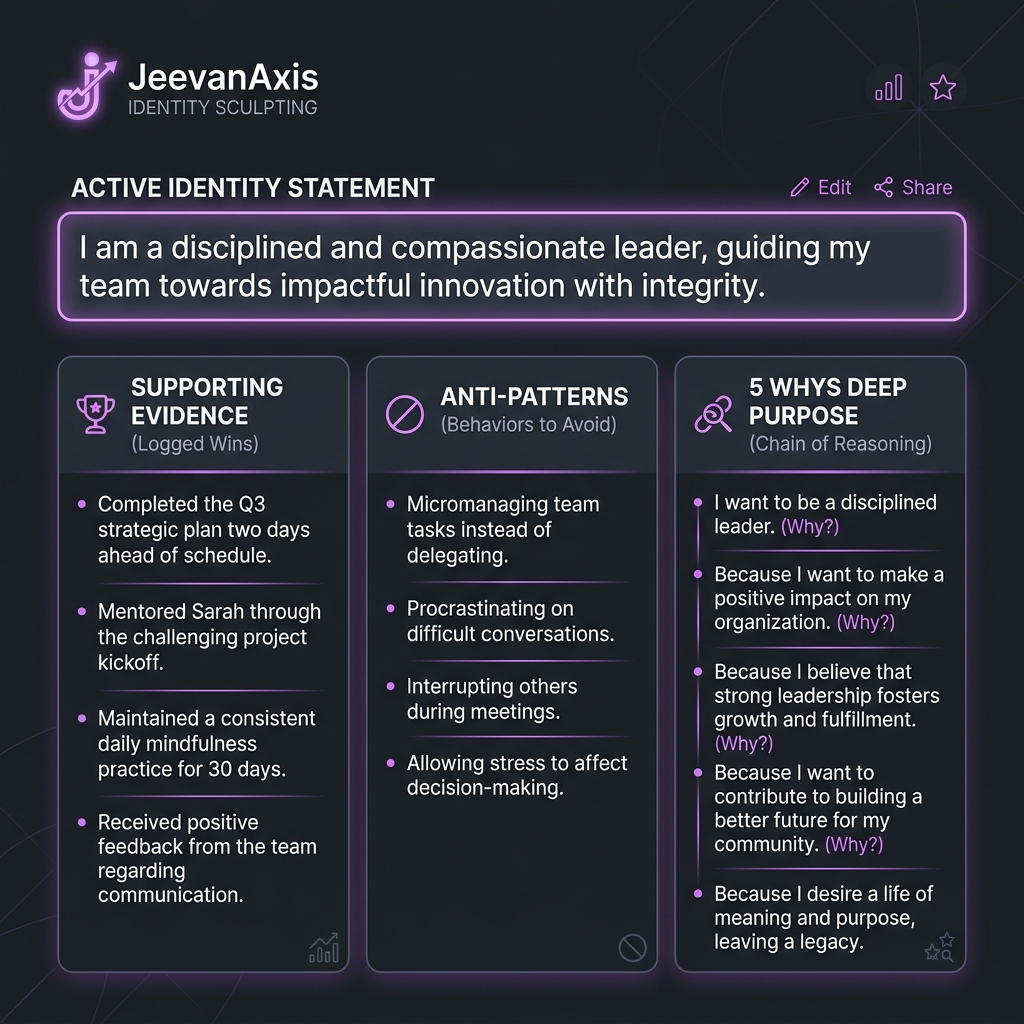
The foundation of Identity Sculpting is the Active Identity statement. This is not a vague affirmation like "I am a good person." It is a sharp, clinical declaration of fact regarding how you operate in the world. Your Active Identity statement must be written in the present tense, framed positively, and inherently actionable.
An effective Active Identity statement serves as a filter for decision-making. When faced with a choice, you run the options through the filter: "Which of these choices aligns with my Active Identity?" The answer dictates your action. There is no debate. There is only execution.
Examples of weak statements: "I want to be fit," or "I will try to be more organized." Examples of strong Active Identity statements: "I am an athlete who trains regardless of convenience," or "I am an operator who executes systems flawlessly."
TACConstructing Your Statement
Constructing your statement requires precision. You must strip away emotion and focus on operational reality. Determine the exact characteristic required to achieve your goals, and claim it immediately.
Section ProtocolLogging Supporting Evidence
An identity statement without evidence is a delusion. The brain is a pattern-recognition machine; it believes what it sees, not what it is told. To overwrite your old identity, you must provide your brain with an overwhelming volume of evidence proving the new identity is real.
This is where the practice of daily logging becomes critical. Every action you take that aligns with your Active Identity is a vote for that identity. If your identity is "I am a disciplined writer," every sentence you write is a piece of evidence. You must log this evidence meticulously within the JeevanAxis system.
TACThe Mechanism of Proof
The mechanism is simple: Action generates evidence, evidence builds belief, belief drives future action. By consistently logging small wins, you create a compounding effect. Eventually, the mountain of evidence becomes undeniable, and your self-image permanently shifts.
Do not wait for massive achievements to log evidence. Did you drink a glass of water instead of soda? Log it. Did you work for 20 focused minutes? Log it. Micro-evidence is just as powerful as macro-evidence when accumulated over time.
Section ProtocolDefining Anti-Patterns (The "Never Do" List)
While logging positive evidence is crucial, defining boundaries is equally important. Anti-patterns are the explicit declarations of what you will never do. They define the edges of your identity, ensuring you do not bleed into destructive behaviors.
An anti-pattern removes the need for in-the-moment decision making. If your anti-pattern is "I never consume sugar after 8 PM," you do not have to debate eating dessert at 9 PM. The decision was made in advance. The debate is closed.
TACThe Power of Absolute Boundaries
Absolute boundaries conserve cognitive energy. When you negotiate with yourself, you drain willpower. Anti-patterns eliminate negotiation. They are binary. You either adhere to them, or you violate your identity. This stark contrast forces compliance and hardens your internal resolve.
Section ProtocolThe 5 Whys Deep Purpose Chain
To sustain a new identity under extreme pressure, you must understand your deepest motivations. Surface-level desires (e.g., "I want to look good") will shatter when things get difficult. The 5 Whys technique is a clinical diagnostic tool used to drill down to your core, unshakeable purpose.
TACExecuting the 5 Whys
Start with your primary goal and ask "Why is this important?" Take the answer to that question, and ask "Why?" again. Repeat this process exactly five times. By the fifth iteration, you will have moved past superficial ego-driven desires and uncovered a deeply rooted psychological driver.
This deep purpose becomes the anchor for your new identity. When the friction of transformation becomes severe, you do not rely on motivation; you rely on the unbreakable tether of your deep purpose.
Section ProtocolCommon Failure Modes
Identity Sculpting is a powerful tool, but it is vulnerable to specific cognitive traps. Review these failure modes and implement defensive strategies to ensure your sculpting process remains intact.
⚠Common Traps
Section ProtocolDeployment Checklist
Follow this checklist to initialize your Identity Sculpting protocol. Ensure every step is completed before moving forward.
✓Integration Checklist
Section ProtocolClinical Reflection
Identity work requires brutal honesty. Use these prompts to examine the integrity of your sculpting process.
Reflection Prompts
Executive Summary
▸Identity Sculpting is the mechanism by which temporary actions become permanent traits.
▸By defining a clinical Active Identity statement, relentlessly logging supporting evidence, establishing rigid anti-patterns, and anchoring it all with the 5 Whys, you rewrite your internal source code.
▸Stop trying to change your habits through sheer force of will.
▸Change your identity, and the habits will naturally follow.
Section ProtocolNext Steps
With your identity sculpted and anchored, you must prepare for the inevitable psychological friction that occurs during transformation.
Intelligence Pipeline
Cognitive Reframing →
Learn to deploy the ABC Model to dismantle irrational beliefs and prevent emotional spirals.
Blueprint Deployment →
Install the habit stacks that will generate the daily evidence needed to prove your new identity.
Identity Analytics →
Monitor your evidence logging consistency to ensure your identity shift is progressing on schedule.
Connected Intelligence
Ready to Deploy Your Life OS?
Experience the full power of integrated intelligence. Stop managing apps and start operating your life.
Launch Command Center