How to Track Income and Expenses
Log daily transactions efficiently and categorize cash flow to understand exactly where your money goes.
How to Track Income and Expenses
Operational Directive
Section ProtocolThe Mechanics of Cash Flow
If accounts are the skeleton of your financial architecture, cash flow is the bloodstream. Income is the vital, life-giving oxygen entering the system. Expenses represent the continuous energy burned to maintain daily operations. If the burn rate consistently exceeds the intake rate, the financial organism will inevitably die. Tracking income and expenses is fundamentally not about restricting joy. It is about acquiring absolute, empirical data regarding your energy consumption. You cannot make strategic, high-level decisions based on gut feelings or vague estimates. You need hard, cold, unassailable, and perfectly accurate numbers. Tracking forces you to relentlessly confront the reality of your daily micro-decisions. That $5 daily coffee is emphatically not a rounding error. It is a recurring, structural leak in the hull of your financial ship. When you track every single transaction, you build a massive, invaluable dataset of your own behavior. This dataset is the raw material required for future optimization and wealth generation. Without the data, you are flying completely blind in a category five hurricane. With the data, you possess the advanced radar necessary to navigate to your exact destination. The JeevanAxis Finance Module provides the sophisticated, precision tools to capture this data. But the iron discipline to actually use those tools must come entirely from you. There are no shortcuts to this specific discipline.
Section ProtocolLogging Transactions
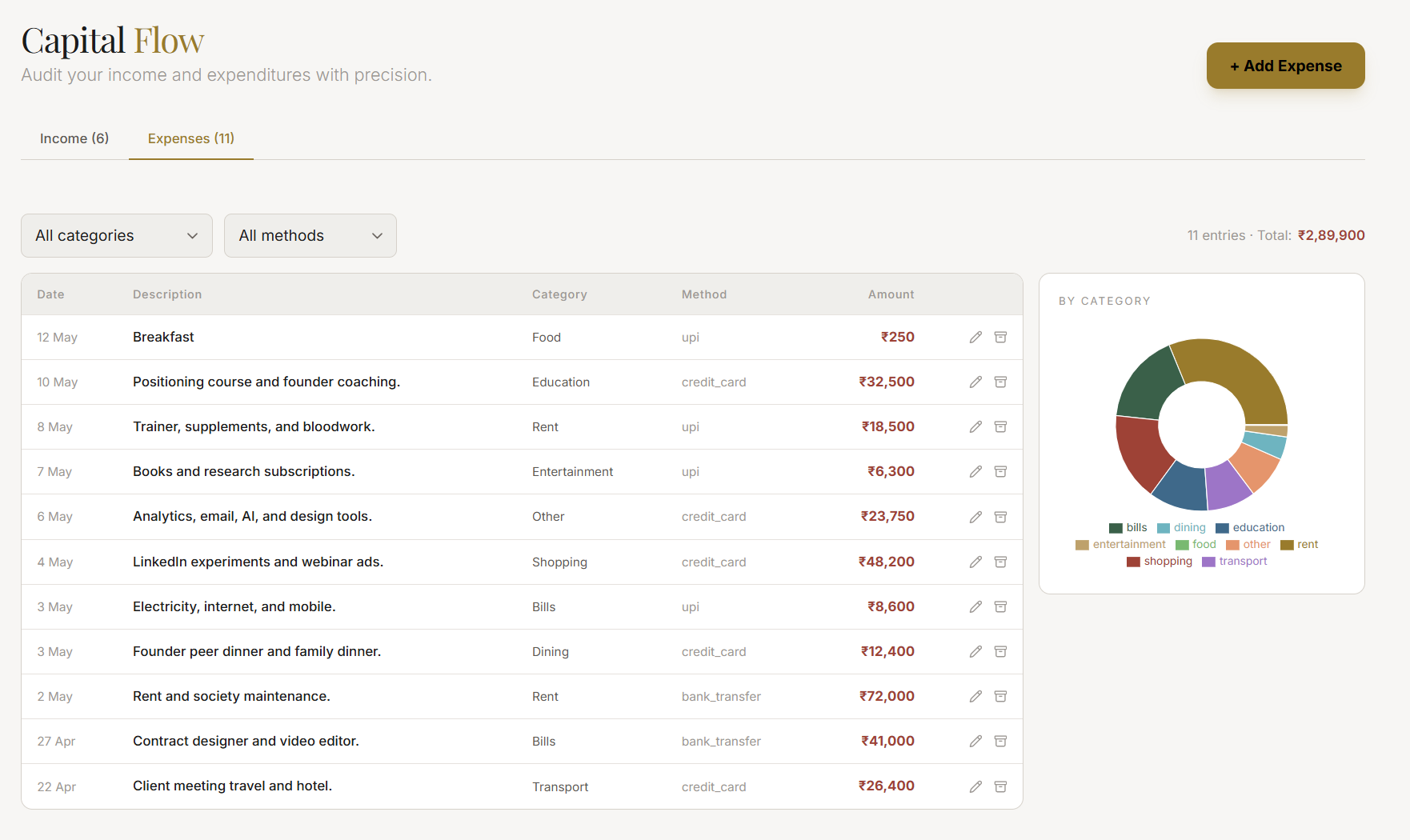
The fundamental, atomic unit of cash flow management is the individual transaction. Every single time money changes hands, a transaction must be permanently logged. There are absolutely no exceptions for small amounts or cash purchases. A leak is a leak, regardless of its microscopic size. A thousand tiny leaks will sink a ship just as surely as one massive hole.
The Rule of Immediate Capture Do not ever wait until the end of the week to log your transactions. Human memory is incredibly flawed, highly biased, and completely unreliable. If you buy something, log it in the JeevanAxis app before you even physically leave the store. This creates immediate, highly effective psychological friction. You immediately feel the visceral reduction in your available resources. This friction is the primary mechanism for long-term behavior modification. If you rely completely on auto-sync, you must still review and approve every transaction daily.
Required Data Points Every logged transaction must contain specific, non-negotiable data points.
- ▶Date: The exact calendar day the transaction physically occurred.
- ▶Payee: Exactly who received the money, or exactly who provided the income.
- ▶Amount: The exact monetary value, measured perfectly down to the penny.
- ▶Account: Which specific structural account the funds entered or exited.
- ▶Category: The specific functional classification of the flow.
If any of these data points are missing, the transaction is invalid.
Section ProtocolCategorizing Cash Flow
Categorization is precisely how you make sense of the raw, chaotic transaction data. A list of a hundred uncategorized transactions is just useless noise. Categorized transactions provide a clear, high-definition picture of your true priorities. Your categories must be completely mutually exclusive and collectively exhaustive. Do not ever create a "Miscellaneous" category. "Miscellaneous" is a cowardly hiding place for undisciplined, embarrassing spending. If an expense does not perfectly fit an existing category, you must thoughtfully define a new, specific one.
Income Categories Income should be strictly categorized by its source and its historical reliability.
- ▶Active Income: Salary, wages, direct consulting fees. (Requires continuous time exchange).
- ▶Passive Income: Dividends, interest, rental yield. (Requires capital deployment, not time).
- ▶Windfalls: Tax refunds, unpredicted bonuses, asset sales. (Unpredictable, one-time events).
Expense Categories Expenses should be strictly categorized by their fundamental necessity and their variability.
- ▶Fixed Survival: Rent, basic utilities, minimum debt service. (Absolutely non-negotiable).
- ▶Variable Operations: Groceries, gas, required household supplies. (Necessary, but highly optimizable).
- ▶Discretionary: Dining out, entertainment, luxury goods. (Entirely optional and easily cut).
By objectively looking at your categorized data, you can instantly see your structural vulnerabilities. If 60% of your total income goes to Discretionary spending, you are highly fragile.
Section ProtocolManaging Split Transactions
Reality is rarely neat, tidy, or perfectly categorized. A single trip to a massive superstore might involve buying groceries, motor oil, and a video game. Logging this as a single $150 "Groceries" transaction fundamentally corrupts your entire dataset. You have effectively, and knowingly, lied to your own ledger. The JeevanAxis module natively supports Split Transactions to solve this exact, common problem. A Split Transaction takes a single, monolithic outflow of cash and meticulously divides it among multiple precise categories.
For the $150 superstore example, you must execute the following:
- ▶Split 1: $90 -> Variable Operations : Groceries
- ▶Split 2: $20 -> Variable Operations : Auto Maintenance
- ▶Split 3: $40 -> Discretionary : Entertainment
Splitting transactions requires extra manual effort and meticulous attention to detail. Do not shy away from this necessary effort. Precision is the exact difference between an amateur guessing and an architect knowing.
Section ProtocolHandling Refunds and Transfers
Not all cash flow is straightforward income or straightforward expense. You must handle internal transfers and external refunds correctly to maintain pristine data integrity.
Transfers Moving money directly from your Checking account to your Savings account is emphatically NOT an expense. It does not decrease your overall net worth. It merely changes the physical location of the asset within your architecture. In JeevanAxis, you must definitively log this as a "Transfer." A Transfer precisely decreases the balance of Account A and identically increases Account B. It has zero net impact on your income or expense analytics dashboard. If you incorrectly log a transfer as an expense, your reporting will falsely show massive cash bleed.
Refunds When you return a purchased item to a store, you receive money back. This is emphatically NOT income. You did not miraculously generate new wealth. You simply, mathematically reversed a previous, logged expense. In JeevanAxis, a refund must be logged exactly as a negative expense in the original category. If you bought a $100 jacket (Discretionary: Clothing) and return it, log a +$100 transaction to the exact same Clothing category. This perfectly zeroes out the expense, keeping your historical analytical data perfectly accurate.
⚠Common Traps
Section ProtocolThe Daily Tracking Ritual
You must actively build a concrete, unbreakable, and daily habit around tracking. Relying on motivation will fail you within weeks. You need an automated behavioral system.
✓Integration Checklist
Section ProtocolReflection on Cash Flow
Your completely transparent cash flow is the ultimate, undeniable lie detector. It loudly reveals what you actually value, completely regardless of what you claim to value.
Reflection Prompts
Section ProtocolThe Clarity of Data
When you have tracked your income and expenses flawlessly for 90 consecutive days, something magical happens. The dense, confusing fog lifts entirely. You no longer wonder if you can afford something; you instantly consult the empirical data. You no longer stress about an upcoming, predictable bill. You already allocated the required capital weeks ago.
Executive Summary
▸Tracking income and expenses is the daily operational discipline of true financial mastery.
▸It definitively transforms abstract anxiety into concrete, actionable data.
▸By categorizing every outflow, managing splits with precision, and understanding the absolute difference between expenses and transfers, you gain absolute radar over your financial ecosystem.
▸You are now fully ready to optimize the machine.
Section ProtocolNext Steps
With pristine, accurate cash flow data, you can now definitively move from passively tracking to actively directing.
Intelligence Pipeline
Build Your Budget →
Use your pristine historical cash flow data to create a forward-looking, highly proactive spending plan.
Optimize Subscriptions →
Identify and ruthlessly cut parasitic recurring expenses that continuously drain your monthly cash flow.
Deploy Capital →
Learn exactly how to aggressively channel your excess cash flow into powerful, growth-generating assets.
Connected Intelligence
Ready to Deploy Your Life OS?
Experience the full power of integrated intelligence. Stop managing apps and start operating your life.
Launch Command Center