How to Manage Your Account and Data Export
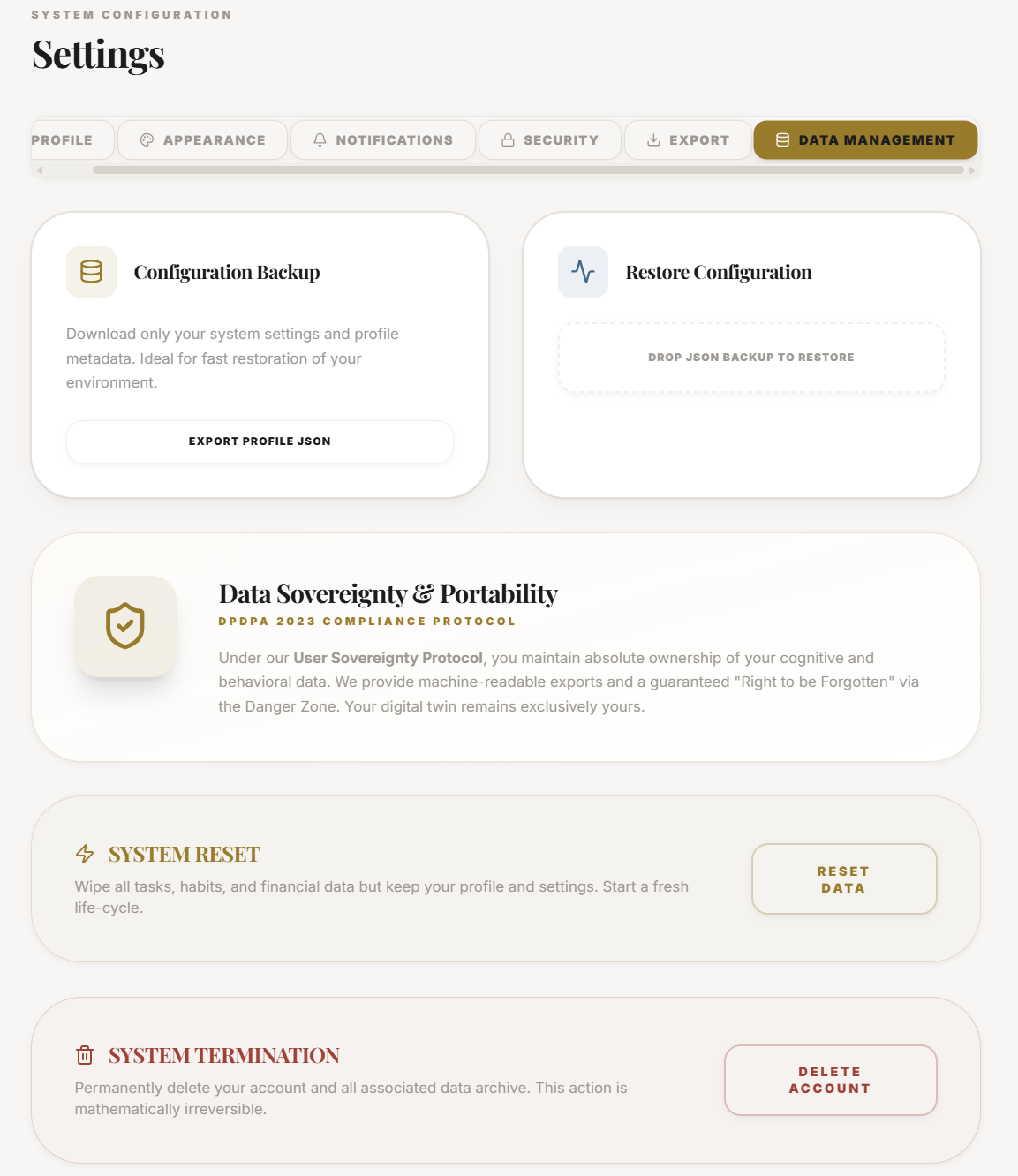
Ensure data sovereignty by learning how to configure privacy modes and export your entire system via JSON.
How to Manage Your Account and Data Export
Operational Directive

Section ProtocolThe Philosophy of Data Sovereignty
Your data is an extension of your mind, a digital footprint of your behavior, habits, and execution. The modern digital landscape is littered with walled gardens and SaaS products that hold your data hostage, leveraging it for engagement or locking you into their ecosystem. JeevanAxis operates on a fundamentally different principle: Data Sovereignty.
Data sovereignty is the belief that the user, and the user alone, owns and controls the data they generate. Your goals, your tracking metrics, your habits, and your journal entries are your intellectual property. Our platform is a vehicle for you to interact with your data, but the data itself remains under your absolute control.
This commitment is realized through transparent privacy modes, frictionless data portability, and robust account security mechanisms. In this guide, we will decompose the exact procedures for configuring your privacy baseline, exporting your system state, and securing your operating environment against unauthorized access or data loss.
Section ProtocolArchitectural Overview: Data Flow and Control
Understanding how data moves and rests within the system is the first step toward true ownership. The following architectural flowchart illustrates the relationship between your local client, our secure cloud infrastructure, and the portability mechanisms available to you.
The data lifecycle begins at the client application, syncing symmetrically with the encrypted cloud database. From the cloud, you can trigger an explicit extraction process that compiles your entire system state into a unified JSON payload, which can then be persisted locally or migrated to other analytical tools.
Section ProtocolPrivacy Modes: Defining Your Operational Security
The platform provides distinct privacy modes, each tailored to different operational requirements. The selection of a privacy mode dictates how your data is synchronized, stored, and accessed.
- ▶Cloud Sync (Default): Optimal balance of security and convenience. Data is encrypted at rest and in transit. Enables seamless synchronization across multiple devices.
- ▶Local-Only (Strict): Maximum operational security. Data never leaves your device. Syncing is disabled, but your data is immune to cloud breaches.
- ▶End-to-End Encrypted (E2EE): Cryptographically secures data so that not even our servers can read it. You hold the decryption keys.
TACPrivacy Mode Selection Protocol
Choosing the correct mode requires an honest assessment of your threat model and convenience requirements.
Configure your privacy mode immediately upon initial setup to establish the baseline for all future data generation.
Section ProtocolThe JSON Export Mechanism: Portability in Action
The ability to extract your data is the cornerstone of sovereignty. The JSON export mechanism compiles your entire operational history—goals, habits, metrics, and configurations—into a structured, machine-readable format.
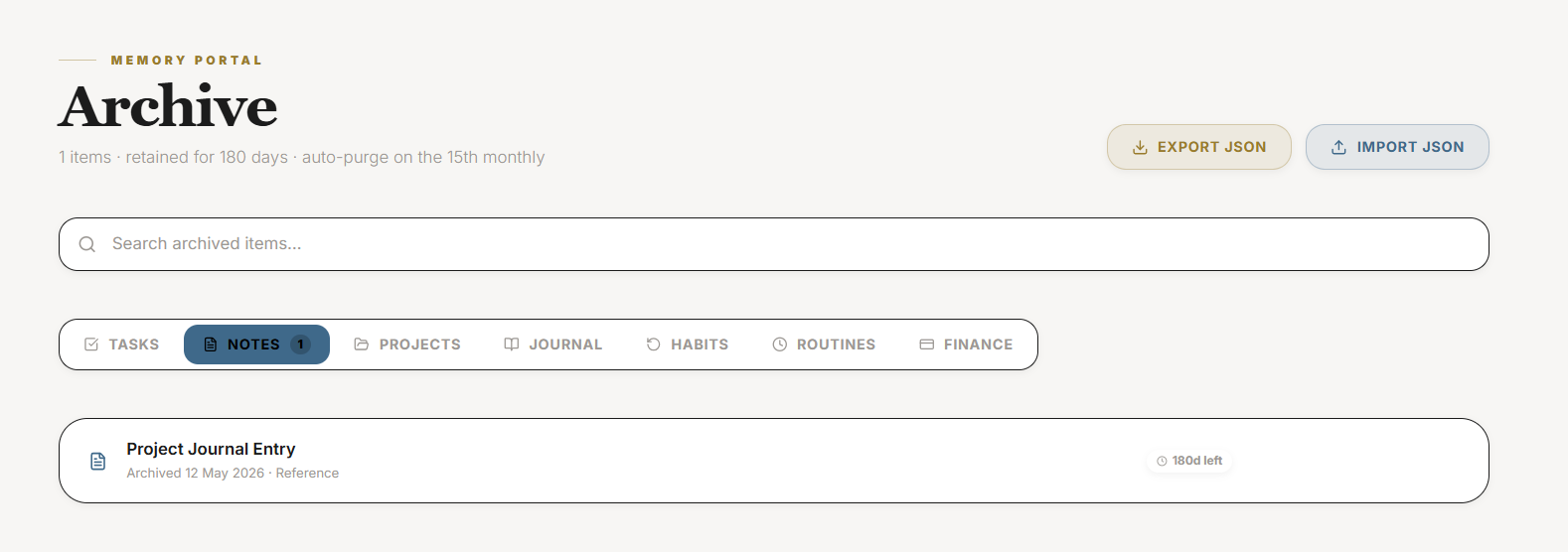
The export structure is designed for maximum compatibility, allowing you to parse the data with custom scripts, import it into external databases, or simply archive it for long-term storage.
TACThe Anatomy of the Export Payload
The exported JSON is categorized logically to reflect the internal structure of the JeevanAxis system.
Regular exports are critical. We recommend establishing a recurring protocol to backup your data, ensuring that a physical copy always resides on hardware you control.
Section ProtocolAccount Security: Fortifying the Perimeter
Sovereignty implies responsibility. While the platform secures your data at rest and in transit, securing the access point—your account—is your primary responsibility. The perimeter must be fortified against unauthorized access.
TACSecurity Hardening Protocol
- ▶Passphrase Complexity: Utilize a generated, high-entropy passphrase. Avoid predictable patterns or reused credentials.
- ▶Multi-Factor Authentication (MFA): Enable Time-based One-Time Passwords (TOTP) immediately. This mitigates the risk of credential compromise.
- ▶Session Management: Regularly review active sessions. Terminate any anomalous or stale connections.
- ▶Recovery Codes: Generate and securely store recovery codes offline. These are your final failsafe in the event of MFA device loss.
Section ProtocolCommon Failure Modes
Managing account security and data portability requires vigilance. Avoid these common operational errors.
⚠Common Traps
Section ProtocolImplementation Checklist
Execute the following protocol to secure your account and establish data portability.
✓Integration Checklist
Section ProtocolOperational Reflection
Security and data management are continuous processes. Reflect on your current posture.
Reflection Prompts
Executive Summary
▸Data sovereignty and robust account security form the bedrock of a resilient personal operating system.
▸By actively managing your privacy modes, enforcing strong authentication protocols like MFA, and regularly exporting your data into portable JSON formats, you guarantee that your operational history remains under your absolute control.
▸Do not delegate the responsibility of your data's integrity to the platform alone; actively maintain your perimeter and your backups.
Section ProtocolNext Steps
With your account secured and data portability established, proceed to optimize your operational environment.
Intelligence Pipeline
Configure Aesthetics →
Optimize the visual psychology of your environment using True Black mode and high-contrast accents.
Design Your 7 Days →
Establish your operational baseline with a focused, clinical onboarding protocol.
Explore Integrations →
Connect your secured system to the rest of your digital ecosystem.
Connected Intelligence
Ready to Deploy Your Life OS?
Experience the full power of integrated intelligence. Stop managing apps and start operating your life.
Launch Command Center