Return to Intelligence Bank
Intelligence Brief
ID: HOW-TO-TRACK-NET-WORTH-AND-ASSETS

How to Track Net Worth and Assets

Log illiquid assets, liabilities, and investment portfolios to calculate your true total net worth.

Operation ZoneFINANCE MODULE
Read Duration8 MIN
NET-WORTHASSETSLIABILITIES

How to Track Net Worth and Assets

Operational Directive

Section Protocol
The Fundamentals of True Wealth

Understanding your net worth is the foundational step toward achieving lasting financial independence. Many individuals focus solely on their income, mistaking high cash flow for actual wealth. This is a fundamental error in personal finance that must be corrected immediately. Income is merely the mechanism by which wealth is generated; it is not the wealth itself. True wealth is measured exclusively by your net worth—the absolute difference between what you own (assets) and what you owe (liabilities). Without a clear understanding of this metric, you are flying blind in your financial journey.

To accurately assess your financial standing, you must move beyond tracking just your bank account balances. You must adopt a comprehensive, clinical approach to evaluating your entire financial landscape. This involves meticulously logging both liquid assets, such as cash and brokerage accounts, and illiquid assets, such as real estate, vehicles, and private equity. Every single asset of value must be accounted for and recorded with precision.

Equally important is the honest accounting of your liabilities. Every mortgage, auto loan, student debt, and credit card balance must be recorded and tracked constantly. Only by juxtaposing your total assets against your total liabilities can you derive the true metric of your financial health: your net worth. Ignoring liabilities is a recipe for financial disaster.

This guide will systematically walk you through the process of tracking every component of your net worth using the JeevanAxis Finance Module. We will cover the nuances of valuing illiquid assets, tracking investment portfolios, managing liabilities, and ultimately calculating your total net worth. We will also discuss the psychological benefits of maintaining an accurate financial scorecard, which provides clarity and reduces anxiety.

Tactical Logic Visualization
SYNTHESIZING DIAGRAM…

Section Protocol
Adding Illiquid Assets

Illiquid assets are assets that cannot be quickly or easily converted into cash without a substantial loss in value. Common examples include real estate, vehicles, art, and ownership stakes in private businesses. While these assets may not provide immediate liquidity, they often constitute a significant portion of an individual's total wealth. Tracking them accurately is non-negotiable for a complete financial picture, even if updating their values requires manual effort.

TACValuing Real Estate

Real estate is typically the largest illiquid asset in a personal portfolio. Accurate valuation is critical for a precise net worth calculation. However, real estate markets are inherently localized and subject to constant, unpredictable fluctuation. You must resist the urge to overvalue your property based on emotional attachment or historical purchase price.

When entering real estate assets into the JeevanAxis app, you should aim for a conservative, realistic valuation. Avoid the temptation to inflate the value based on speculative market trends or outlier sales in your area. A prudent approach is to utilize automated valuation models (AVMs) provided by reputable real estate platforms, or to base the value on recent comparable sales in your immediate neighborhood.

Furthermore, it is essential to account for transaction costs that would arise upon sale. If you were to liquidate the property tomorrow, you would incur broker fees, closing costs, and potential taxes. A clinical approach to net worth tracking often involves applying a "liquidity discount" (typically 5-10%) to the estimated market value of the property to reflect its true, realizable value.

TACValuing Vehicles

Vehicles are depreciating assets that consume wealth over time. Unlike real estate or equities, which have the potential to appreciate, vehicles almost universally lose value the moment they are driven off the lot. Treating them as investments or long-term stores of value is a critical cognitive error that distorts financial reality.

To accurately track vehicles in the JeevanAxis Finance Module, you must regularly update their valuation to reflect rapid depreciation. Utilize industry-standard resources like Kelley Blue Book or Edmunds to determine the current private party value of your vehicle. Do not use the retail replacement value, as this is not the amount you would receive if you sold the asset today.

Be disciplined in updating these valuations at least semi-annually, if not quarterly. Failing to account for vehicle depreciation will result in an artificially inflated net worth and poor decision making. In the long run, this leads to an inaccurate assessment of your financial readiness for major life transitions.

Tactical Logic Visualization
SYNTHESIZING DIAGRAM…

Section Protocol
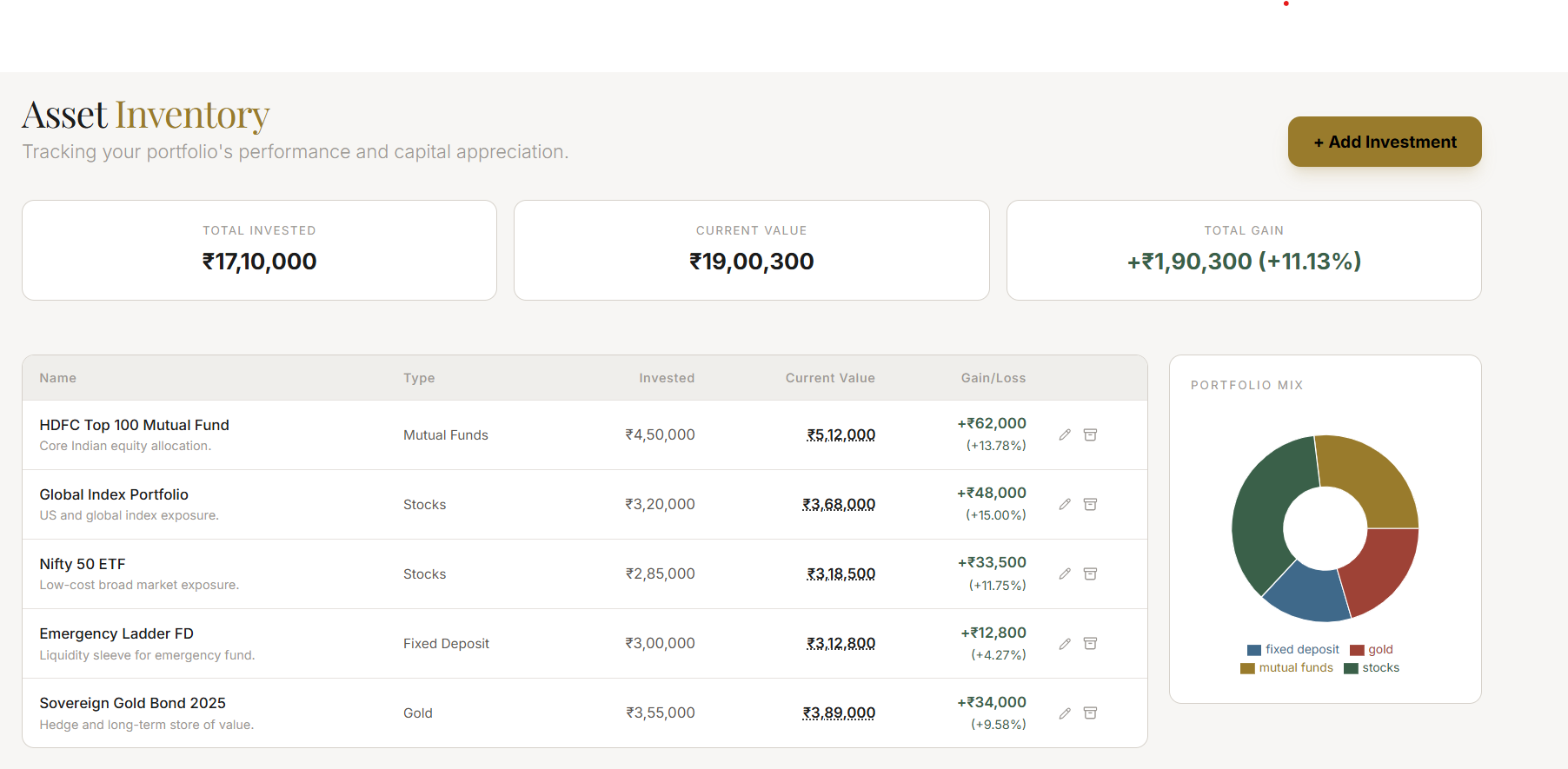
Tracking Investment Portfolios

Investment portfolios, comprising stocks, bonds, mutual funds, and ETFs, represent the primary engine of your wealth creation. These assets are typically highly liquid and their valuations are readily available through public markets. They are the instruments through which you harness the exponential power of compound interest over time.

The JeevanAxis Finance Module allows you to integrate your brokerage accounts or manually track your investment positions. For optimal accuracy, automated integration is recommended, as it ensures your net worth reflects real-time market fluctuations without manual intervention. Manual tracking, while acceptable, requires rigorous discipline and frequent updates to maintain analytical value.

When tracking investments, it is crucial to categorize them correctly by account type and tax status. Differentiate between taxable brokerage accounts, tax-advantaged retirement accounts (such as IRAs or 401ks), and education savings accounts. This categorization is vital for understanding your liquidity profile and planning for future tax liabilities upon withdrawal.

Furthermore, track the cost basis of your investments alongside their current market value. This allows you to monitor unrealized capital gains or losses, providing a deeper understanding of your portfolio's raw performance. It also prepares you for the inevitable tax implications upon liquidation, preventing unexpected tax bills that erode wealth.

Tactical Logic Visualization
SYNTHESIZING DIAGRAM…

Section Protocol
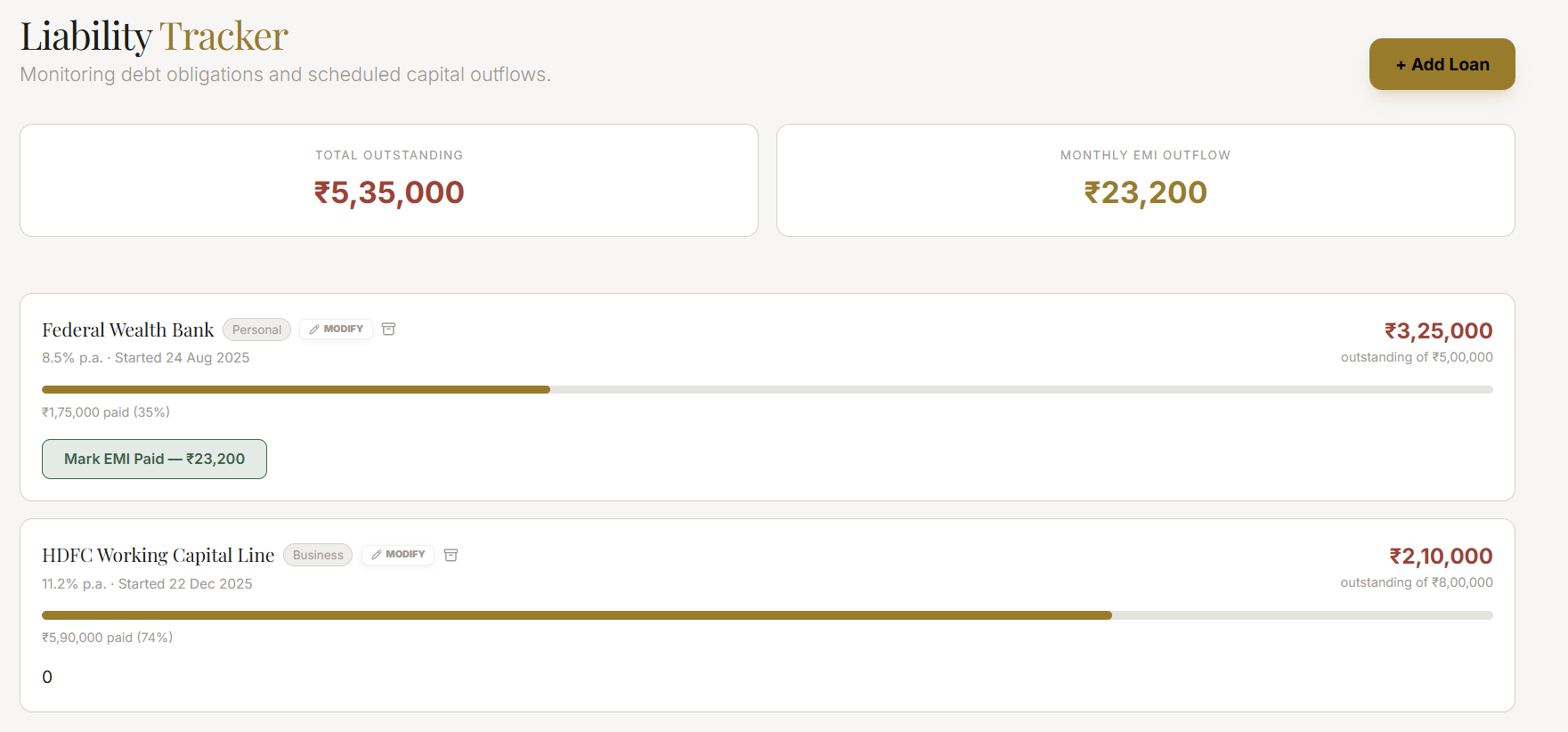
Logging Liabilities: The Cost of Debt

Liabilities are financial obligations or debts that you owe to others, and they actively destroy wealth through interest. They are the subtractive element in the net worth equation and must be monitored constantly. A precise accounting of liabilities is arguably more critical than tracking assets, as unmanaged debt can rapidly erode even a large portfolio.

TACMortgages

For individuals who own real estate, the mortgage is typically the largest liability on their balance sheet. When recording a mortgage in JeevanAxis, you must track the principal balance, not the total amount of future payments remaining. The principal balance represents the actual amount required to satisfy the debt today, which is the only relevant metric for net worth.

As you make monthly mortgage payments, a portion goes toward interest and a portion reduces the principal balance. Ensure that your liability tracking accurately reflects this steady reduction in principal. Over time, you will see the principal balance decrease, accelerating your net worth growth as the equity in your home expands.

TACAuto Loans and Personal Debt

Auto loans, student loans, and personal loans must be meticulously tracked alongside mortgages. Similar to mortgages, record the current principal payoff amount, not the sum of remaining installments. Do not ignore these debts; confront them with clinical precision and a dedicated repayment strategy.

Pay close attention to the interest rates associated with these unsecured or depreciating-asset liabilities. High-interest debt, such as credit card balances or high-rate personal loans, represents an absolute financial emergency. Your net worth tracking should clearly highlight these liabilities, prioritizing their rapid elimination above all other financial goals.

TACCredit Cards

Credit card balances must be recorded as liabilities if they are not paid in full each month without exception. If you utilize credit cards for daily expenses but pay the statement balance in its entirety, you may choose to exclude them from your long-term liability tracking. However, this assumes the corresponding cash to pay the balance is also excluded from your asset count to prevent double-counting.

For a truly comprehensive picture, recording the current balance of all credit cards provides the most accurate real-time snapshot of your financial position. It prevents any illusion of having more cash than you actually do, maintaining a conservative and precise ledger.

Tactical Logic Visualization
SYNTHESIZING DIAGRAM…

Section Protocol
Calculating Total Net Worth

With all assets and liabilities accurately logged, the calculation of total net worth is straightforward. The formula is absolute, universal, and unforgiving: Total Assets minus Total Liabilities equals Net Worth. There is no room for subjective interpretation or creative accounting in this calculation.

The JeevanAxis Finance Module performs this calculation automatically, providing you with a real-time dashboard of your wealth. However, the value lies not just in the static number, but in tracking the trajectory of your net worth over extended periods of time. A single snapshot is merely a data point; a series of snapshots reveals a powerful trend.

A positive trajectory indicates that you are accumulating assets faster than liabilities, or reducing liabilities faster than assets are depreciating. This is the hallmark of financial success and the ultimate validation of your financial strategy. A negative trajectory demands immediate attention, comprehensive review, and swift corrective action. It signifies that you are consuming wealth rather than building it, putting your future independence at severe risk.

By regularly updating your asset valuations and liability balances, you ensure that your net worth scorecard remains an accurate and actionable reflection of your financial reality. This regular cadence of review builds financial discipline, situational awareness, and long-term wealth.

Tactical Logic Visualization
SYNTHESIZING DIAGRAM…

Common Traps

Integration Checklist

Reflection Prompts

"

Executive Summary

Tracking your net worth is the absolute foundational practice of effective financial management.

By clinically and precisely logging all liquid and illiquid assets, alongside a rigorous, unforgiving accounting of every liability, you create an accurate scorecard of your true wealth.

Regular, disciplined updates to this data in the JeevanAxis Finance Module will empower you to make informed, strategic decisions to optimize your financial trajectory and build lasting financial independence over a lifetime.

Intelligence Pipeline

Ready to Deploy Your Life OS?

Experience the full power of integrated intelligence. Stop managing apps and start operating your life.

Launch Command Center